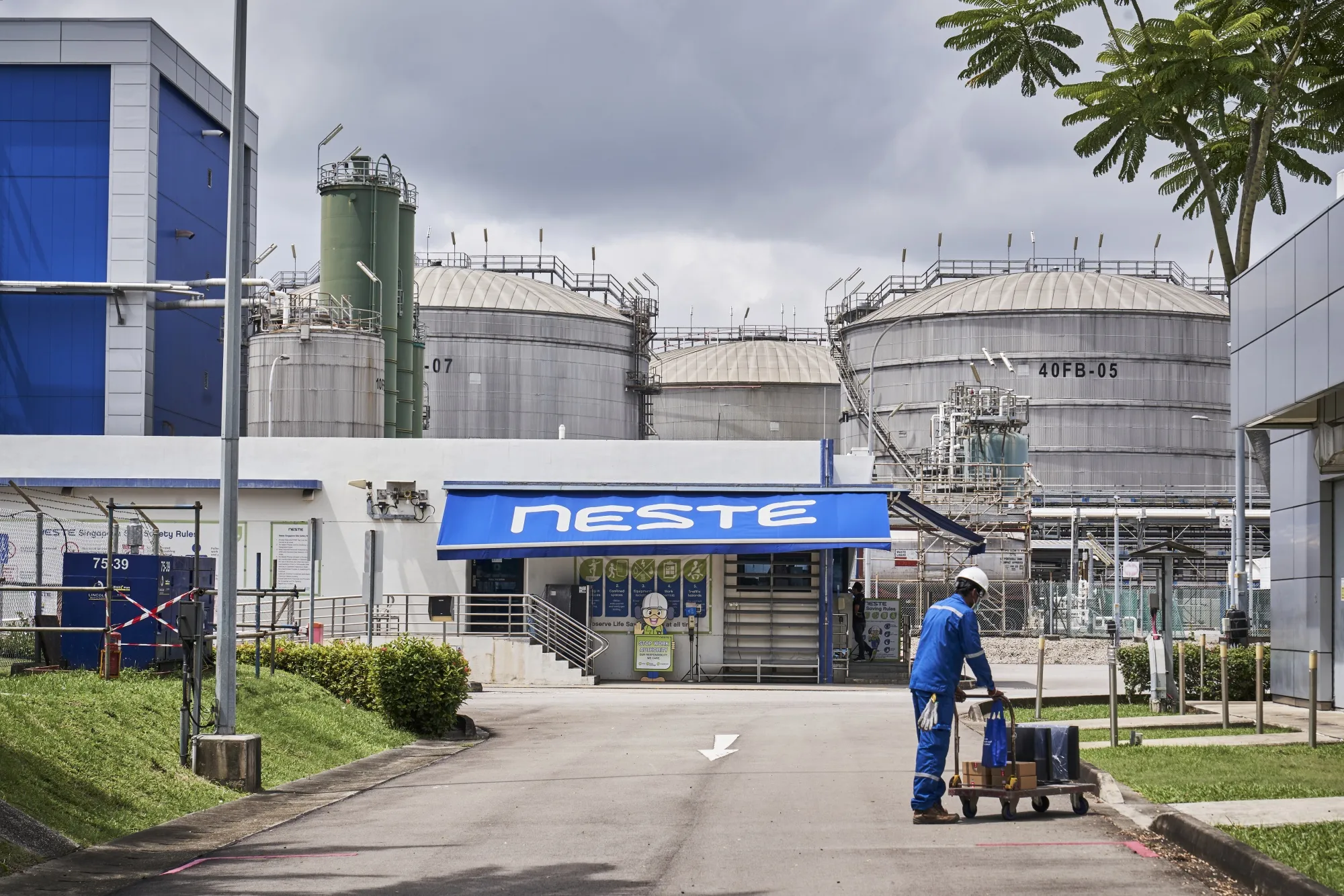
The strategic partnership between Neste and United Airlines to expand sustainable aviation fuel (SAF) deliveries to key U.S. hubs marks a pivotal moment for decarbonizing air travel and presents compelling implications for energy investors. This collaboration, extending to major airports including Houston (IAH), Newark (EWR), and Dulles (IAD), underscores a growing commitment from industry leaders to integrate lower-carbon solutions into mainstream operations. For investors tracking the energy transition, this move highlights not just the operational scaling of SAF but also the critical role of policy support and existing infrastructure in accelerating its adoption.
Navigating Volatility: SAF’s Resilience Amidst Crude Market Swings
The expansion of Neste’s SAF supply to United arrives at a fascinating juncture for the broader energy market. As of today, Brent crude trades at $90.38 per barrel, reflecting a significant 9.07% decline within the trading day. This recent downturn is part of a more pronounced trend, with Brent prices having fallen by nearly 20% from $112.78 just two weeks ago on March 30th. Similarly, WTI crude stands at $82.59, down 9.41% today, while gasoline prices have dipped to $2.93 per gallon, a 5.18% decrease.
This market volatility, characterized by sharp price corrections, often prompts investors to question the long-term viability of alternative fuels. Indeed, our reader intent data shows a strong focus on “what do you predict the price of oil per barrel will be by end of 2026?” Such inquiries underscore a natural investor concern about the competitive landscape for SAF, especially when conventional jet fuel costs are influenced by fluctuating crude prices. However, the sustained commitment from major airlines like United, which consumed over 4,300 metric tons (13 million gallons) of SAF in 2024 alone, demonstrates a strategic imperative beyond short-term commodity price swings. The drive for decarbonization and long-term climate targets provides a fundamental underpinning for SAF investment, positioning it as a structural growth story rather than a cyclical play tied solely to crude benchmarks.
Policy Imperatives and Investor Confidence
The successful scaling of SAF hinges significantly on robust policy frameworks, a point repeatedly emphasized by both United’s Chief Sustainability Officer, Lauren Riley, and Neste’s Senior Vice President of Commercial Renewable Products, Carl Nyberg. Their calls for stronger state and federal incentives reflect a clear understanding that market mechanisms alone, especially in nascent industries, are often insufficient to drive rapid, large-scale adoption. The partnership’s expansion builds on earlier successes, such as Neste’s supply to Chicago O’Hare International Airport following the introduction of a SAF purchase credit in Illinois, clearly demonstrating the direct impact of supportive legislation.
For investors, policy certainty translates directly into reduced risk and enhanced project economics. Mechanisms akin to California’s Low Carbon Fuel Standard (LCFS), which provides credits for reducing the carbon intensity of transportation fuels, are vital. These policies offer predictable revenue streams and lower the financial barriers for producers and consumers of SAF. As investors assess opportunities in the renewable energy space, the presence or absence of such supportive legislation is a key differentiator. The current questions from our readership, particularly those around “OPEC+ current production quotas” and overall market stability, highlight a broader investor appetite for clarity and predictability across the energy complex, making policy support for SAF an even more critical component for attracting capital.
Seamless Integration: The Key to Scalability and Future Growth
A crucial aspect of the Neste-United agreement is the efficient use of existing infrastructure. By transporting neat Neste MY Sustainable Aviation Fuel through established pipeline networks from Neste’s terminal in Houston to IAH, EWR, and IAD, the partnership circumvents the need for costly and time-consuming new infrastructure development. This method, already operational for Houston deliveries since July and for Newark and Dulles since September, with supplies continuing through late 2025, significantly accelerates SAF’s market penetration and reduces the logistical hurdles often associated with new energy solutions.
This integration capability is a major draw for investors looking for scalable solutions in the energy transition. The ability to leverage existing assets minimizes upfront capital expenditure and speeds up return on investment. Looking ahead, the broader energy market will be closely watching several upcoming events that could indirectly influence the trajectory of SAF and the larger decarbonization agenda. The OPEC+ JMMC and Ministerial Meetings on April 19th and 20th, respectively, will set the tone for global crude supply, impacting conventional fuel prices and potentially the urgency for alternatives. Subsequent EIA Weekly Petroleum Status Reports and Baker Hughes Rig Count data will provide further insights into market fundamentals. While these events don’t directly target SAF, a stable and predictable energy market, influenced by these decisions, creates a more conducive environment for strategic investments in sustainable alternatives and policy discussions that favor long-term energy diversification.
Investment Outlook: The Decarbonization Dividend
United Airlines’ commitment, as the leading SAF user in the U.S., combined with Neste’s global production capabilities, paints a compelling picture for the future of sustainable aviation fuel. This partnership is not merely a transaction; it represents a strategic blueprint for how industries can collaborate to achieve ambitious decarbonization goals. For investors, the takeaway is clear: the demand for SAF is structural and growing, driven by both corporate sustainability pledges and evolving regulatory landscapes. Companies positioned across the SAF value chain—from feedstock sourcing and processing to production and distribution—stand to benefit significantly.
The journey to net-zero carbon emissions by 2050 for the aviation sector is long, but partnerships like Neste and United’s demonstrate tangible progress. As the industry pushes for more states to enact proven incentive policies, the investment thesis for SAF strengthens. Savvy investors will continue to monitor policy developments, technological advancements in SAF production, and the expansion of integrated supply chains as key indicators of future growth and profitability in this critical segment of the energy transition.


