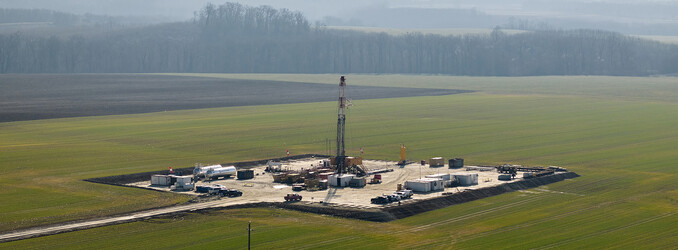
In a significant move for Hungary’s energy landscape, MOL and O&GD have announced a new oil discovery near Galgahévíz, capable of producing approximately 1,000 barrels of crude oil per day. This discovery, named Galgahévíz-4, underscores a strategic imperative for domestic energy security and offers a tangible boost to MOL’s production portfolio amidst a volatile global market. For investors, this development highlights the enduring value of regional exploration and production, particularly in nations striving to reduce import dependency and secure supply chains against geopolitical headwinds.
MOL’s Relentless Pursuit of Hungarian Energy Security
The Galgahévíz-4 well, located in the Mogyoród concession area, reached its target depth of 2,400 meters in just 37 days, showcasing efficient operational execution by MOL’s subsidiary, Rotary Zrt. Now in production, the well’s 1,000 bopd output is processed at the Danube Refinery in Százhalombatta, directly contributing to Hungary’s crude supply. This joint venture sees O&GD and MOL sharing the extracted volume in a 51%-49% ratio, a testament to collaborative efforts in boosting national resources.
This latest success is not an isolated event but part of a consistent pattern of domestic exploration for MOL. The company has a demonstrated track record of recent hydrocarbon discoveries across Hungary, including the Vecsés-2 (November 2022), Vecsés-1 (May 2024), and Vecsés-3 (November 2024) wells, alongside a significant find in Transdanubia near Somogysámson in March 2025. Furthermore, its “shallow gas” program, initiated in 2019, has yielded 25 successful drillings. These achievements collectively reinforce MOL’s position as Hungary’s largest hydrocarbon producer, accounting for 47% of domestic oil production and nearly 80% of natural gas production in 2024. The Galgahévíz-4 well, while a single discovery, contributes approximately 4% to MOL’s crude oil production within Hungary, a meaningful increment in the context of national supply.
Navigating Market Volatility with Domestic Production
The timing of this discovery is particularly salient given the current dynamics in the global energy markets. As of today, Brent crude trades at $98.38 per barrel, reflecting a 1.02% dip in intraday trading, while WTI crude stands at $89.99, down 1.29%. More broadly, Brent has experienced a notable retreat, falling 12.4% from $112.57 just two weeks ago. This recent softening in prices underscores the inherent volatility in global oil markets, making secure, domestic production streams even more valuable.
For investors, understanding the interplay between global price trends and localized production efforts is critical. “What is the current Brent crude price?” is a frequent query, reflecting a keen interest in market fundamentals. While a 1,000 bopd addition may seem modest on a global scale, its direct contribution to national energy security shields Hungary from the full brunt of international price swings and supply chain disruptions. For MOL, this new production stream, at today’s Brent price, represents approximately $48,206 in daily gross revenue from its 49% share, providing a steady, predictable income stream that helps to de-risk its broader portfolio against external market pressures. This strategic focus on domestic resource development offers a degree of insulation from the uncertainties that often plague imported supplies, aligning with a broader trend among European nations seeking greater energy autonomy.
Upcoming Events and Their Impact on Domestic Strategy
The strategic importance of domestic discoveries like Galgahévíz-4 is further amplified by the upcoming calendar of global energy events. Investors are keenly awaiting the OPEC+ Joint Ministerial Monitoring Committee (JMMC) meeting on April 18th, followed closely by the Full Ministerial meeting on April 20th. These gatherings are crucial for establishing future production quotas, a topic frequently raised by our readers who are actively seeking clarity on “OPEC+ current production quotas” and their implications for global supply and pricing.
Any decision by OPEC+ to adjust production levels could significantly impact the global supply-demand balance, and consequently, the profitability of both international and domestic projects. Should OPEC+ opt for tighter controls, the value of secure, non-OPEC production, especially within Europe, would likely increase. Conversely, an expansion of quotas could exert downward pressure on prices, though the strategic benefit of domestic supply security remains paramount for nations like Hungary. Furthermore, regular market health checks like the Baker Hughes Rig Count (April 17th, April 24th) and the API and EIA weekly inventory reports (April 21st, 22nd, 28th, 29th) will provide additional layers of insight into the prevailing supply and demand conditions, influencing investor sentiment towards exploration and production ventures, both large and small.
Algyő’s Legacy and the Future of Hungarian Hydrocarbons
This new discovery coincides with the 60th anniversary of the Algyő field, a site that has been the bedrock of Hungary’s energy security since production began in 1965. Algyő, with nearly 1,000 wells drilled over its lifespan, historically provided up to 70% of the country’s hydrocarbon demand in the 1980s. While its known reserves are depleting, it still contributes significantly, meeting one-tenth of Hungary’s total natural gas demand and five percent of its crude oil needs today.
The evolution of Algyő mirrors the broader energy transition, with the site now gradually incorporating renewable energy production and storage alongside its traditional hydrocarbon extraction. This dual strategy — maximizing existing and new domestic hydrocarbon resources while simultaneously investing in sustainable energy solutions — defines Hungary’s pragmatic approach to energy independence. The Galgahévíz-4 discovery, therefore, is not merely about adding barrels; it’s about extending the runway of domestic energy self-reliance, ensuring a stable transition period, and reinforcing the nation’s energy sovereignty in an increasingly complex global environment. For MOL, this commitment to domestic exploration remains a strategic priority, safeguarding Hungary’s supply security while navigating the evolving demands of the energy sector.