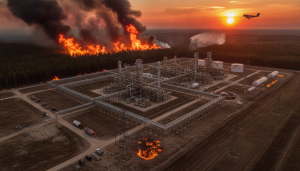
The Middle East, a lynchpin of global oil supply, is currently grappling with unprecedented and “hellish” heatwave conditions, particularly across Jordan and Israel. Nocturnal temperatures have shattered records, with lows remaining above 35C (95F) in areas like Ghor es-Safi and Aqaba, and hitting a staggering 36C in Sedom. These extreme overnight conditions, coupled with daytime highs nearing 50C in Gilgal kibbutz (49.7C) and Aqaba (49.6C), pose a significant, yet often underestimated, threat to the region’s critical energy infrastructure and, by extension, global oil market stability. For oil and gas investors, this isn’t merely a weather report; it’s a rapidly escalating operational risk that demands immediate attention and integration into forward-looking market models. The compounding effect of relentless heat, day and night, strains human capital, equipment, and supply chains, potentially disrupting production, processing, and export capabilities in a region responsible for a substantial portion of the world’s crude output.
Operational Stress Points and Supply Chain Vulnerabilities
The intensity and duration of this heatwave introduce tangible risks to the Middle East’s oil and gas operations. Sustained temperatures far exceeding seasonal norms, particularly the record-breaking nocturnal heat, prevent critical cooling of equipment and infrastructure. Refineries, natural gas liquefaction plants, and pumping stations rely heavily on efficient cooling systems. Elevated ambient temperatures reduce their effectiveness, potentially leading to deratings, unplanned shutdowns, or increased maintenance requirements. Human productivity also suffers drastically; as highlighted by local climate scientists, even with air conditioning, the relentless heat affects workforces, especially those engaged in outdoor maintenance, construction, and field operations. The sheer physical stress on personnel operating in conditions where “it’s like you’re walking in a sauna” can lead to reduced efficiency, increased accident rates, and labor shortages. While the most extreme temperatures are currently localized in Jordan and Israel, the broader regional implications for energy demand (e.g., increased power generation for cooling) and potential for operational spillover cannot be ignored. Any disruption in even a minor part of the supply chain in this interconnected region can create ripple effects for crude exports and product availability.
Market Dynamics Amidst Emerging Supply Risks
As of today, Brent crude trades at $98.2 per barrel, marking a 3.44% increase for the day and operating within a range of $94.42 to $99.84. This upward movement suggests a degree of market resilience or perhaps an underlying bullish sentiment driven by broader geopolitical factors. However, this immediate gain contrasts with a notable correction over the past two weeks, during which Brent shed 12.4%, falling from $108.01 on March 26th to $94.58 just yesterday. While the current heatwave’s impact on Middle Eastern production has yet to manifest in official output statistics, the market is beginning to price in the potential for supply disruptions. The unprecedented nature of these temperatures, especially the “hellish” nighttime minimums, adds a new layer of uncertainty. Investors should recognize that while today’s price action might reflect other immediate catalysts, the persistent and extreme heat in a critical producing region introduces a non-trivial supply-side risk that can quickly exacerbate price volatility. The sheer scale of operational challenges, from reduced worker efficiency to equipment stress, could tighten supply and push prices higher if prolonged or if it spreads to major production hubs.
Forward Outlook: Heatwave’s Influence on Upcoming Energy Events
The escalating heat in the Levant arrives days before a series of critical energy events that will undoubtedly shape the near-term crude trajectory. The OPEC+ Joint Ministerial Monitoring Committee (JMMC) convenes on April 18th, followed swiftly by the full Ministerial Meeting on April 20th. While the primary agenda for these meetings will revolve around existing output quotas and market rebalancing, the operational challenges posed by extreme weather in a key producing region cannot be overlooked. Discussions may implicitly or explicitly address the resilience of supply, and any perceived vulnerability could influence future production strategies or rhetoric. Beyond OPEC+, the market will closely monitor the API Weekly Crude Inventory reports on April 21st and 28th, and the EIA Weekly Petroleum Status Reports on April 22nd and 29th. Should the heatwave lead to even minor operational slowdowns or increased domestic energy consumption for cooling, these reports could show tighter-than-expected inventories, signaling a supply squeeze. Furthermore, the Baker Hughes Rig Count on April 17th and 24th, while primarily focused on North American activity, will provide a broader gauge of industry confidence and investment, which could be subtly affected by the global implications of such severe weather events.
Investor Focus: Integrating Climate Risks into Price Forecasts
Our internal reader intent data reveals a strong investor emphasis on future price direction, with frequent queries surrounding a “base-case Brent price forecast for next quarter” and the “consensus 2026 Brent forecast.” The current Middle East heatwave underscores a critical, evolving dimension for these forecasts: the increasing impact of climate-related risks on energy supply stability. While traditional models often focus on demand growth, geopolitical tensions, and OPEC+ policy, the operational integrity of production and export infrastructure under extreme weather conditions is becoming an undeniable factor. Investors must now integrate these “non-traditional” climate-induced disruptions into their fundamental analysis. The current heatwave serves as a stark reminder that physical climate risks can translate directly into supply shocks, potentially tightening markets and driving prices beyond conventional expectations. Building a robust forecast for the next quarter and beyond necessitates accounting for the potential for sustained operational disruptions, increased regional energy demand for cooling (diverting local crude), and the long-term implications of climate change on the reliability of global energy supply chains. This requires a more nuanced approach than ever, moving beyond historical averages to consider the accelerating frequency and intensity of extreme weather events.