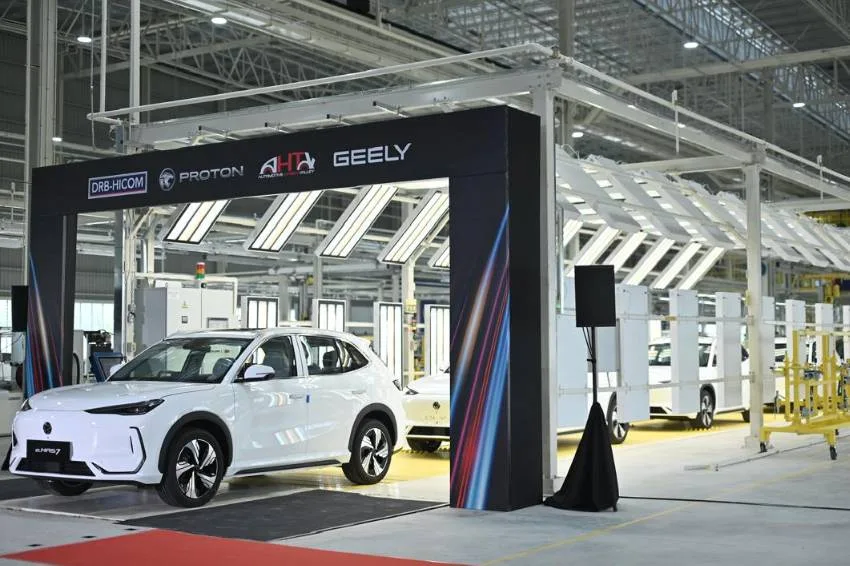
Malaysian EVs: A Growing Headwind for Oil Demand in Southeast Asia
Malaysia’s ambitious push into electric vehicle (EV) manufacturing, spearheaded by local automotive giant Proton, signals a clear strategic pivot that warrants close attention from oil and gas investors. The recent inauguration of Proton’s first EV assembly plant in Perak marks a significant milestone, not just for Malaysia’s industrial policy but also for the long-term demand outlook for crude oil and refined products in a critical growth region. While individual market shifts may appear localized, the cumulative effect of such initiatives across emerging economies presents a structural headwind that will increasingly challenge traditional oil demand forecasts and strategic planning for energy majors.
Proton’s EV Offensive: A Microcosm of Regional Shift
The new Proton EV assembly plant, situated within Malaysia’s Automotive High-Tech Valley, is a tangible manifestation of the nation’s commitment to becoming a regional EV hub. With an initial annual production capacity of 20,000 units, scalable to 45,000, this facility represents a substantial investment. The first phase of construction, costing approximately RM47 million, underscores the seriousness of this endeavor, with a total planned investment of around RM82 million. The rapid seven-month construction timeline, from groundbreaking in February to the start of production, highlights the urgency and efficiency driving this transition. Backed by majority owner DRB HICOM and China’s Zhejiang Geely Holding Group, Proton’s move is part of a broader national target to achieve a 20% margin of electrified car sales by 2030. This shift is not merely about production; it extends to critical infrastructure, with Proton signing MoUs for feasibility studies on railway cargo connections to support logistics. Each EV produced and sold directly displaces internal combustion engine (ICE) vehicles, incrementally eroding gasoline demand in a country that has historically been a robust market for petroleum products.
Crude Prices Under Pressure: The Macro and Micro Headwinds Converge
The implications of regional EV adoption, such as Malaysia’s, come into sharp focus when observing the current state of the global oil market. As of today, Brent Crude trades at $90.38, marking a significant 9.07% decline within the day, having ranged from $86.08 to $98.97. Similarly, WTI Crude stands at $82.59, down 9.41% for the day, after trading between $78.97 and $90.34. This steep daily correction follows an already pronounced downward trend over the past 14 days, with Brent shedding 18.5% from $112.78 to $91.87. Gasoline prices are also reflecting this bearish sentiment, currently at $2.93, a 5.18% drop. In this environment of weakening crude prices, driven by a complex interplay of macroeconomic concerns and supply-side dynamics, the structural erosion of demand from EV adoption, even in markets like Malaysia, adds another layer of complexity. While the immediate impact of 20,000 or even 45,000 EVs on global oil demand might seem marginal, these localized efforts collectively contribute to the broader narrative of peak oil demand and the long-term energy transition. For investors, understanding these micro-level demand destruction trends is crucial, as they reinforce the bearish undercurrents impacting the commodity.
Addressing Investor Concerns: Long-Term Outlook and OPEC+ Strategy
Our proprietary reader intent data reveals that investors are keenly focused on the long-term trajectory of oil prices, with a frequently asked question being: “What do you predict the price of oil per barrel will be by end of 2026?” Another pertinent query revolves around “What are OPEC+ current production quotas?” These questions are intrinsically linked to developments like Malaysia’s EV push. The accelerating pace of EV adoption in high-growth regions like Southeast Asia directly influences the long-term demand curve, making it harder for analysts to project stable or increasing oil consumption. For OPEC+, these demand headwinds mean their production quotas and market management strategies face an evolving challenge. If structural demand erosion, amplified by regional EV growth, outpaces supply cuts, the effectiveness of their efforts to prop up prices could diminish. Investors need to consider that while OPEC+ might manage supply in the short term, the demand side is undergoing a fundamental transformation driven by policy, technology, and consumer preference. The Malaysian example highlights that the energy transition is not confined to developed nations but is rapidly gaining traction in emerging markets, impacting global oil demand projections for years to come and influencing the future efficacy of cartel actions.
Upcoming Market Events: Navigating Demand Shifts with Supply Signals
The confluence of these demand-side shifts with upcoming energy market events will be critical for investors to monitor. In the immediate future, the OPEC+ Joint Ministerial Monitoring Committee (JMMC) and the Full Ministerial Meeting on April 18th and 19th, respectively, will set the tone for supply management. Their decisions on production quotas will be closely watched for how they respond to current market weakness and the subtle but persistent demand headwinds emerging from regions like Southeast Asia. Following these, the API Weekly Crude Inventory (April 21st, 28th) and the EIA Weekly Petroleum Status Report (April 22nd, 29th) will provide real-time insights into crude and product inventory levels, offering a snapshot of actual demand versus supply. A significant build in inventories, despite OPEC+ efforts, could signal that demand erosion, partly driven by EV adoption, is gaining momentum. Furthermore, the Baker Hughes Rig Count on April 24th and May 1st will indicate future supply intentions from North American producers. Investors should analyze these supply-side signals through the lens of a transitioning demand landscape, where initiatives like Malaysia’s EV expansion contribute to a more complex and potentially more volatile market environment. The interplay between proactive supply management and evolving demand dynamics will define crude price trajectories heading into the latter half of 2026.


