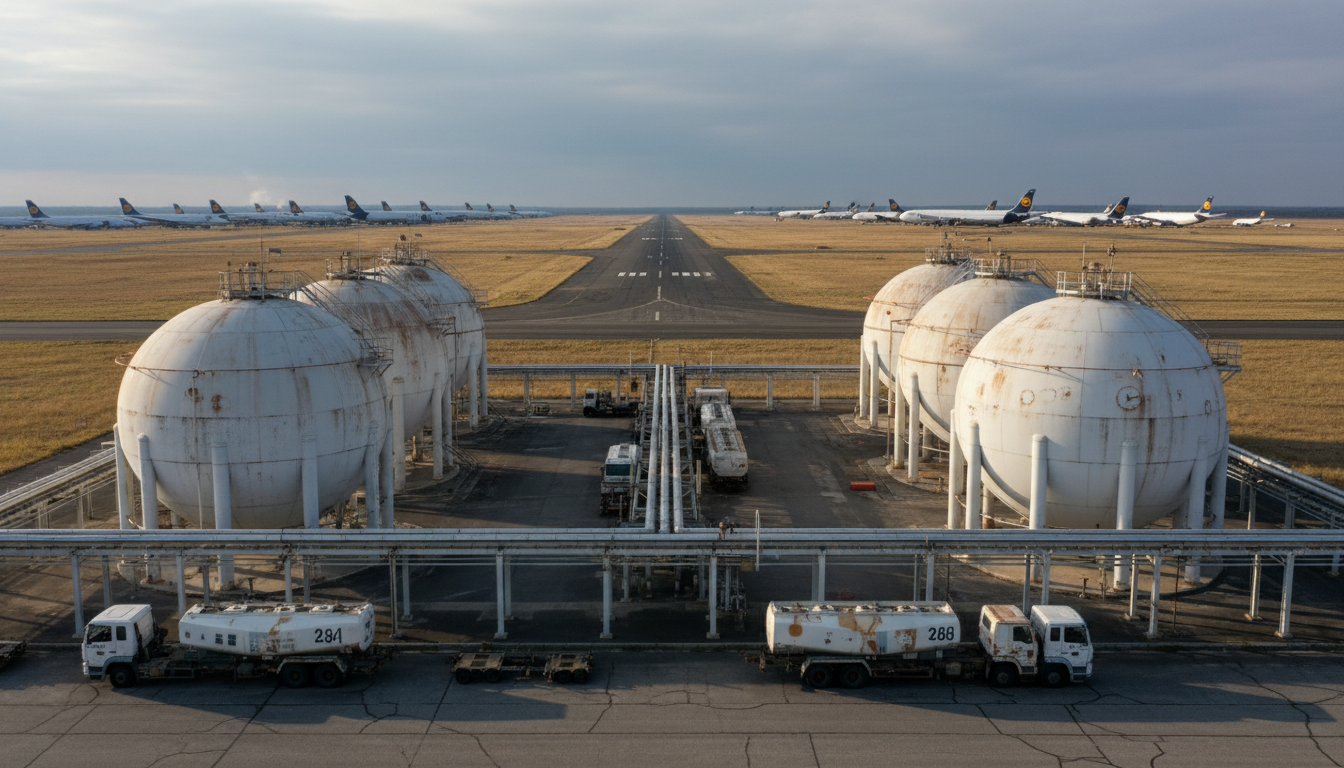
The recent decision by Europe’s aviation giant, Lufthansa, to curtail 20,000 short-haul flights through October sends an unmistakable signal to energy investors: the global jet fuel market is under significant duress. This isn’t merely an airline adjusting capacity; it’s a stark economic imperative driven by soaring kerosene costs and deeply rooted supply vulnerabilities. For those tracking the intricate balance of crude and product markets, Lufthansa’s move acts as a crucial indicator, highlighting escalating geopolitical risks, the persistent fragility of refining infrastructure, and the direct impact on downstream energy demand and profitability.
Jet Fuel’s Price Shock and Its Market Ripple Effects
Lufthansa’s operational cuts, designed to conserve an estimated 40,000 metric tons of jet fuel, underscore the severe financial pressures confronting the aviation sector. Jet fuel prices have experienced an unprecedented surge, more than doubling since recent escalations in Middle Eastern conflicts began to tighten global energy supply chains. This extreme cost escalation has rendered specific routes economically unviable, forcing carriers to make difficult decisions that directly impact their bottom line and broader energy consumption patterns. As of today, Brent crude, the international benchmark for oil, trades at $103.24 per barrel, reflecting a robust 1.52% gain within the day’s range of $101.6 to $104.11. This price point continues an upward trajectory, with Brent having climbed over 7.6% in the last 14 days alone, moving from $94.75 on April 8th to $101.95 by April 27th. Such sustained strength in crude prices inevitably filters through to refined products like jet fuel, exacerbating the cost pressures faced by airlines. WTI crude also mirrors this trend, currently trading at $97.95, up 1.64%.
Europe’s Structural Vulnerability to Geopolitical Shocks
The current predicament facing Europe’s jet fuel supply is a confluence of long-term structural dependencies and immediate geopolitical disruptions. Europe’s reliance on external jet fuel sources, particularly from the Middle East, has created a critical vulnerability. Recent conflicts and heightened tensions, especially those impacting vital maritime arteries like the Strait of Hormuz, have severely curtailed the flow of critical energy supplies into the European market. The arrival of the last significant cargoes that navigated the Strait before the conflict intensified has left Europe scrambling for alternative sources. This acute shortage is further compounded by a decades-long trend of declining domestic refining capacity within Europe, reducing its ability to convert crude oil into essential products like jet fuel. The strategic decisions made by Lufthansa, including accelerating the retirement of older, less fuel-efficient aircraft, are a direct response to this multifaceted challenge, where energy economics and geopolitical instability converge to create an incredibly complex operating environment.
Forward Outlook: Navigating Upcoming Data and Price Signals
For investors seeking to understand the trajectory of crude and refined product markets, several key data releases in the coming weeks will provide crucial signals. On April 28th, the API Weekly Crude Inventory report will offer an initial glimpse into U.S. supply-demand balances, followed by the more comprehensive EIA Weekly Petroleum Status Report on April 29th. These reports are critical for gauging inventory levels and overall petroleum product demand, including jet fuel. Further insights into future supply will come from the Baker Hughes Rig Count on May 1st, indicating drilling activity and potential production trends. Perhaps most significant will be the EIA Short-Term Energy Outlook (STEO) released on May 2nd, which will offer updated forecasts for crude prices, production, and consumption, providing a vital framework for investors building their base-case scenarios. Subsequent API and EIA reports on May 5th and 6th, respectively, will continue to refine our understanding of market dynamics. These upcoming events will be instrumental in assessing whether the current supply tightness, exacerbated by geopolitical events, is a persistent feature or if market adjustments are beginning to alleviate pressure on refined products like jet fuel.
Investor Focus: Price Catalysts and Long-Term Demand Shifts
Our proprietary reader intent data reveals a heightened focus among investors on crude price forecasts and the catalysts that could dramatically shift the market. Many are asking for a base-case Brent price forecast for the next quarter, while others are keen to understand what factors could push Brent below $80 or above $120 per barrel. The current geopolitical backdrop, coupled with supply chain vulnerabilities highlighted by Lufthansa’s actions, certainly bolsters arguments for an elevated risk premium. A significant de-escalation of Middle East tensions or a global economic slowdown could provide the impetus to push Brent towards the $80 mark. Conversely, any further supply disruptions, refinery outages, or a stronger-than-expected rebound in global travel could quickly propel prices beyond $120. While the immediate focus remains on these short-to-medium-term market dynamics, investors are also actively querying the long-term impact of EV adoption on oil demand projections. While EV growth is a critical long-term structural shift, it currently remains overshadowed by the immediate, acute supply-demand imbalances and geopolitical risks that are driving current crude and jet fuel market volatility. Investors must remain vigilant, balancing these immediate pressures against the evolving long-term energy landscape.


