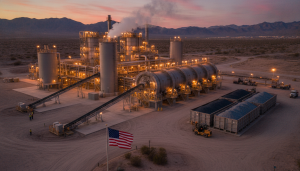
The energy investment landscape is witnessing a significant pivot as governments increasingly intervene to secure critical mineral supply chains. This strategic shift was starkly highlighted by the recent surge in Lithium Americas (LAC) stock, which jumped nearly 90% in a single trading session. This dramatic move wasn’t driven by a new technological breakthrough but by reports of the US administration considering a substantial equity stake in the company, alongside a hefty Department of Energy loan for its Thacker Pass lithium project in Nevada. For oil and gas investors, this signals a broader trend: the intersection of national security, economic policy, and the accelerating energy transition, demanding a closer look at diversified energy plays beyond traditional hydrocarbons.
Government’s Strategic Play: De-Risking Domestic Lithium Production
The reported consideration of a 10% government stake in Lithium Americas, coupled with negotiations for a $2.26 billion Department of Energy loan, underscores Washington’s aggressive push to onshore critical mineral production. The Thacker Pass project, slated to be the largest planned lithium mine in the Western Hemisphere, is viewed as a cornerstone in establishing a robust domestic supply chain for battery-grade lithium. This move is a direct response to the global dominance of China, which, while third in raw lithium production, processes over 75% of the world’s supply into battery materials. This direct government ownership model, previously seen in the chipmaker Intel and the rare earths miner MP Materials (where the Department of Defense became the largest shareholder), effectively de-risks capital-intensive projects. Analysts from TD Cowen noted that a government stake would lend crucial credibility to Thacker Pass’s completion and expansion, potentially enhancing its economics. Lithium Americas, with a market value of approximately $1.46 billion after the surge, confirmed ongoing discussions with the U.S. energy department and General Motors regarding the loan.
Offtake Agreements and Project Durability: A Blueprint for Future Investments
Beyond direct equity, long-term offtake agreements are proving to be a critical component in securing strategic projects. General Motors, having already invested $625 million for a 38% stake last year, holds the right to purchase all of the lithium from Thacker Pass’s first phase and a portion from the second for two decades. The administration is reportedly seeking further guarantees on GM’s commitment, reinforcing the importance of secured demand. As observed in the MP Materials-DoD model, government equity, combined with long-term offtake and potential price support, significantly de-risks strategic ventures. This framework, if applied to Lithium Americas, would not only strengthen project funding and durability for an anticipated 2028 production start but could also include crucial offtake price guarantees, providing a stable revenue outlook. While such arrangements could lead to some shareholder dilution, the enhanced project certainty and financial backing often outweigh these concerns for long-term investors.
Navigating Volatility: Broader Energy Market Headwinds vs. Strategic Investments
The specific, government-backed certainty offered to projects like Thacker Pass stands in stark contrast to the broader volatility currently impacting traditional oil and gas markets. As of today, Brent Crude is trading at $90.38 per barrel, a significant 9.07% decline, while WTI Crude sits at $82.59, down 9.41% within the day’s trading range. Gasoline prices have also fallen to $2.93, representing a 5.18% drop. This daily snapshot extends a trend observed over the past two weeks, with Brent crude having fallen by over $20 per barrel, or 18.5%, from $112.78 on March 30th to $91.87 just yesterday. This sustained downward pressure, despite underlying geopolitical tensions, highlights the unpredictable nature of global energy demand and supply dynamics. For investors, it creates a dual narrative: the increasing stability and strategic importance of critical mineral investments versus the inherent price swings in the mature hydrocarbon sector. It is a critical period for portfolio re-evaluation, considering where government policy is actively de-risking capital.
Investor Focus: Future Oil Prices and Upcoming Market Catalysts
The contrasting market movements naturally lead investors to question the future trajectory of traditional energy commodities. We’ve noted a significant uptick in reader inquiries asking about the prediction for oil prices per barrel by the end of 2026, alongside keen interest in OPEC+ current production quotas. These questions underscore a desire for clarity amidst the current market flux. Looking ahead, the next two weeks hold several key events that will undoubtedly shape market sentiment and potentially influence prices. The OPEC+ Joint Ministerial Monitoring Committee (JMMC) meeting on April 18th, followed by the full OPEC+ Ministerial Meeting on April 19th, will be closely watched for any signals regarding production policy. Any adjustments to quotas could significantly impact the supply-demand balance and, consequently, global oil prices. Additionally, the weekly API and EIA crude inventory reports on April 21st, 22nd, 28th, and 29th, along with the Baker Hughes Rig Count on April 24th and May 1st, will provide crucial insights into domestic supply and demand dynamics in the US. While these directly impact the oil and gas sector, the broader trend of government intervention in critical minerals also plays into the long-term energy transition narrative, which all energy investors must now consider.