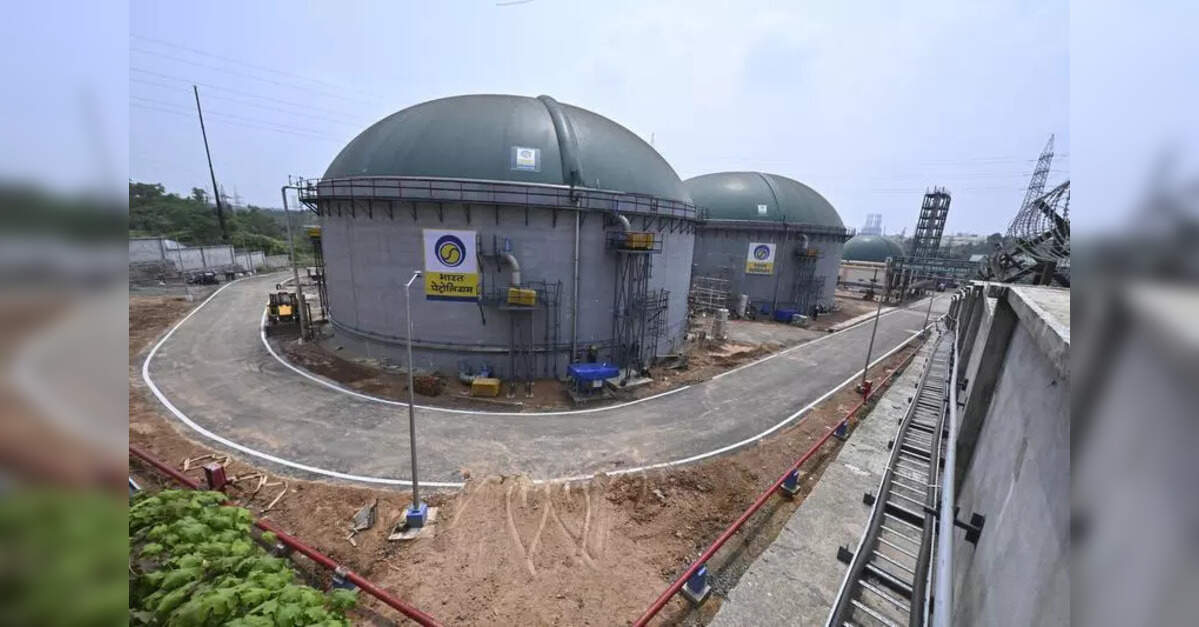
India’s energy landscape is undergoing a profound transformation, with a distinct pivot towards sustainable and domestically sourced alternatives. A significant milestone in this journey was recently achieved with the operationalization of Bharat Petroleum Corporation Ltd’s (BPCL) Compressed Biogas (CBG) plant in Kochi. This development is not merely a local environmental win; it signals a strategic shift for public sector undertakings and offers a compelling narrative for investors keen on India’s energy transition, particularly those focused on Environmental, Social, and Governance (ESG) criteria. For savvy investors, understanding the implications of such projects goes beyond the headlines, revealing crucial trends in energy security, diversification, and long-term value creation within the oil and gas sector.
The Strategic Shift Towards Bioenergy and ESG Leadership
BPCL’s new CBG facility in Brahmapuram, Kochi, stands as a tangible example of India’s commitment to a circular economy and sustainable waste management. Designed to process 150 tonnes of source-segregated biodegradable municipal solid waste daily, the plant is poised to generate 5.6 tonnes of compressed biogas and a substantial 28 tonnes of organic manure each day. This dual-output model not only addresses the critical issue of urban waste but also creates valuable resources: clean fuel and agricultural input. From an ESG perspective, this initiative significantly enhances BPCL’s environmental footprint by reducing landfill burden, mitigating methane emissions, and producing renewable energy. It aligns perfectly with the National Policy on Biofuels, 2018, which provides the overarching framework for promoting bioenergy in India. With the Ministry of Petroleum and Natural Gas targeting 195 CBG plants nationwide, including seven specifically for Kerala, BPCL’s Kochi project positions the company as a frontrunner in a rapidly expanding green energy segment. Investors are increasingly scrutinizing companies’ ESG performance, and BPCL’s proactive steps in this domain demonstrate a forward-thinking strategy that can attract capital seeking sustainable growth opportunities.
Navigating Volatility: CBG as a Diversifier in a Fluctuating Market
The global energy market continues to present a complex picture of volatility, making stable, domestically produced energy sources increasingly attractive. As of today, Brent Crude trades at $93.92, marking a modest 0.73% increase within the day’s range of $93.52-$94.21. Meanwhile, WTI Crude stands at $90.48, up 0.9%, fluctuating between $89.71 and $90.7. These figures, while showing intraday strength, follow a significant downturn; Brent crude notably shed nearly 20% in the past 14 days, dropping from $118.35 on March 31st to $94.86 just yesterday. This stark $23.49 decline underscores the inherent unpredictability of international crude markets, driven by geopolitical tensions, supply-demand dynamics, and economic forecasts. In this context, projects like BPCL’s Kochi CBG plant offer a crucial element of diversification. By generating fuel from local waste streams, India reduces its reliance on imported crude, enhancing energy security and insulating against global price shocks. For investors, this translates into a more resilient portfolio. Companies actively investing in such localized, renewable fuel production are building a hedge against the very volatility that dominates discussions around traditional crude, thereby de-risking their long-term growth trajectory.
The Investor’s Lens: What This Means for BPCL and the Broader Sector
Our proprietary data indicates that investors are keenly focused on the future trajectory of crude prices, with questions like “is WTI going up or down?” and “what do you predict the price of oil per barrel will be by end of 2026?” dominating recent inquiries. While these concerns are valid for the immediate and medium-term outlook of traditional oil and gas revenues, the operationalization of the Kochi CBG plant offers a different, complementary perspective for long-term value. For BPCL, this initiative is more than just a corporate social responsibility endeavor; it’s a strategic move to diversify revenue streams, enhance brand perception, and secure a competitive edge in India’s evolving energy mix. As a public sector undertaking, BPCL’s commitment to the government’s bioenergy goals positions it favorably for future policy support and expansion opportunities. Investors should view this as part of a broader strategy by Indian oil majors to de-carbonize their operations and capture value in the burgeoning renewable energy sector. Companies that successfully integrate such projects into their core business models are likely to command higher valuations, given the increasing weight institutional investors place on sustainability metrics and future-proofed business models. The shift towards decentralized, waste-to-energy solutions also creates new value chains, from waste collection and processing to CBG distribution, opening up ancillary investment opportunities.
Looking Ahead: The Future of Biogas and Upcoming Market Catalysts
The successful commissioning of the Kochi plant is just the beginning of a larger national rollout. Plans are already in motion to establish similar facilities in other key districts across Kerala, including Kozhikode, Kollam, Palakkad, Thrissur, and Kottayam. This phased expansion aligns with the Ministry of Petroleum and Natural Gas’s broader vision to establish 195 CBG plants across India, signaling a robust and consistent growth trajectory for the bioenergy sector. While the immediate focus of global energy markets will be on macro events like the OPEC+ JMMC Meeting scheduled for April 21st and the EIA Weekly Petroleum Status Reports on April 22nd and 29th, the steady progress in India’s domestic bioenergy sector provides a compelling, long-term investment narrative that is less susceptible to international geopolitical tremors. Further insights into the broader energy landscape will come from the Baker Hughes Rig Count on April 24th and May 1st, and the EIA Short-Term Energy Outlook on May 2nd, which will offer updates on conventional energy supply. However, the consistent development of projects like Kochi CBG reinforces India’s commitment to bolstering its energy independence through diverse and sustainable means. Savvy investors should monitor the progress of these upcoming CBG projects closely, as they represent not just environmental initiatives, but significant, de-risked growth avenues within India’s energy investment thesis.


