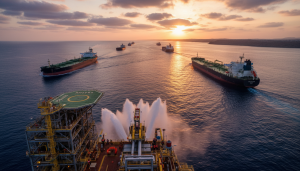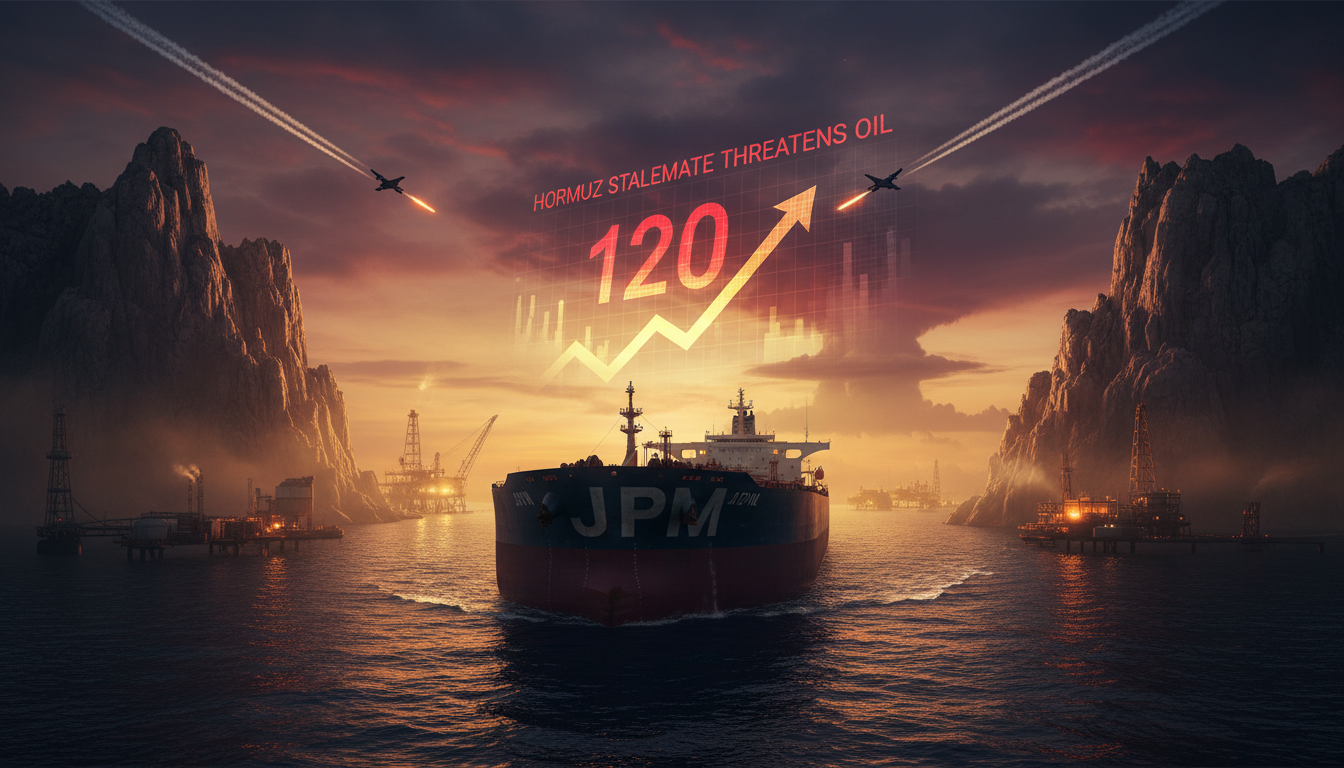
The global oil market is bracing for a potential seismic shift, with leading financial institutions warning that crude prices could skyrocket to nearly $120 per barrel if full restoration of shipping through the vital Strait of Hormuz extends into July. This grim forecast, emanating from analysts at JP Morgan, signals a significant upside risk for energy investors, echoing levels last seen during peak geopolitical tensions.
Strait of Hormuz Remains Under Tight Control Despite Ceasefire
Despite recent announcements of a ceasefire, the critical maritime chokepoint of the Strait of Hormuz remains severely constrained. Vessel traffic through this strategic waterway operates under strict supervision and requires explicit approval from Iran’s Islamic Revolutionary Guard Corps (IRGC). This ongoing restriction undermines earlier market optimism that a ceasefire would swiftly normalize commercial navigation.
Maritime intelligence firm Windward recently confirmed the persistent limitations. “The ceasefire has not reopened the Strait of Hormuz, and transit remains tightly controlled,” the firm stated, emphasizing that “There has been no return to open commercial navigation.” Their assessment highlights that transit through the Strait is currently “restricted, coordinated, and selectively enforced,” painting a picture of continued instability and potential supply disruption for the global energy sector.
Geopolitical Leverage and Market Uncertainty
Investor attention now turns to the upcoming Iran-U.S. negotiations, with hopes that these discussions could de-escalate the situation and pave the way for a rapid resumption of unrestricted commercial shipping through Hormuz. However, significant uncertainties loom. A key risk factor is whether Iran will choose to relinquish its leverage over this strategic maritime route during the talks. Should Iran maintain its control, the implications for global oil supplies and prices could be profound.
The initial burst of optimism following the ceasefire, which anticipated a swift reopening of the Strait, has clearly waned. Analysts across the board are now recalibrating timelines and assessing the potential for renewed upward pressure on oil prices, a scenario that demands close monitoring from all energy market participants.
Analyst Projections: A Path to $120 Oil
JP Morgan’s latest analysis, released in a recent note, details the market’s current expectations for traffic restoration. Analysts suggest that approximately half of normal oil flows could be restored by May, with a full recovery anticipated by June. However, the investment bank cautions against this optimistic timeline.
A more gradual return to pre-conflict levels, where 100% of normal traffic is not achieved until July, could introduce a substantial “upside risk” to crude prices, potentially adding $15 to $20 per barrel. Such an increase would push international benchmarks dangerously close to the $120 per barrel mark, representing a significant premium over the $95-$97 per barrel range where both international crude benchmarks traded early on Friday. This scenario underscores the extreme sensitivity of the global oil market to the operational status of the Strait of Hormuz.
The Critical Importance of the Strait of Hormuz
For investors, understanding the strategic importance of the Strait of Hormuz is paramount. This narrow waterway, situated between the Persian Gulf and the Gulf of Oman, serves as the only sea passage from the Persian Gulf to the open ocean. It is a vital artery for global energy trade, through which roughly 20% of the world’s total petroleum liquids consumption and a significant portion of liquefied natural gas (LNG) passes. Any disruption, even partial, has immediate and far-reaching implications for global supply chains and energy security.
Historically, geopolitical tensions in the region have led to sharp spikes in crude oil prices, reflecting the market’s inherent fear of supply outages from the Middle East. The current situation, with the Strait under ongoing restrictions by the IRGC, presents a tangible threat to this critical flow, directly impacting the supply-demand balance and investor sentiment.
Goldman Sachs Warns of Sustained High Prices
Adding to the cautious outlook, Goldman Sachs analysts issued their own warning, projecting that Brent Crude could average above $100 per barrel for the entire year if the Strait of Hormuz remains largely inaccessible to tanker traffic for another month. This forecast highlights not only the immediate risk of price spikes but also the potential for prolonged elevated prices should the restrictions persist.
For energy investors, these projections from two of the world’s leading financial institutions serve as a critical indicator. They signal that the risk premium associated with Middle East geopolitical instability is firmly back on the table, likely leading to increased volatility and potentially substantial gains for those positioned correctly in the upstream sector or specific energy-related ETFs.
Navigating the Volatility: Investor Outlook
The current environment demands a sophisticated approach from oil and gas investors. While the prospect of $120 oil presents a lucrative opportunity for certain market segments, it also introduces significant risk. The interplay of geopolitical negotiations, military oversight, and the physical constraints on global shipping create a highly unpredictable landscape.
Companies with diversified supply chains or those less reliant on the Hormuz passage might fare better, while the broader market faces inflationary pressures from higher energy costs. Investors should monitor developments in the Iran-U.S. negotiations closely, as any breakthrough could rapidly shift market sentiment. Conversely, a failure to reach a resolution or an escalation of restrictions could send oil prices soaring, impacting everything from airline profitability to industrial output.
Ultimately, the global oil market stands at a critical juncture. The Strait of Hormuz, once again, emerges as a pivotal determinant of crude oil prices. As analysts weigh the potential for a prolonged disruption against the hopes for diplomatic resolution, investors must remain vigilant, prepared for rapid shifts in a market heavily influenced by geopolitical currents.