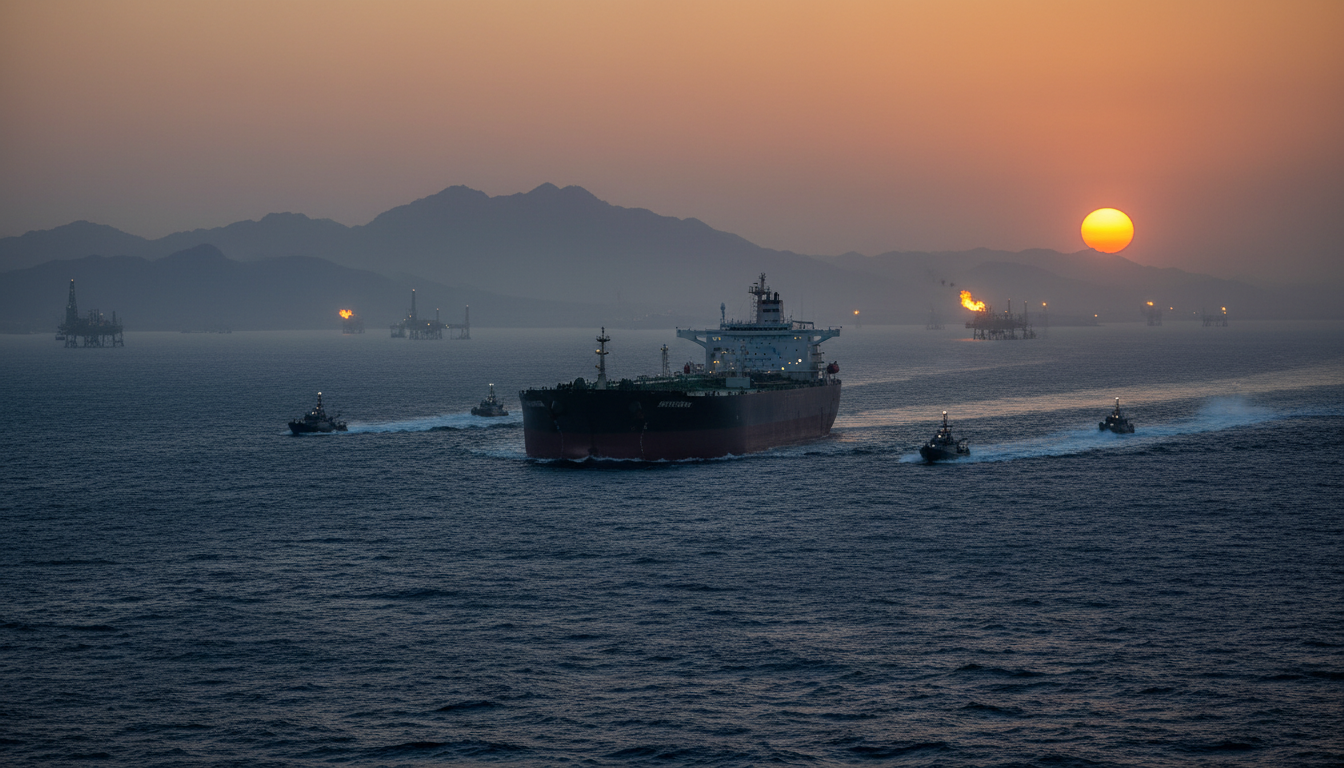
Hormuz Bottleneck: A Critical Test for Global Oil Prices
The global oil market faces significant headwinds and potential for explosive volatility as the critical Strait of Hormuz remains under tight control, despite a recently announced ceasefire. Financial titan J.P. Morgan issues a stark warning to investors: crude oil prices could surge to nearly $120 per barrel, revisiting the peaks seen during previous Iran-related conflicts, should a full restoration of normal vessel traffic through the strategic waterway be delayed until July.
This forecast underscores the immense geopolitical risk currently baked into energy markets. While a ceasefire might suggest de-escalation, the reality on the ground, or rather, at sea, paints a different picture. The Strait of Hormuz, a vital chokepoint for approximately one-fifth of the world’s daily oil consumption and roughly one-third of all seaborne crude oil, continues to operate under severe restrictions. Supervision and approval by Iran’s Islamic Revolutionary Guard Corps (IRGC) effectively dictate the pace and volume of tanker traffic, introducing an element of profound uncertainty for the global oil supply chain.
Commercial Navigation Remains Restricted Amid Geopolitical Tensions
Maritime intelligence firms confirm the persistent operational challenges. Industry analysis highlights that the ceasefire has not translated into an immediate reopening of the Strait of Hormuz for unhindered commercial navigation. Instead, transit remains meticulously coordinated and selectively enforced. This means that while some vessels may pass, the fluidity and predictability essential for the efficient global oil trade are severely compromised. The absence of a return to open commercial navigation presents a direct threat to the stability of energy supplies and reinforces the existing geopolitical risk premium in oil prices.
Market participants initially hoped that an end to hostilities would swiftly lead to the resumption of unfettered tanker traffic. However, this immediate optimism has largely dissipated as the restrictions endure. Investors are now keenly observing the upcoming Iran-U.S. negotiations, anticipating that these talks could offer a pathway to de-escalation and a faster normalization of commercial shipping through the Strait. Yet, significant uncertainties persist. A key question for the energy sector is whether Iran will leverage its control over the Hormuz chokepoint as a bargaining chip in these crucial discussions, further prolonging the current supply uncertainty.
J.P. Morgan’s Price Trajectory: The $120 Barrel Scenario
J.P. Morgan’s analysts have meticulously modeled various scenarios for oil price movements based on the timeline for the Strait of Hormuz’s full reopening. Their base case projection assumes a gradual but steady improvement: approximately half of normal crude oil flows are expected to be restored by May, with a full restoration of pre-conflict levels anticipated by June. Under this scenario, while prices might remain elevated, the more extreme spikes could be averted as oil supply constraints ease.
However, the investment bank’s experts also detailed a less favorable, yet increasingly plausible, alternative. Should a complete return to 100% of pre-war shipping levels be delayed until July, the market could experience a substantial upside risk to oil prices, potentially adding $15 to $20 per barrel. This incremental surge would push international crude oil benchmarks dangerously close to the $120 mark, a price level last witnessed during intense periods of geopolitical instability. Such a scenario would have profound implications for global inflation, industrial output, and consumer spending, severely impacting economic growth.
The current market reflects this elevated risk profile. As of early Friday, international oil benchmarks were trading in the range of $95 to $97 per barrel. This represents a significant premium, primarily driven by the ongoing uncertainty surrounding the Strait of Hormuz and the broader Middle East. Energy investors must remain acutely aware of how quickly this delicate balance could shift, with supply disruptions capable of triggering rapid price appreciation.
Goldman Sachs Echoes Warning: Sustained $100+ Brent
Adding to the chorus of concern, analysts at Goldman Sachs had previously warned that Brent Crude is projected to average above $100 per barrel for the entire year if the Strait of Hormuz remains largely inaccessible to tanker traffic for just one more month. This corroborates J.P. Morgan’s assessment and highlights a growing consensus among major financial institutions regarding the potential for sustained high oil prices. The confluence of these expert opinions reinforces the notion that the geopolitical premium in crude oil is not merely transitory but could become a defining feature of the energy market throughout the year.
For investors focused on the oil and gas sector, these analyses present both challenges and opportunities. While prolonged high oil prices can benefit exploration and production (E&P) companies, they also introduce significant volatility and risk across the entire value chain. Refiners, for instance, might face increased feedstock costs, potentially squeezing margins. Meanwhile, the broader implications for the global economy from sustained high energy prices cannot be overstated, impacting demand forecasts and ultimately influencing long-term investment strategies in oil and gas.
Monitoring the flow of oil through the Strait of Hormuz, the progression of diplomatic negotiations, and the statements from key geopolitical players will be paramount for anyone invested in the energy space. The current situation serves as a potent reminder of the fragility of global supply lines and the enduring power of geopolitical events to reshape the energy landscape and drive significant movements in oil commodity prices.