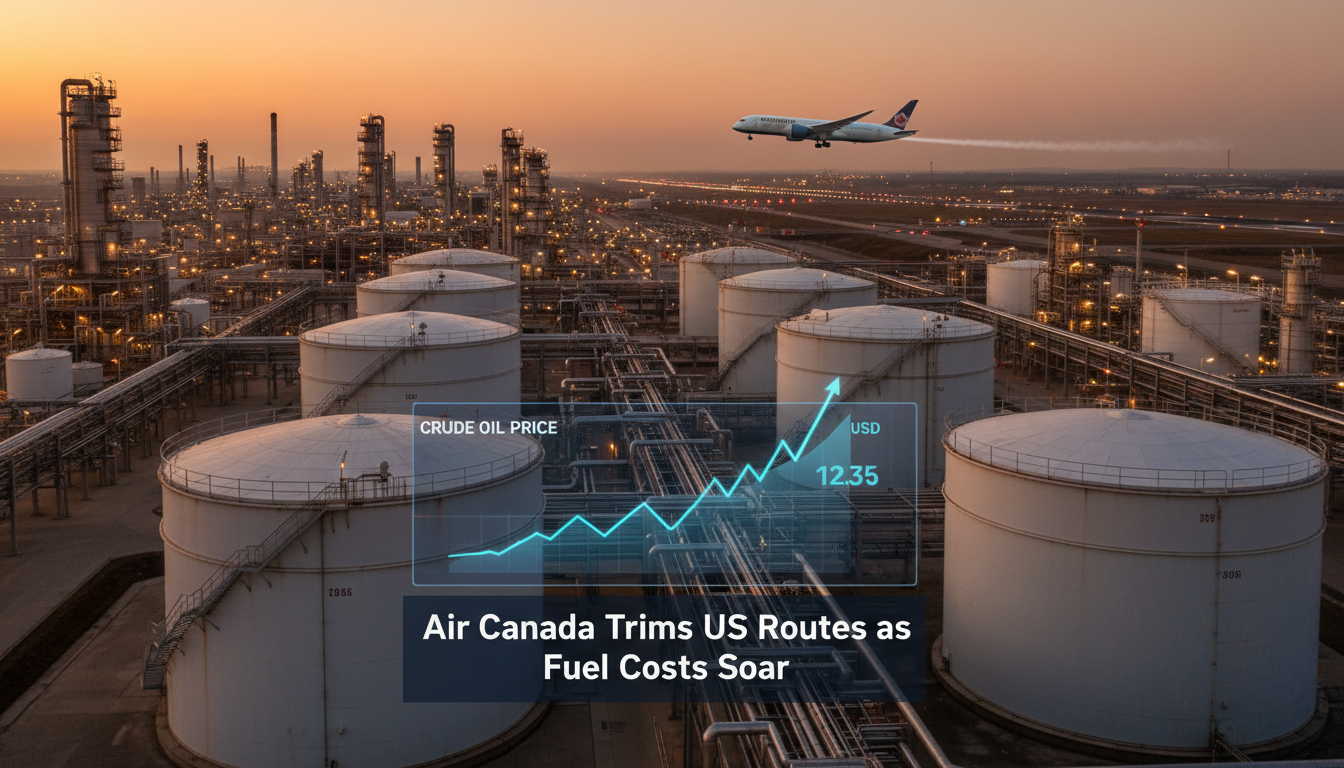
The global aviation sector is sending a clear, actionable signal to energy investors: persistently high jet fuel prices are actively curbing demand. This isn’t theoretical; it’s manifesting in concrete schedule adjustments by major carriers. Air Canada’s decision to suspend key routes, including connections to John F. Kennedy International Airport from Toronto and Montreal from June 1, 2026, through October 25, 2026, alongside other service reductions, exemplifies the financial pressures airlines face. This strategic trimming, echoed by international players like Lufthansa and KLM, offers a critical lens for understanding demand destruction in the current crude oil landscape and its forward trajectory. For astute energy investors, these airline adjustments are more than just industry news; they are a tangible indicator of demand elasticity at elevated price points, shaping the outlook for refined products and crude oil alike.
Jet Fuel’s Price Surge: A Direct Threat to Demand Stability
The immediate catalyst for these widespread airline cutbacks is an undeniable surge in jet fuel prices. Following the escalation of geopolitical tensions, particularly the Iran-United States conflict that began in late February, the cost of jet fuel catapulted from approximately $2.50 per gallon pre-conflict to over $4.30 per gallon by mid-April. This near-doubling in cost has exposed airlines with insufficient hedging strategies to immense financial strain, especially considering jet fuel typically constitutes 20% to 30% of an airline’s total operating expenses. The impact is particularly acute for budget airlines such as JetBlue, Spirit, and Frontier, many of whom were already navigating profitability challenges even before this latest price shock.
As of today, Brent crude trades at $99.13, reflecting a modest daily dip of 0.22% but still holding near the psychologically important triple-digit threshold, with a daily range between $97.55 and $101.32. WTI crude similarly stands at $94.4, down 1.51% today, trading within a range of $92.68 to $97.85. While these crude benchmarks have seen some cooling from their recent peaks – our proprietary data shows Brent declined by $9.49, or 8.7%, from $109.27 on April 7, 2026, to $99.78 on April 24, 2026 – the underlying cost of crude continues to keep refined product prices, including jet fuel, elevated. This sustained high-cost environment directly translates into the operational adjustments we’re now observing across the aviation sector, signaling a tangible form of demand destruction for energy markets.
Airline Resilience and the Hedging Advantage: What it Means for Energy Investors
In this turbulent environment, not all airlines are equally vulnerable, and this differentiation holds significant implications for energy investors assessing future jet fuel demand. Our analysis suggests that only a select group of U.S. carriers, namely Delta Air Lines, United Airlines, and Southwest Airlines, are positioned to maintain profitability should jet fuel prices persist around the $4.00 per gallon mark. This resilience stems from a combination of strategic advantages, including higher operating margins, a diversified revenue mix, robust hedging strategies, and in some cases, vertical integration such as Delta’s ownership of an oil refinery. These factors allow certain airlines to absorb higher fuel costs more effectively, mitigating the immediate need for drastic schedule cuts.
For energy investors, this divergence highlights that demand destruction in the aviation sector might be uneven. While budget carriers are quickly forced to trim capacity, more resilient airlines might maintain or even gain market share, providing a floor to a portion of jet fuel demand. However, the overall trend indicates a clear sensitivity of demand to price. A sustained period of $4.00+ jet fuel, even if only impacting a segment of the airline industry, will inevitably weigh on total aviation fuel consumption. This uneven impact also suggests that while some energy demand remains sticky, the sector’s overall elasticity to price shocks is considerable, indicating a potential cap on crude oil’s upside if refined product prices soar too high.
Navigating Future Volatility: Upcoming Events and Investor Concerns
The current market dynamics, characterized by high crude prices and signs of demand destruction in key sectors, underscore the importance of forward-looking analysis for energy investors. Our first-party reader intent data reveals a keen interest in crude oil price drivers, with many asking: “What would push Brent below $80? What would push it above $120?” The softening jet fuel demand, driven by sustained high prices, presents a clear downward pressure on crude. However, geopolitical factors, specifically the stalled US-Iran negotiations and the ongoing Israel-Lebanon ceasefire extensions, continue to inject significant uncertainty and potential for upward price swings, keeping the market in a state of tug-of-war.
Investors should closely monitor several upcoming energy events for further clarity. The API Weekly Crude Inventory report on April 28, followed by the EIA Weekly Petroleum Status Report on April 29, will provide crucial insights into supply-demand balances, directly influencing crude pricing and, by extension, refined products like jet fuel. Further into the future, the Baker Hughes Rig Count on May 1 and May 8 will offer a snapshot of drilling activity, impacting future supply expectations, while the EIA Short-Term Energy Outlook on May 2 will provide broader projections for the coming months. These data points will be instrumental in gauging whether current demand destruction signals, like those from the aviation sector, are becoming more widespread or if supply constraints continue to dominate the narrative. While the long-term impact of EV adoption on overall oil demand remains a significant question, the immediate focus is on how short-term price elasticity is reshaping consumption patterns.
The Broader Crude Outlook: Beyond Aviation’s Turbulence
The aviation sector’s proactive capacity reductions serve as a bellwether for broader energy markets. When a critical sector like air travel, a significant consumer of refined products, begins to visibly trim operations due to fuel costs, it signals that the market is reaching a price point where demand destruction becomes unavoidable. The current Brent crude price of $99.13, while dipping slightly today, remains firmly near triple-digits. This indicates that despite these demand signals, the market perceives underlying supply tightness or geopolitical risk as persistent and influential.
The recent -$9.49 decline in Brent from its April 7 peak of $109.27 to $99.13 today suggests that demand concerns are indeed beginning to be priced in, providing some relief from the most extreme highs. However, the market’s inability to break significantly lower underscores the powerful influence of supply-side factors. Gasoline prices, currently at $3.33 per gallon and showing a slight daily dip of 0.3%, further reflect this high-cost environment, hinting at broader consumer pain points that could further dampen overall petroleum demand beyond just the aviation sector. For oil and gas investors, navigating this environment requires a nuanced understanding: while immediate demand destruction from sectors like aviation will cap upside, persistent supply risks mean significant downside could be limited, creating a volatile trading range. The interplay between these forces will define crude oil’s trajectory in the coming months, urging investors to remain agile and data-driven in their portfolio strategies.


