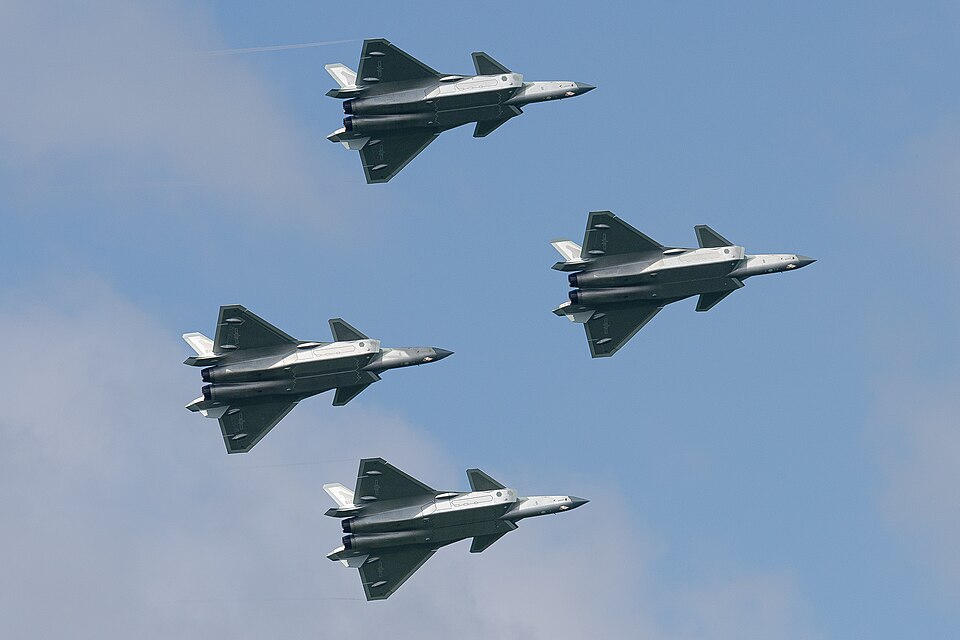
The recent, subtle display of advanced Chinese air power in critical Asian waterways – specifically the reported J-20 stealth fighter transit through the Korea Strait – serves as a stark reminder for oil and gas investors of the escalating geopolitical risks undergirding global energy markets. While seemingly a military technicality, this maneuver highlights a growing challenge to regional stability and, by extension, the security of vital shipping lanes. For an industry deeply sensitive to supply disruptions, such developments in one of the world’s most critical energy consumption hubs demand immediate analytical attention.
Geopolitical Undercurrents and Supply Chain Fragility
The significance of the reported J-20 flight through the Korea Strait cannot be overstated for global energy security. This narrow waterway, connecting the East China Sea to the Sea of Japan, is a critical chokepoint for maritime traffic, including a substantial portion of the world’s crude oil and LNG shipments destined for major Asian economies. The implied ability of Beijing’s most advanced stealth aircraft to operate undetected in such a heavily monitored corridor, within reach of key U.S., Japanese, and South Korean bases, fundamentally alters the calculus of regional stability. Allied planners are increasingly operating under the assumption of a “dual contingency” scenario – a Chinese move on Taiwan potentially compounded by opportunistic North Korean aggression. In such an environment, the demonstrated operational reach of the J-20 introduces disproportionate problems for both deterrence and potential conflict. The risk extends beyond military implications; it signals a potential erosion of security in a region that is a lynchpin of global energy consumption and trade. For oil and gas investors, this translates into elevated risk for supply chain resilience, potentially increasing shipping costs, insurance premiums, and the overall geopolitical risk premium embedded in crude prices.
Current Market Dynamics Versus Escalating Risk
As of today, Brent crude trades at $98.17, reflecting a -1.23% decline within a day range of $97.92-$98.58. Similarly, WTI crude is at $89.78, down -1.52%, fluctuating between $89.57 and $90.21. This recent daily dip continues a broader downward trend for Brent, which has fallen by approximately $14, or 12.4%, from $112.57 on March 27th to $98.57 just yesterday. This immediate market snapshot suggests investors are currently weighing factors like global demand outlooks, perhaps inventory builds, or broader economic sentiment. However, the J-20 incident highlights a significant disconnect between these short-term market fluctuations and the simmering, long-term geopolitical risks in East Asia. While the market may currently be focused on more conventional supply and demand metrics, the demonstrated capability for undetected military operations in critical shipping lanes introduces a substantial, yet unpriced, risk premium. This implies a potential for sharp, sudden price volatility should geopolitical tensions escalate, underscoring that current prices may not fully reflect the underlying security fragilities exposed by such events.
Investor Focus: Pricing in the Unseen Risk
Our proprietary reader intent data reveals a consistent investor focus on fundamental questions, such as ‘What are OPEC+ current production quotas?’ and ‘What is the current Brent crude price and what model powers this response?’ These inquiries rightly underscore the importance of supply-side decisions and current market pricing mechanisms. However, the J-20 flight serves as a powerful reminder that conventional supply/demand models, while crucial, often struggle to adequately incorporate high-impact, low-probability geopolitical events. The ability of a major power to project stealth air capabilities undetected through vital international straits adds an unpredictable and potentially volatile variable to any oil price forecast. It’s not simply about OPEC+ production levels or weekly inventory draws; it’s fundamentally about the security and unimpeded flow of crude through the world’s most critical maritime arteries. Investors must consider how such an erosion of security confidence in chokepoints like the Korea Strait could significantly alter the risk premium in future Brent pricing, potentially offsetting any perceived market surpluses or demand slowdowns. This underscores the need for a more holistic approach to energy investment analysis, integrating nuanced geopolitical risk assessment alongside traditional market fundamentals.
Forward-Looking: Geopolitical Tensions & Upcoming Supply Decisions
Looking ahead, the next two weeks bring crucial catalysts for market sentiment, including the OPEC+ Joint Ministerial Monitoring Committee (JMMC) meeting on April 18th, followed by the full Ministerial meeting on April 20th. These gatherings are typically pivotal for determining global oil supply strategies. Additionally, investors will keenly watch the API Weekly Crude Inventory reports on April 21st and 28th, and the EIA Weekly Petroleum Status Reports on April 22nd and 29th, for insights into demand and inventory levels. While these events are traditionally the primary drivers of short-term price movements, the underlying geopolitical tension exemplified by the J-20 flight casts a significant shadow. The specter of a “dual contingency” in Asia could subtly, or even overtly, influence OPEC+’s long-term strategy, potentially encouraging them to maintain tighter control over supply as a hedge against global instability. The perception of heightened risk to critical shipping lanes in East Asia could also inject an immediate and substantial premium into oil prices, irrespective of short-term inventory levels or rig counts, compelling investors to factor in a growing geopolitical surcharge on all future oil transactions.