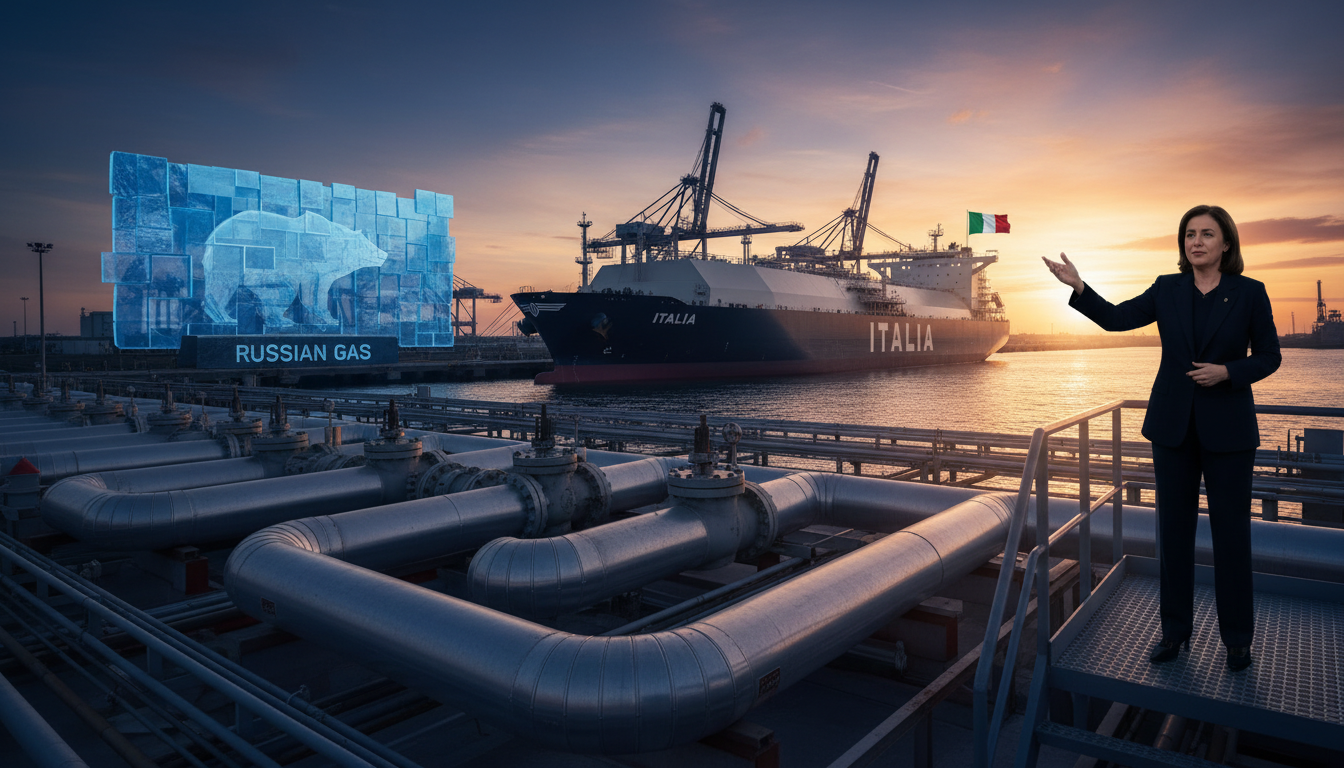
Italy’s energy strategy is navigating a perilous confluence of geopolitical resolve and immediate economic necessity, creating a complex investment landscape for the oil and gas sector. Premier Giorgia Meloni has unequivocally maintained Italy’s commitment to eschewing Russian gas imports, a stance that stands firm despite escalating Middle East conflicts driving global energy prices higher and tightening supply chains. This unwavering political principle, however, is increasingly at odds with pragmatic calls from within Italy’s energy industry, setting the stage for continued market volatility and critical decisions for Europe’s energy future. For investors, understanding this delicate balance and its implications for supply, demand, and price trajectories is paramount.
Italy’s Strategic Resolve Amidst Industry Dissent
Premier Meloni’s government has articulated a clear, long-term vision for Italy’s energy independence from Russia, extending its strategic timeline to potentially January 2027 for a peaceful resolution in Ukraine. This period aligns with existing European energy agreements, underscoring the strategic dimension of Italy’s current energy policy. Meloni views economic leverage against Russia as the most potent instrument for achieving lasting peace, firmly stating that any discussion about shifting this stance is “premature.” This political conviction directly contrasts with growing apprehension within Italy’s energy sector. Claudio Descalzi, CEO of Eni SpA, recently highlighted the profound reliance of Italy on natural gas, suggesting a re-evaluation of plans to prohibit Russian liquefied natural gas (LNG) imports. This divergence between political principle and commercial pragmatism reveals a deep fault line for investors tracking European markets, hinting at potential policy shifts should market duress intensify significantly.
Market Volatility and Geopolitical Premiums: An Investor’s View
The current geopolitical landscape, marked by both the protracted conflict in Ukraine and the escalating hostilities in the Middle East, has injected substantial volatility into global energy markets. Investors are keenly observing how these macro factors directly impact commodity prices. As of today, Brent crude trades at $95.07 per barrel, demonstrating a robust 5.19% gain on the day, within a range of $92.77 to $97.81. This uptick follows a notable period of decline over the past two weeks, where Brent fell from $112.78 on March 30th to $90.38 by April 17th, representing a significant 19.9% depreciation. WTI crude has also seen a strong surge today, reaching $86.9, up 5.22%, indicating broad market reaction to supply concerns. Gasoline prices are similarly affected, currently at $3.03, up 3.41%. This rebound underscores the market’s sensitivity to geopolitical developments, particularly the recent closure of the Strait of Hormuz, a critical maritime artery for global commodity flows. Italy, one of Europe’s most gas-dependent nations, finds itself in a particularly precarious position, with the availability and cost of gas shipments directly impacted by these choke points. The recent price movements highlight the persistent geopolitical risk premium embedded in crude benchmarks, a crucial factor for investors assessing the profitability and stability of energy assets.
Addressing Investor Concerns: The Path of Oil and Gas Prices
The current market environment has naturally prompted a surge in investor inquiries, with many asking about the future trajectory of crude benchmarks like WTI and overall oil prices by the end of 2026. The tension between Italy’s political resolve and the commercial pragmatism advocated by figures like Descalzi adds another layer of complexity to these predictions. Italy’s profound reliance on natural gas, combined with the vulnerability exposed by global conflicts and supply chain disruptions, makes the cost and availability of alternative energy sources a central concern. Investors are assessing whether Italy’s commitment to diversification, spearheaded by Premier Meloni’s diplomatic efforts to secure alternative energy sources, can truly insulate it from price shocks. The ongoing debate about re-evaluating LNG import bans signals the real-world pressure felt by energy companies. For firms like Eni, navigating a landscape where political mandates clash with economic realities requires agile strategic planning, impacting their short-term operational costs and long-term investment decisions. The ability of European nations, including Italy, to maintain energy security without Russian gas will be a defining factor in regional economic stability and, by extension, the performance of major energy players.
Forward-Looking Analysis: Upcoming Catalysts and Supply Dynamics
The immediate future holds several key events that could significantly influence global oil and gas markets, directly impacting Italy’s energy strategy. The OPEC+ Joint Ministerial Monitoring Committee (JMMC) Meeting on April 20th, followed by the full OPEC+ Ministerial Meeting on April 25th, are paramount. Any decisions regarding production quotas will reverberate across the globe, potentially easing or exacerbating supply tightness. For Italy, which is actively seeking to diversify its energy sources, global supply availability and price stability are critical. Concurrently, the API Weekly Crude Inventory reports on April 21st and 28th, along with the EIA Weekly Petroleum Status Reports on April 22nd and 29th, will offer crucial insights into US supply and demand fundamentals, providing a snapshot of the world’s largest consumer and producer. These reports, alongside the Baker Hughes Rig Count on April 24th and May 1st, will paint a clearer picture of future production trends. Meloni’s diplomatic offensive to secure alternative energy sources is a proactive step, but its success is heavily dependent on the stability and availability of global supplies, which these upcoming events will undoubtedly shape. Investors should monitor these catalysts closely, as they will provide critical signals on market direction and potential policy implications for gas-dependent nations like Italy.
Investment Implications of Europe’s Energy Transition
Italy’s firm stance against Russian gas, despite market pressures and industry calls for pragmatism, underscores Europe’s broader commitment to energy independence and diversification. For oil and gas investors, this presents a nuanced landscape of risks and opportunities. While the immediate geopolitical tensions drive price volatility, the long-term trend points towards increased investment in alternative gas suppliers, LNG infrastructure, and renewable energy projects across Europe. Companies positioned to capitalize on these diversification efforts, whether through new supply agreements, infrastructure development, or technological innovation in renewables, stand to benefit. Conversely, those heavily exposed to the short-term whims of volatile spot markets or reliant on traditional, politically sensitive supply routes face elevated risks. Italy’s journey, balancing economic necessity with strategic principle, offers a microcosm of the challenges and transformations underway in the global energy sector, demanding a sophisticated and forward-looking investment approach.


