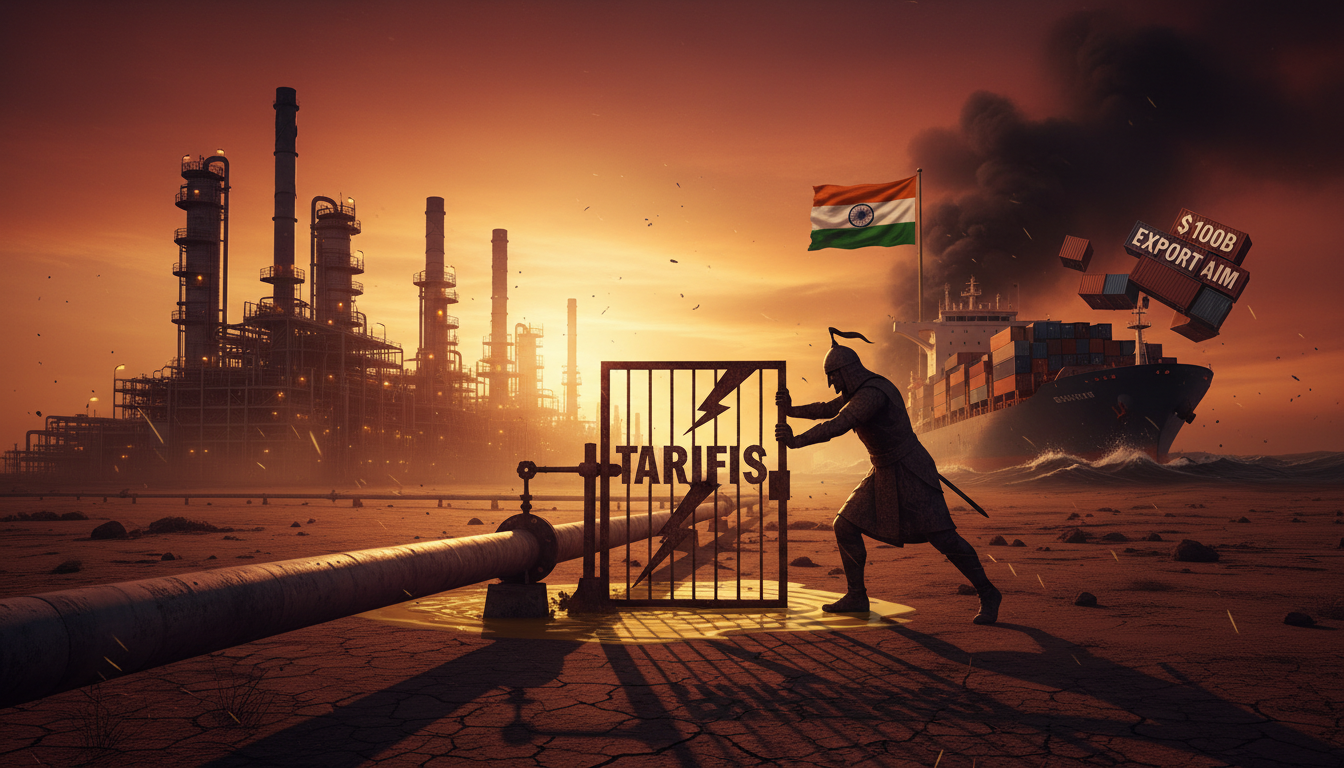
Geopolitical Shocks Rattle Indian Exports: An Oil Market Perspective
India’s ambitious economic trajectory, often hailed as the world’s fastest-growing major economy, faces significant headwinds from an unexpected quarter: the global energy market. While the headlines frequently focus on crude oil futures and refinery margins, the ripple effects of geopolitical strife in key oil-producing regions are now severely impacting even diverse sectors like India’s massive textile industry. For investors eyeing emerging market opportunities, understanding these linkages – particularly how energy market volatility directly translates into industrial costs and export competitiveness – is paramount.
The challenges for Indian textile exporters initially stemmed from external trade policy, specifically a 50% tariff imposed by Washington in August of the previous year. Although these duties were mercifully slashed in February, providing a brief moment of optimism, any sustained recovery was quickly extinguished by the outbreak of the U.S.-Israel conflict with Iran. This new geopolitical flashpoint has rapidly escalated operational costs, dampened international demand, and even triggered a migration of the workforce, creating a complex web of difficulties that threatens India’s significant export ambitions.
Energy Instability: A Second Blow to Industrial Resilience
The U.S.-Israel military actions against Iran, commencing on February 28, have predictably created acute instability in vital maritime routes, most notably disrupting commercial shipping through the Strait of Hormuz. This critical choke point for global oil transit immediately sent energy commodity prices soaring and introduced unprecedented volatility into freight markets. For an economy heavily reliant on imports for its energy needs and exports for its growth, the consequences are far-reaching. The Indian textile sector, a colossal employer supporting over 45 million jobs, provides a stark illustration of these broader economic pressures.
Beyond the direct impact on raw material and shipping expenses, the energy crisis has presented unusual and pressing social challenges. Industry leaders report significant difficulties for migrant workers in securing liquified petroleum gas (LPG), a primary cooking fuel in many Indian households. Such fundamental disruptions to energy access have compelled some workers to leave industrial hubs and return to their home towns, further exacerbating labor shortages and production constraints within the textile industry. This illustrates how energy price spikes can quickly cascade into labor market instability, adding another layer of risk for investors.
Petrochemical Pressures and Eroding Export Competitiveness
The immediate aftermath of the Iran conflict quickly translated into tangible financial pain for manufacturers. As Ashwin Chandran, chairman of the Confederation of Indian Textile Industry, observed, just as the sector began to stabilize in February, the new geopolitical crisis emerged. This timing is particularly unfortunate given India’s ambitious target to boost its annual textile exports to $100 billion by 2030.
Data from the Indian commerce ministry reveals that between April 2025 and February this year, combined exports of cotton, man-made yarns, fabrics, and ready-made garments reached $29.5 billion, a slight but concerning dip from $29.8 billion recorded a year prior. While seemingly modest, this downward trajectory signals a significant challenge to growth targets.
The direct impact of rising crude oil prices on petrochemical feedstocks is evident. Madhu Sudhan Bhageria, chairman of Filatex India, a prominent manufacturer of synthetic and polyester filament yarns, highlighted that polyester prices have surged by more than 40% since the war began. This dramatic increase makes it exceedingly difficult for companies to pass on costs to consumers without eroding demand. Bhageria noted that “demand has fallen as people don’t want to buy at high prices,” compounded by fears that a sudden de-escalation of the conflict could lead to a sharp fall in prices, leaving companies with expensive, unsold inventory. Consequently, Filatex India has already implemented a 25% reduction in production, awaiting a return of market stability and demand.
Global Demand Concerns and Investor Outlook
India holds the distinction of being the world’s sixth-largest textile exporter, and recent strategic trade agreements with the U.K. (last year) and the EU and U.S. (earlier this year) were expected to catalyze a robust recovery. However, the current environment of elevated energy costs and supply chain uncertainty is overshadowing these potential gains.
Pallab Banerjee, managing director of Pearl Global Industries, a key supplier to major U.S. retailers like JCPenney, Macy’s, and Walmart, indicated that while the company targeted a compound annual growth rate (CAGR) of 12% to 15%, current growth for the financial year ending March 2026 is averaging closer to 9%. Although some ready-made garment companies are managing to transfer a portion of their increased costs to international customers, a persistent concern remains: the potential for a broader slowdown in U.S. consumer demand if global oil prices continue their ascent.
Banerjee drew parallels to the Ukraine conflict in 2022, which led to diminished store sales, mounting inventories, and substantial challenges for U.S. retailers. Such an outcome, driven by sustained high oil prices impacting household budgets and discretionary spending, is a scenario no investor wishes to see repeated. While a fragile ceasefire has temporarily cooled crude oil prices to just below $100 per barrel, they remain significantly above pre-conflict levels, maintaining immense pressure on production costs and consumer demand. Without a definitive and lasting resolution to the geopolitical tensions impacting global energy markets, Indian exporters face another year defined by survival tactics rather than expansion.
Strategic Shifts Amidst Energy Volatility
Amidst these immediate challenges, India is also making strategic moves that could shape its long-term energy and economic outlook. The nation is actively exploring collaborations with Chinese firms in critical future-facing sectors such as electric-vehicle charging and energy storage solutions. A recent delegation of Indian businesses visited China, signifying a renewed focus on technological partnerships that could enhance India’s energy security and reduce its reliance on fossil fuel imports in the long run.
Moreover, global brokerage Macquarie projects India as a potential “AI powerhouse,” leveraging its extensive data sets and rapidly expanding infrastructure to underpin a new era of growth. This demonstrates a clear intent to diversify and build resilience beyond traditional manufacturing and energy consumption patterns.
Significantly, India has resumed purchasing oil and gas from Iran after a seven-year hiatus. This decision underscores India’s pragmatic approach to managing supply disruptions and elevated energy prices triggered by the broader Middle East conflict. These initiatives collectively indicate that while current geopolitical energy shocks are creating significant short-term pain for industries like textiles, India is simultaneously working to secure its long-term energy supplies and economic competitiveness in a volatile global landscape, offering a nuanced view for discerning investors.