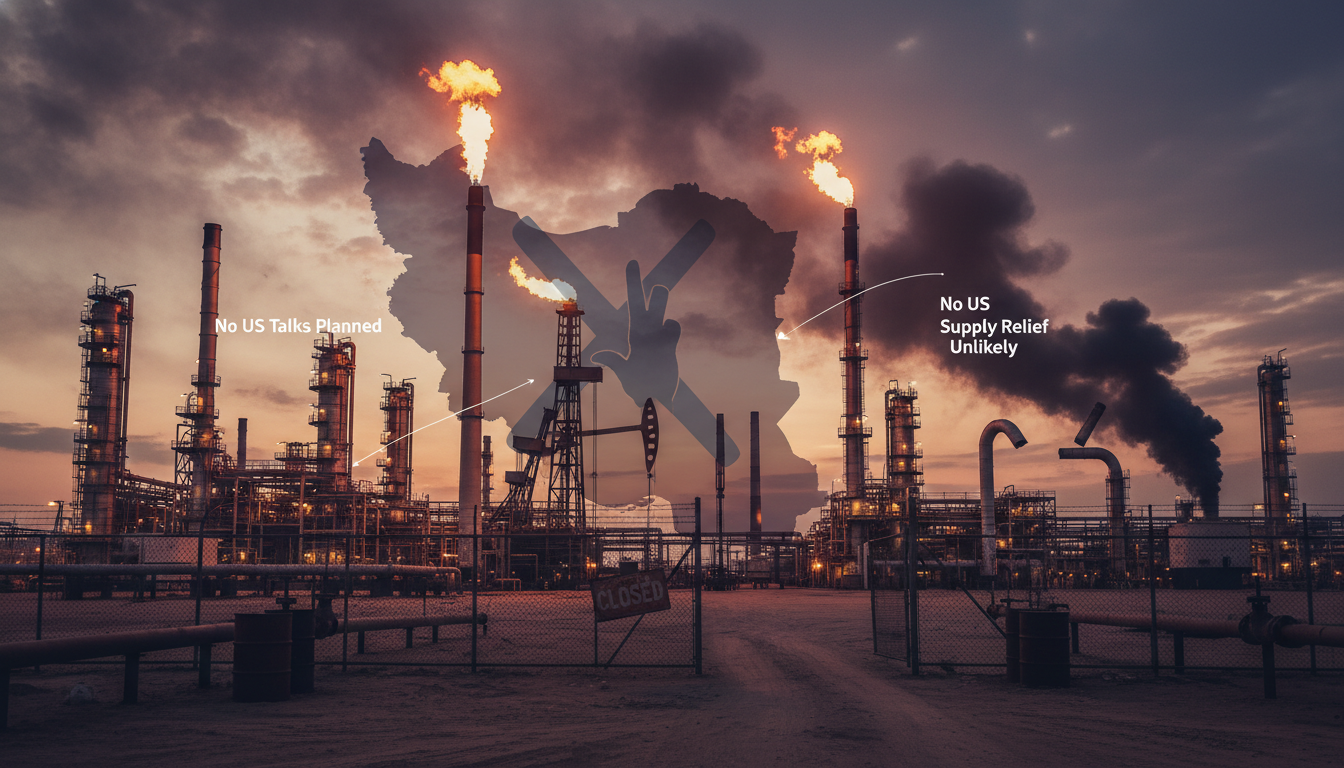
The global oil market faces renewed uncertainty as high-stakes diplomatic efforts between the United States and Iran appear to have stalled, effectively dashing any immediate hopes for a significant increase in Iranian crude supply. This diplomatic impasse, characterized by conflicting signals and a lack of direct engagement, reinforces a geopolitical risk premium already baked into energy prices. For investors, this means the prospect of a tighter market persists, keeping crude benchmarks elevated and demanding close attention to supply fundamentals and regional developments.
Diplomatic Impasse Solidifies Geopolitical Risk Premium
Expectations for a crucial second round of direct talks between Washington and Tehran have evaporated, with Iranian officials explicitly stating no meeting has been scheduled with U.S. negotiators. This stands in stark contrast to White House affirmations that a U.S. delegation, including special envoy Steve Witkoff and senior advisor Jared Kushner, was dispatched to Pakistan for “direct talks.” Iran’s preference to relay its perspectives through Pakistani intermediaries rather than engage face-to-face signals a deeper diplomatic hurdle, moving past the initial, unproductive session held weeks prior. This lack of direct dialogue not only underscores a significant gap in positions but also eliminates any near-term path for a resolution that could bring additional Iranian barrels to an already stretched global market. Foreign Minister Araghchi’s multi-stop tour, encompassing Islamabad, Muscat, and Moscow, further highlights the complex regional chessboard at play, where bilateral coordination takes precedence over immediate U.S.-Iran rapprochement.
Crude Markets React: Brent Holds Above $110 Amid Supply Concerns
The market’s immediate reaction to the stalled diplomatic efforts is evident in current crude prices. As of today, Brent Crude trades at $112 per barrel, up 1.45% on the day, with WTI Crude following suit at $106.13, marking a 1.01% increase. This upward momentum is not new; our proprietary data reveals Brent has climbed significantly from $99.36 on April 13th to $111.7 on April 30th, representing a substantial 12.4% gain over the past two weeks. This sustained rally demonstrates the market’s acute sensitivity to supply-side uncertainties. The removal of potential Iranian supply relief from the immediate horizon means global crude balances remain precarious, particularly against a backdrop of steady demand. Gasoline prices, currently at $3.66 per gallon, also reflect this upward pressure, climbing 1.11% today as refiners grapple with elevated input costs. Investors are clearly pricing in a continued scarcity premium, betting against any swift resolution that would unlock significant new production.
Investor Focus Shifts to Existing Supply and Chokepoint Risks
With the hopes of a quick influx of Iranian crude diminished, investor attention is keenly focused on existing production capabilities and the inherent geopolitical vulnerabilities of key supply routes. Our reader intent data shows a clear emphasis on understanding the “2026 weekly trend for crude oil” and building a “base-case Brent price forecast for next quarter.” These questions underscore a market hungry for certainty in an uncertain environment. The stalled U.S.-Iran talks amplify the significance of the Strait of Hormuz, a critical maritime chokepoint through which a substantial portion of the world’s oil transits. Any escalation of tensions in the broader Middle East, directly or indirectly linked to the U.S.-Iran standoff, immediately heightens the risk of supply disruption in this vital waterway. This vulnerability keeps investors on edge, reinforcing the “geopolitical risk” premium and prompting questions like “Which OPEC+ members are over-producing this month?” as market participants look for any signals of increased supply elsewhere to offset persistent tightness.
Navigating the Near-Term: Upcoming Data Points and Market Volatility
Without the prospect of an immediate diplomatic breakthrough, the market’s immediate focus will pivot sharply to fundamental data releases over the next two weeks. Investors will closely scrutinize the Baker Hughes Rig Count reports on May 1st and May 8th for insights into North American production trends. Crucially, the EIA Short-Term Energy Outlook on May 2nd will provide a broader perspective on global supply and demand balances, offering updated forecasts that could significantly influence sentiment. Weekly inventory data from both the API (May 5th, May 12th) and EIA (May 6th, May 13th) will be paramount for gauging the immediate health of crude and product stocks, giving a granular view of market tightness. Furthermore, the IEA Oil Market Report on May 12th will offer a comprehensive global overview, providing critical context for supply, demand, and inventory projections. These upcoming events become increasingly important in an environment where geopolitical solutions to supply constraints are off the table, demanding that investors remain agile and responsive to evolving market signals.
The diplomatic stalemate between the U.S. and Iran removes a key potential catalyst for increased global oil supply, sustaining a bullish outlook for crude prices. With hopes for Iranian barrels dashed in the near term, geopolitical risk in the Middle East, particularly around the Strait of Hormuz, continues to command a significant premium. Investors must brace for continued volatility and place increased emphasis on weekly inventory reports, production data, and broader market outlooks as the primary drivers in a market constrained by supply and heightened by regional tensions.