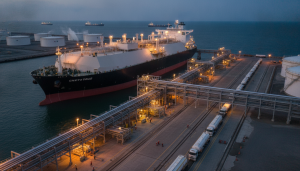
The geopolitical landscape of the Middle East continues to send significant tremors through global financial markets, with the oil and gas sector at the epicenter of investor concern. As policymakers recently convened in Washington, D.C., the escalating U.S.-Iran conflict emerged as a dominant theme, casting a long shadow over economic forecasts and energy investment strategies. While Tehran has affirmed the Strait of Hormuz remains open for commercial traffic amid a ceasefire between Israel and Lebanon, the U.S. maintains a naval blockade on Iranian ports, demanding a definitive agreement. This delicate balance of declarations and actions keeps energy investors on high alert, necessitating a close examination of the escalating risks to global energy supplies and broader economic stability.
Geopolitical Tensions Drive Market Volatility
The ongoing U.S.-Iran conflict introduces a layer of profound uncertainty that directly impacts crude oil benchmarks. The duration and ultimate resolution of hostilities remain opaque, compounded by mixed signals from Washington. For instance, recent statements from President Trump have fluctuated, at one point suggesting an imminent end to the conflict, a stark contrast to earlier projections of several more weeks. This lack of clear guidance from both sides fuels market apprehension and translates into tangible price movements.
As of today, Brent crude trades at $102.77, marking a 0.84% increase within a day range of $101.34 to $106.1. Similarly, WTI crude stands at $93.49, reflecting a 0.57% gain, with its daily range spanning $92.3 to $97.22. This short-term uptick comes after a notable period of downward pressure; our proprietary data reveals Brent crude experienced a significant decline over the past two weeks, falling from $109.03 on April 2nd to $101.35 yesterday, representing a nearly 7% drop. Such volatility underscores how swiftly geopolitical events can reprice risk in the energy market, compelling investors to constantly re-evaluate their positions. Gasoline prices have also seen a slight increase, currently at $3.26, up 0.31%, reinforcing the immediate consumer impact of these global tensions.
The Looming Threat of Stagflation
The economic ramifications of a prolonged conflict are a primary concern for central bankers and financial leaders worldwide. As highlighted by figures like Pierre Gramegna of the European Stability Mechanism at recent international meetings, the impact is already undeniable. He pointed to rising inflation rates and elevated prices at gas stations globally as clear evidence. The inherent difficulty in concluding conflicts, often more complex than initiating them, creates an enduring uncertainty that weighs heavily on future economic outlooks and strategic investment planning across the energy landscape.
Bank of France Governor François Villeroy de Galhau has cautioned against relying solely on optimistic outcomes, emphasizing the “unprecedented uncertainty” that defines the current environment. A protracted conflict, he warns, risks triggering not just heightened energy costs but also broader “secondary effects,” leading to a challenging combination of “higher inflation and lower growth” – a classic recipe for stagflation. Sweden’s Finance Minister, Elisabeth Svantesson, echoed these concerns, anticipating potentially severe consequences as the full economic ramifications unfold. She projected that the war’s intensity and duration would inevitably depress global demand and slow economic expansion, impacting virtually every nation and further complicating the investment thesis for energy-related assets.
Investor Focus: Navigating Uncertainty with Data and Upcoming Events
Against this backdrop of geopolitical tension and economic uncertainty, our proprietary reader intent data offers a window into the immediate concerns of energy investors. There’s a clear demand for directional clarity, with investors actively asking questions like ‘is WTI going up or down?’ and seeking robust predictions for ‘the price of oil per barrel by end of 2026.’ While long-term price forecasts remain challenging given the current volatility, the next two weeks offer several critical data points that will shape short-term market sentiment and provide crucial clues for these broader outlooks.
Investors should closely monitor the upcoming Baker Hughes Rig Count reports on April 24th and May 1st, which offer insights into drilling activity and potential future supply. The API Weekly Crude Inventory reports on April 28th and May 5th, followed by the EIA Weekly Petroleum Status Reports on April 29th and May 6th, will provide vital information on U.S. crude and product stockpiles, indicating current supply-demand dynamics. Additionally, the EIA Short-Term Energy Outlook on May 2nd will offer official agency projections, directly influencing market expectations. These scheduled events, coupled with any new developments in the U.S.-Iran situation, will be pivotal in informing investment decisions and helping to answer the pressing questions our readers are asking about the future trajectory of oil prices.
Strategic Implications for Energy Investment Portfolios
The confluence of escalating geopolitical risk and the specter of stagflation necessitates a highly strategic approach to energy investment. For portfolio managers, this environment underscores the importance of diversification, not just across sub-sectors within energy but also geographically. Companies with strong domestic production assets, less exposed to the direct transit risks of the Middle East, may see their valuations hold up better. Furthermore, midstream assets, such as pipelines and storage facilities, often offer more stable, fee-based revenues that can provide a hedge against crude price volatility, making them attractive in times of heightened uncertainty.
Investors should also prioritize companies with robust balance sheets, strong cash flows, and manageable debt levels, as these will be better positioned to weather prolonged periods of economic slowdown or elevated operating costs. The current climate also places an increased premium on timely, accurate market intelligence and sophisticated analytical tools. Understanding the nuances of global supply chains, political rhetoric, and the immediate impact of inventory reports is more critical than ever. As the U.S.-Iran conflict continues to evolve, a flexible, data-driven investment strategy will be paramount for navigating the inherent risks and identifying potential opportunities in the volatile oil and gas market.