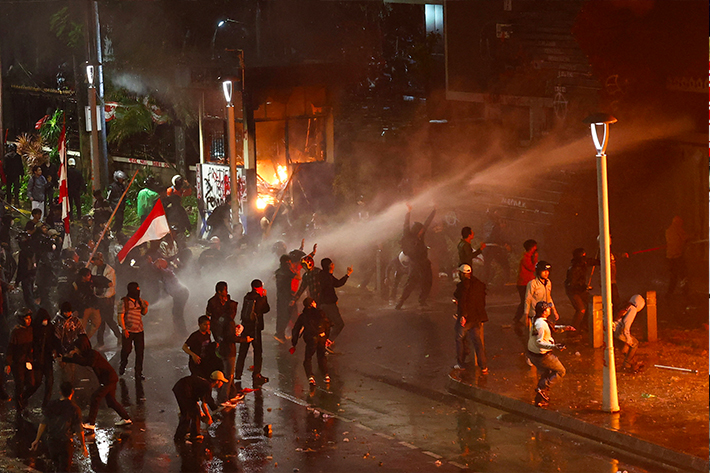
The recent wave of anti-government protests and subsequent unrest in Indonesia presents a significant new layer of political risk for investors monitoring Southeast Asian markets. President Prabowo Subianto’s swift action to curb lawmaker benefits and his firm directive against rioters signal an immediate attempt to stabilize the situation. However, the underlying grievances and the scale of the violence, which included the ransacking of state buildings and private residences, underscore a fragility that warrants close attention from those with exposure to the region’s energy sector. For oil and gas investors, this domestic turmoil, while not directly impacting global crude supply, adds to a complex tapestry of geopolitical and economic factors shaping market dynamics.
Geopolitical Instability Weighs on Southeast Asian Investment Climate
Indonesia, a key member of the G20 and a significant regional economy, is currently grappling with its most severe political challenge in years. Last week’s demonstrations, initially sparked by claims of excessive parliamentary allowances and escalating to widespread rioting following a fatal incident involving a motorcycle rideshare driver, have deeply shaken investor confidence. President Prabowo Subianto’s announcement on Sunday, outlining cuts to lawmaker perks and a moratorium on overseas work trips, was a direct response aimed at quelling the unrest. However, the violence, which saw homes of political figures like Finance Minister Sri Mulyani Indrawati targeted and state buildings set ablaze, has triggered a steep selloff in local stock and currency markets. The deployment of military personnel to guard the Presidential Palace and other key government installations, coupled with the President’s cancelled high-profile trip to China, highlights the gravity of the situation. While student groups have not yet called off further planned protests for Monday, the government’s strong stance against what it labels “terrorism and treason” suggests a potentially prolonged period of heightened internal security measures. This environment naturally elevates the risk premium associated with Indonesian assets, including its burgeoning energy sector, and could lead to delays or re-evaluations of foreign direct investment in exploration and production.
Crude Markets React to Global Headwinds and Regional Shocks
The political turbulence in Indonesia arrives at a time when global crude markets are already experiencing significant volatility. Our proprietary market snapshot reveals a pronounced downward pressure on prices today. Brent Crude currently trades at $90.38 per barrel, marking a sharp 9.07% decline from its previous close and moving significantly lower from its intraday high of $98.97. Similarly, WTI Crude has seen a substantial drop, settling at $82.59 per barrel, down 9.41% within the current trading session. This daily decline extends a broader trend observed over the past two weeks, where Brent crude has fallen from $112.78 on March 30th to $91.87 just yesterday, April 17th, representing an 18.5% erosion of value. While Indonesia is a net importer of crude and its internal stability does not directly threaten global supply lines in the same way a disruption in a major producer might, the widespread unrest in a G20 economy contributes to a general risk-off sentiment. Such geopolitical uncertainty can exacerbate market anxieties, particularly when coupled with other macroeconomic concerns, influencing overall commodity demand forecasts and investor appetite for risk assets across the energy complex.
OPEC+ Decisions and Inventory Data: Crucial Catalysts Amidst Uncertainty
Amidst regional flashpoints like Indonesia, the global energy market’s primary focus remains on fundamental supply and demand drivers, heavily influenced by key scheduled events. This weekend marks a critical juncture with the OPEC+ Joint Ministerial Monitoring Committee (JMMC) meeting today, April 18th, followed by the full Ministerial Meeting tomorrow, April 19th. These gatherings are paramount for establishing future production quotas, directly addressing questions from our readership about current OPEC+ output levels. Any decisions to adjust supply will have an immediate and profound impact on crude prices, potentially overshadowing localized geopolitical risks. Furthermore, our calendar highlights the recurring importance of weekly inventory data from both the API (April 21st, April 28th) and the EIA (April 22nd, April 29th). These reports offer vital insights into crude and product stock levels, acting as real-time barometers of demand health in major consuming economies. Combined with the bi-weekly Baker Hughes Rig Count (April 24th, May 1st), which provides a proxy for future production activity, these upcoming data releases will serve as crucial catalysts, shaping investor sentiment and price direction far more directly than regional political instability in the near term.
Navigating Investor Concerns: Beyond Short-Term Volatility
The current market environment, characterized by sharp price fluctuations and persistent geopolitical risks, naturally fuels investor apprehension. Our proprietary reader intent data reflects this uncertainty, with a significant number of inquiries focusing on long-term price predictions, such as “what do you predict the price of oil per barrel will be by end of 2026?” This question underscores the challenge of forecasting in a world where factors like Indonesian political stability, OPEC+ policy, and global economic growth constantly shift. While the unrest in Jakarta may not derail the broader trajectory of crude prices, it adds to the overall risk premium assigned to emerging markets and can impact the operational environment for international energy companies with regional interests. For example, the performance of companies like Repsol, which readers are asking about for April 2026, can be indirectly affected by the general investment climate in Southeast Asia. Investors must therefore adopt a multi-faceted risk assessment approach, balancing the immediate impacts of political instability with the overriding influence of global supply-demand dynamics and the strategic decisions from major producers. Prudent portfolio management in this climate demands a keen eye on both micro-level regional events and macro-level market fundamentals.