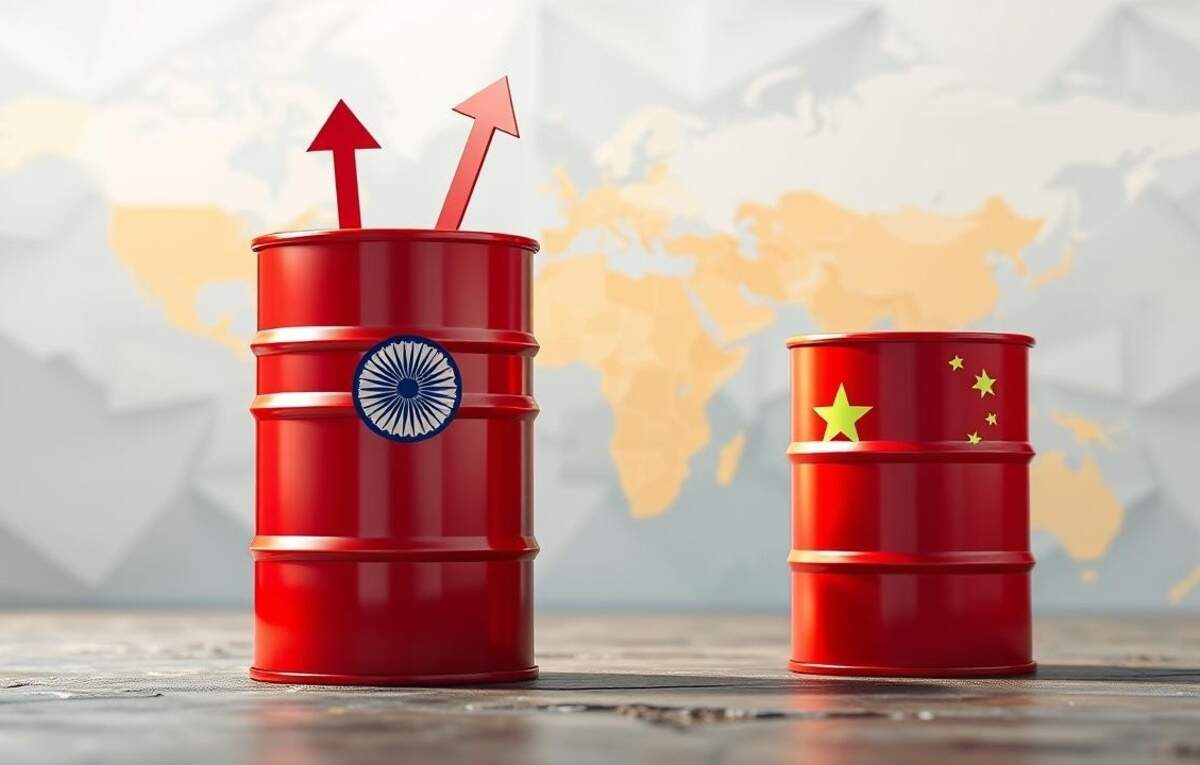
The global energy landscape is undergoing a significant transformation, with projections indicating a fundamental shift in the primary engine of oil demand growth over the coming decade. For years, China has been the undisputed leader, driving a substantial portion of the world’s incremental crude consumption. However, our analysis, reinforced by recent market intelligence, points to India emerging as the new frontrunner, poised to outpace China in oil demand expansion. This pivot presents both opportunities and challenges for global energy markets, national oil companies (NOCs), and investors navigating an increasingly complex geopolitical and economic environment.
India: The Next Decade’s Demand Powerhouse
India is on track to become the dominant force in global oil demand growth, projected to maintain an impressive annual growth rate of 3-5% over the next 3-5 years. This contrasts sharply with China, where crude oil consumption is anticipated to peak within the same timeframe. The underlying drivers for this divergence are clear: India’s robust economic expansion and industrialization are fueling increasing energy needs, while China faces a maturing economy and an accelerating transition towards new energy vehicles (NEVs). As a result, India’s reliance on oil imports is set to intensify significantly, especially if domestic production cannot stem its current decline. This escalating import dependency will place India firmly at the center of global energy security discussions and strategic supply considerations, making it a critical watch for investors.
Divergent Strategies for Asian National Oil Companies
The strategic priorities and operational capabilities of national oil companies in these two Asian giants reflect their differing demand trajectories and national objectives. Chinese NOCs are expected to maintain their lead in production growth over their Indian counterparts for the next 3-5 years. This advantage stems from substantial investments in complex shale gas and offshore projects, bolstering their reserves and enhancing self-sufficiency. Furthermore, Chinese NOCs benefit from greater value chain integration, which provides a buffer against earnings volatility, coupled with lower leverage and higher interest coverage. Their investment focus remains heavily on exploration and development to secure domestic supply, although downstream refining and petrochemical investments are gradually tapering off as most major projects reach completion.
Conversely, Indian NOCs contend with challenges posed by aging wells and a slower pace of investment in upstream activities. While there are plans to boost domestic oil and gas production, the execution remains a key variable. Their primary investment thrust over the next five years will be directed towards expanding refining and petrochemical facilities. This strategic focus is essential to meet India’s surging domestic demand for refined products, ensuring supply stability in a market increasingly dependent on imports. For investors, understanding these distinct investment cycles and operational headwinds is crucial when evaluating the long-term prospects of these regional energy giants.
Market Dynamics and Investor Sentiment Amid Shifting Demand
The projected shift in demand leadership comes at a dynamic time for global energy markets. As of today, Brent Crude trades at $96.06, marking a 1.34% gain, while WTI sits at $92.46, up 1.29%. This uptick reflects ongoing market tightness and geopolitical premiums. However, the recent 14-day trend saw Brent dip from $102.22 on March 25th to $93.22 by April 14th, illustrating the inherent volatility that investors must navigate. Many investors are currently asking for a base-case Brent price forecast for the next quarter, and India’s robust demand growth provides a strong foundational support, potentially offsetting some of the downside risks from a slowing China or increased non-OPEC+ supply.
Our proprietary reader intent data reveals a keen interest in understanding the broader implications of Asian demand trends, including inquiries about Chinese ‘tea-pot’ refinery run rates and consensus 2026 Brent forecasts. While China’s refining sector will still be significant, the long-term investment trajectory suggests a gradual decline in new capacity, whereas India’s expansion plans will dominate the downstream narrative. This evolving demand landscape, coupled with current price levels, suggests continued robust margins for refiners capable of meeting India’s product needs, while upstream players will benefit from sustained crude demand, albeit with an increasing focus on the reliability of supply chains to India.
Policy, ESG, and Upcoming Catalysts
Government policies play a pivotal role in shaping the operational environment for NOCs in both countries. China’s policies are increasingly market-oriented, yet both nations prioritize price stability and adequate supply. In India, however, policy mechanisms have historically led to more pronounced swings in earnings and cash flows for companies, as the nation relies heavily on taxes and dividends from its petroleum sector to bolster its fiscal budget. This can introduce a higher degree of financial volatility for Indian energy companies, a factor savvy investors must consider.
Furthermore, the pressure to transition to green energy solutions differs significantly. Chinese NOCs face stricter carbon regulations and a more immediate imperative to invest in green technologies. In contrast, India’s carbon regulation framework is still developing, affording Indian NOCs a comparatively less immediate pressure to pivot away from traditional fossil fuel investments. This disparity in ESG pressures will influence capital allocation and long-term valuation.
Looking ahead, several upcoming calendar events will provide critical insights into supply-side dynamics that will interact with India’s surging demand. The OPEC+ Joint Ministerial Monitoring Committee (JMMC) meeting on April 18th, followed by the Full Ministerial meeting on April 20th, will be crucial in determining global crude supply levels. Any decision on production quotas will directly impact the price stability and import bills for nations like India. Additionally, the Baker Hughes Rig Count reports on April 17th and 24th, alongside the API and EIA Weekly Petroleum Status Reports on April 21st, 22nd, 28th, and 29th, will offer granular data on North American production and inventory levels. These short-term indicators will provide valuable context for investors building their long-term strategies around India’s ascent as the new growth engine of global oil demand.


