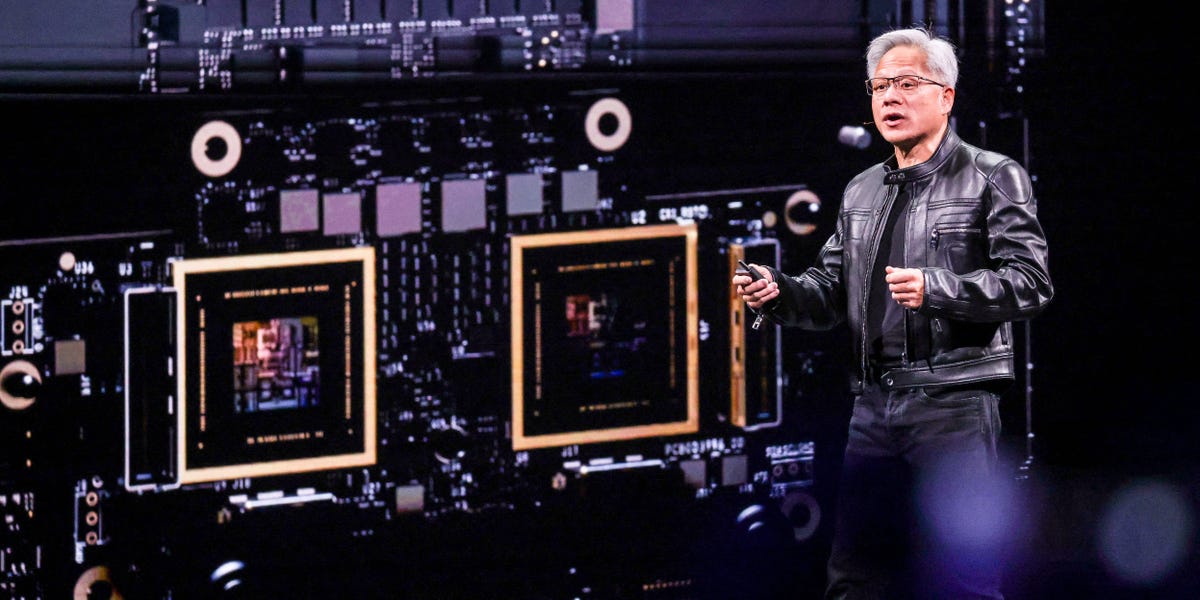
The burgeoning artificial intelligence revolution, spearheaded by breakthroughs from technology giants and innovative research firms, is poised to dramatically reshape global energy demand, creating a compelling new narrative for investors in the oil and gas sector. Nvidia CEO Jensen Huang, a prominent voice in the AI landscape, has unequivocally stated that the world will require “enormous amounts of energy” to power the AI factories of tomorrow, projecting an “exponential” surge in energy consumption over the next five years. This declaration underscores a critical intersection between cutting-edge technology and foundational energy resources, signaling potentially robust long-term demand for traditional and novel power sources.
The AI Energy Imperative
Huang’s insights come amidst a period of intense innovation and market speculation within the AI sphere. He recently lauded the Chinese AI model DeepSeek R1 for its significant contributions to AI research, acknowledging its “real impact” on the development of inference and reasoning capabilities. This praise is particularly notable given the market’s initial reaction to DeepSeek’s emergence; Nvidia’s stock experienced a sharp decline in January during a broader “DeepSeek selloff.” However, Huang firmly believes that investors misjudged the situation, emphasizing the model’s technical prowess and its potential to push the boundaries of artificial intelligence.
DeepSeek R1 demonstrated remarkable performance, notably outperforming established models like GPT-3.5 and Llama 2 in certain benchmarks. While GPT-3.5 achieved a 70.0 score on the challenging Massive Multitask Language Understanding (MMLU) benchmark and Llama 2 scored 68.9, DeepSeek R1 secured a competitive 66.8. Beyond raw scores, its promising results in reasoning capabilities highlight the rapid advancements occurring across the AI ecosystem. These developments, while exciting from a technological standpoint, carry profound implications for energy infrastructure and resource allocation globally.
The sheer scale of AI’s projected energy appetite is staggering. Huang has previously indicated that artificial intelligence will necessitate “trillions of dollars” in new data centers and supporting infrastructure. This isn’t merely a theoretical projection; the International Energy Agency (IEA) has issued a stark forecast, estimating that AI data centers could consume a colossal 1,000 terawatt-hours of electricity by 2026. To put this into perspective, this figure is double the consumption levels observed in 2022 and roughly equivalent to the total electricity consumption of an entire industrialized nation like Japan. Such an unprecedented increase in demand presents both challenges and unparalleled opportunities for energy producers and related industries.
Innovative Solutions for Powering AI
Addressing this looming energy crunch requires innovative thinking, and Huang himself has proposed solutions that could further intersect with traditional energy markets. He advocates for the use of generative AI to enhance the efficiency of energy generation, storage, and transmission, effectively using “artificial intelligence to make intelligence” in the energy sector. Furthermore, he points to advanced energy solutions such as “fusion power” and “advanced forms of geothermal energy” as vital components of a future energy mix capable of sustaining AI’s growth. While these advanced technologies mature, conventional energy sources, including oil and natural gas, will remain indispensable in bridging the gap and ensuring reliable power supply for expanding AI operations.
The Broader Energy Market Context
This AI-driven energy imperative unfolds against a backdrop of already tightening global energy markets. Oil demand continues its upward trajectory, with projections indicating record consumption levels in 2024. The concerted efforts of OPEC+ to manage supply through production cuts have contributed to a tighter market, pushing crude oil prices higher. Brent crude, the international benchmark, has been trading robustly around $84.00 per barrel, while West Texas Intermediate (WTI), the U.S. benchmark, hovers near $79.90 per barrel. These price levels reflect a fundamental imbalance between robust demand and constrained supply, a situation that AI’s growing energy footprint is only likely to exacerbate.
The broader economic environment further complicates the energy outlook. Consumers are already contending with higher gasoline prices in many regions compared to a year ago, contributing to persistent inflationary pressures. The Federal Reserve’s ongoing deliberations on interest rates are closely watched, as their decisions significantly influence economic activity and, by extension, energy consumption patterns. Recent data from the U.S. Energy Information Administration (EIA) underscored the tight supply narrative, reporting a surprising decrease of 2.5 million barrels in U.S. crude inventories last week, contrary to analyst expectations of a 2 million barrel increase. Such inventory draws highlight the underlying strength of demand and the sensitivity of the market to supply disruptions.
Investment Implications for Energy Investors
Even as the AI revolution promises transformative advancements, vigilance remains paramount in the energy sector. Saudi Arabia’s energy minister, Prince Abdulaziz bin Salman, has repeatedly cautioned against complacency, citing a complex global economic landscape fraught with uncertainties. This warning resonates deeply when considering the dual impact of accelerating AI energy demand and existing geopolitical and economic volatilities. For investors, the convergence of AI’s insatiable energy needs with a fundamentally strong, yet supply-constrained, oil and gas market presents a compelling thesis for sustained investment. The sector is not merely a legacy industry but a crucial enabler of the digital future, positioned to benefit from the foundational energy requirements of the next technological frontier.


