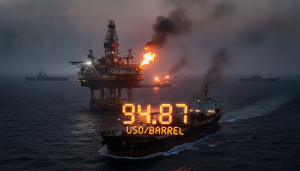
Trump Firm on Iran Blockade Amid Soaring Oil Prices and Escalating Geopolitical Tensions
President Donald Trump has unequivocally reiterated his administration’s commitment to maintaining a robust naval blockade on Iranian ports, a move that extends the high-stakes standoff over the strategically critical Strait of Hormuz. This unwavering stance, articulated amid a burgeoning global energy crisis, signals a prolonged period of market volatility for oil and gas investors.
The President confirmed the blockade will remain firmly in place until Tehran capitulates to U.S. demands regarding its nuclear program. Speaking recently, Trump characterized the naval operation as profoundly effective, stating it imposes immense economic pressure, a tactic he deems superior to military engagement in achieving U.S. objectives. He asserted that Iran is under severe strain, declaring its inability to develop nuclear weapons. Crucially, Trump reportedly rejected a recent Iranian proposal that would have seen the strait reopened in exchange for deferring nuclear negotiations, underscoring his demand for an immediate and comprehensive resolution.
The Geopolitical Chessboard: Iran’s Defiance and U.S. Pressure Tactics
At the heart of this complex impasse lies Iran’s insistence that it will neither recommence negotiations nor lift restrictions on transit through the Strait of Hormuz as long as the U.S. naval blockade persists. This creates a deeply entrenched stalemate, with both sides exhibiting resolute determination. The conflict, now subject to a ceasefire but having raged for over two months, has already sent seismic shocks across the Middle East and triggered a significant surge in global energy prices.
Meanwhile, the U.S. military command has reportedly prepared contingency plans for targeted, powerful strikes against Iranian assets. These potential actions aim to intensify pressure on the regime, highlighting the precarious balance between economic coercion and kinetic engagement. Such developments necessitate close monitoring by investors, as any escalation could dramatically alter market dynamics and risk profiles.
Market Reaction: Brent Crude Surges to $119, Storage Woes Loom for Iran
With the Strait of Hormuz effectively shut down for two months and no immediate signs of a resolution, the global oil markets continue their upward trajectory. Brent crude futures, a key international benchmark, have climbed substantially, trading around $119 a barrel in London. This significant price increase reflects a growing geopolitical risk premium embedded in energy commodity prices, a direct consequence of the supply uncertainty emanating from the Gulf region.
A pressing concern for global oil supply chain stability is Iran’s diminishing crude storage capacity. According to analytics firm Kpler, Iran has a critical window of only 12 to 22 days before it may be forced to initiate the highly damaging process of shutting down oil wells. Such a measure could inflict permanent harm on its production capabilities, presenting a potentially irreversible supply shock to an already constrained market. This tight timeline introduces a significant speculative element for energy traders and investors.
Tehran’s Response: Calls for Unity Amidst External Pressure
Iranian officials have shown no indication of yielding to U.S. pressure. Parliament Speaker Mohammad Bagher Ghalibaf, in a public statement, accused President Trump of actively attempting to fracture Iranian society through economic duress and internal divisions. Ghalibaf’s message, delivered to the Iranian populace, emphasized the paramount importance of national unity as the sole effective counter to external adversarial forces. This rhetoric underscores the deep ideological chasm between Washington and Tehran, complicating any potential de-escalation efforts.
President Trump has, in turn, frequently asserted that perceived divisions within the Iranian regime are impeding its decision-making processes. These claims are framed within a context where U.S. and Israeli operations have reportedly targeted and eliminated several high-ranking Iranian leaders, undoubtedly contributing to internal complexities within Tehran’s power structures.
White House Engages Industry: Navigating Sanctions and Consumer Impact
Recognizing the intricate economic ramifications of the blockade, the Trump administration recently convened a crucial meeting with prominent oil and trading industry executives. Representatives from major players such as Chevron Corp., Trafigura Group, Vitol Group, and Mercuria Energy Group Ltd. participated in these discussions. The primary agenda focused on strategies for sustaining the naval blockade on Iranian ports while concurrently minimizing any adverse impact on American consumers – a delicate balancing act for the administration.
Administration officials have repeatedly expressed optimism that oil and gasoline prices will eventually decline once the conflict concludes. However, the current upward trajectory of commodity prices weighs heavily on the administration, particularly with critical November midterm elections approaching. The Republican Party’s continued control of Congress hinges significantly on public sentiment, which is highly susceptible to fluctuations in consumer energy costs. A prolonged disruption to shipping through the Strait of Hormuz, inevitably tightening global oil supplies, is widely expected to propel prices even higher, escalating both economic and political stakes for investors and policymakers alike.