The AI Revolution’s Unseen Tailwind: Fueling a Hard Asset Supercycle
The global investment landscape is undergoing a profound transformation, driven by an unprecedented surge in AI-related capital expenditure. With estimates suggesting AI investments could rival the scale of the early-2000s internet buildout, approaching $1 trillion annually by 2027, the implications extend far beyond technology valuations. This isn’t merely a technological shift; it’s an inflationary supercycle that amplifies energy demand, metals consumption, and supply chain constraints simultaneously. For discerning investors, 2026 is shaping up to be a pivotal year where hard assets, particularly within the energy sector, emerge as primary beneficiaries of this structural rebalancing.
AI’s Insatiable Appetite: A Catalyst for Energy Demand
The narrative around AI often centers on semiconductors and software, yet the physical infrastructure required to power this revolution demands colossal amounts of energy and raw materials. Data centers, high-performance computing clusters, and the expanded electricity grids needed to support them are energy hogs. Each new AI model, every complex query, translates directly into increased power consumption. This dynamic is rapidly intensifying the existing tightness in energy markets, a situation exacerbated by years of significant underinvestment across the upstream oil and gas sector. As artificial intelligence integrates deeper into global industries, the collision between surging power requirements and constrained traditional energy supplies creates a fertile ground for a sustained upside squeeze in crude and related commodities. The question many investors are actively exploring, including “what do you predict the price of oil per barrel will be by end of 2026?”, underscores the urgency in understanding these long-term drivers beyond daily fluctuations.
Navigating Volatility: Current Market Snapshot and Underlying Strength
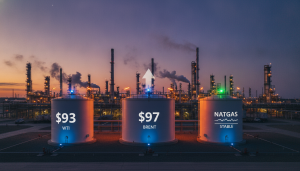
While the long-term outlook for hard assets remains compelling, market participants must always navigate short-term volatility. As of today, Brent Crude trades at $91.87 per barrel, reflecting a -7.57% drop within its day range of $86.08 to $98.97. Similarly, WTI Crude is at $84, down -7.86% from its day range of $78.97 to $90.34, with gasoline also seeing a daily decline to $2.95 per gallon. This recent intraday correction follows a notable downward trend over the past two weeks, where Brent shed $14, moving from $112.57 on March 27th to $98.57 on April 16th—a -12.4% decline. However, a deeper analysis reveals that such price movements, while significant in the moment, may obscure the powerful underlying currents. Years of capital starvation in exploration and production, coupled with the escalating energy demands of the AI build-out, suggest that any significant pullbacks could present strategic accumulation opportunities for investors focused on the bigger picture. The current market action, despite its daily negativity, must be viewed through the lens of a broader commodity renaissance that is only just beginning.
Upcoming Events and Investor Focus: Paving the Path Forward
The immediate future holds several critical events that will shape sentiment and provide further clarity on supply-demand dynamics. This Friday, April 17th, the OPEC+ Joint Ministerial Monitoring Committee (JMMC) convenes, followed by the full Ministerial Meeting on Saturday, April 18th. These meetings are particularly relevant given investor queries about “OPEC+ current production quotas” and their potential impact on market stability. Any adjustments to production policy or forward guidance will be scrutinized for their ability to balance market supply with growing global demand. Beyond OPEC+, the weekly API Crude Inventory report on April 21st and the EIA Weekly Petroleum Status Report on April 22nd will offer crucial insights into U.S. inventory levels, a key indicator of short-term supply-demand balances. These will be followed by further reports on April 28th and 29th, respectively. Furthermore, the Baker Hughes Rig Count, scheduled for April 24th and May 1st, provides a forward-looking gauge of drilling activity and potential future supply. Monitoring these events closely is essential for investors looking to position effectively in a market increasingly influenced by both geopolitical factors and unprecedented technological demand.
Beyond Crude: The Broader Hard Asset Thesis
While oil and gas are central to this narrative, the inflationary supercycle driven by AI extends across the entire hard asset complex. Gold has already demonstrated its resilience, with central bank accumulation, fiscal pressures, and geopolitical fragmentation pushing the yellow metal into a sustained price discovery phase, with institutional models outlining a credible path toward $6,000–$8,000. Silver, often overlooked, carries a unique dual-demand profile at the nexus of AI infrastructure, electrification, and solar expansion, suggesting its upside could surprise if the Gold-to-Silver ratio compresses meaningfully. Copper, often described as the “most mispriced asset of the decade” by several hedge funds, remains an acute pressure point. AI data centers, electric vehicles, and grid upgrades are draining inventories faster than global mining capacity can respond. This convergence of factors underscores that the commodity renaissance is not merely a cyclical phenomenon but a generational wealth transfer. In a K-shaped economic environment, capital flows inevitably gravitate towards scarcity, optionality, and real assets. For those positioned early, the current macro setup offers one of the most asymmetric opportunities in modern financial history. The window for strategic accumulation is closing, and history will not be kind to those who waited for consensus.