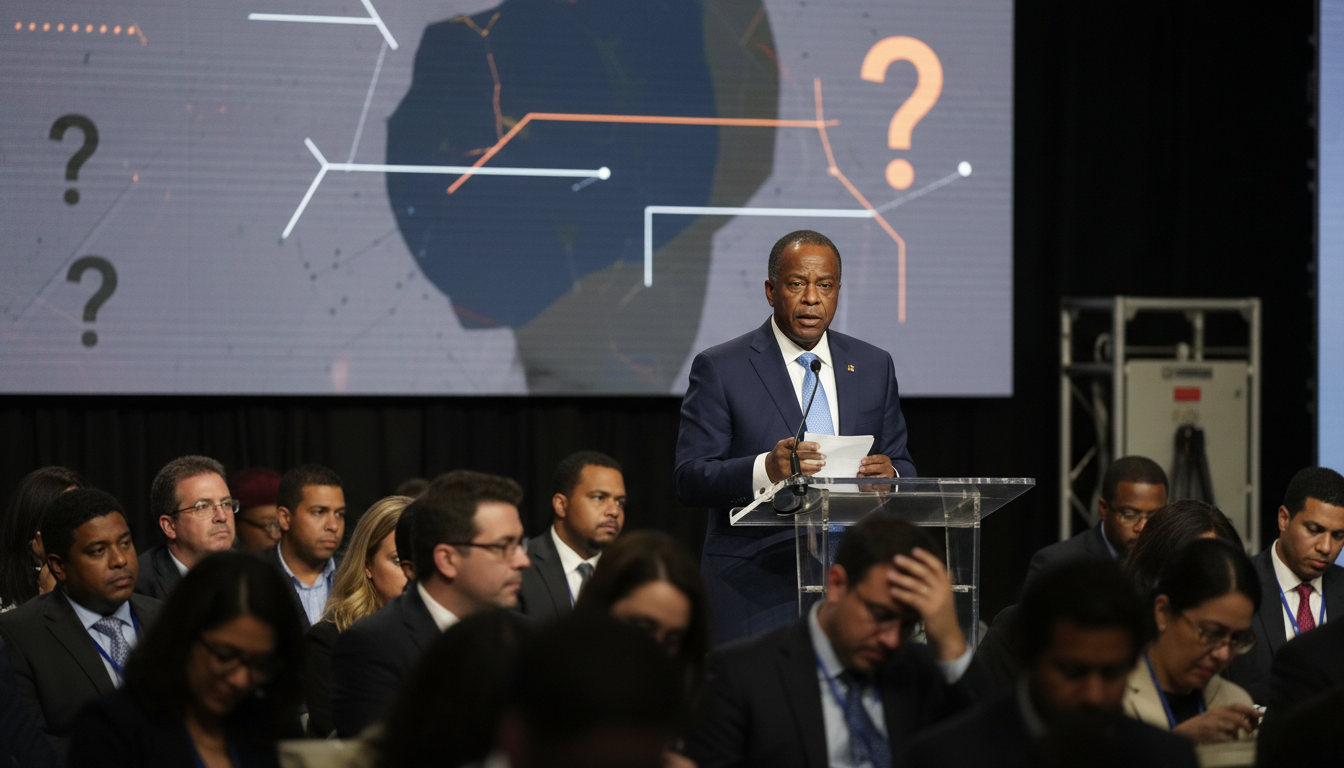
Guyana’s Energy Vision Takes Center Stage at OTC: A Divergent Narrative for Investors
The Offshore Technology Conference, now in its 58th annual gathering, commenced with an opening general session widely promoted as essential viewing. Headlining the event was Dr. Mohamed Irfaan Ali, President of Guyana, a nation rapidly asserting its position as a global hydrocarbon powerhouse. For astute investors keenly tracking the burgeoning South American oil frontier, expectations were undeniably high for an in-depth discourse on Guyana’s remarkable upstream successes. However, President Ali’s hour-long address largely sidestepped detailed insights into the very oil and gas developments that have captivated global markets, prompting a re-evaluation of the immediate investment takeaways.
Anticipation for a robust update on Guyana’s oil and gas sector was palpable among the estimated 800 to 1,000 attendees. With Guyana on an impressive trajectory to achieve 1.0 million barrels of oil per day (MMbopd) production in the near future, market participants were eager for granular details regarding project timelines, operational efficiencies, and future growth strategies. Yet, President Ali’s expansive remarks offered only fleeting references to these critical aspects of his nation’s economic engine, leaving many investors seeking more specific guidance on the country’s hydrocarbon future.
Guyana’s Oil & Gas Growth: Brief Mentions Amidst Broader Themes
Despite the high-level focus on diverse topics, President Ali did briefly acknowledge significant milestones in Guyana’s burgeoning oil industry. He confirmed that the Yellowtail field successfully initiated production last August, contributing to the country’s escalating output. Furthermore, he highlighted that Uaru, positioned as the fifth major development within the prolific Stabroek Block, remains on schedule to commence production later this year. These developments are central to Guyana’s ascendancy, underpinning its projected output increase and solidifying the Stabroek Block’s reputation as one of the world’s most valuable deepwater assets. Importantly, President Ali also articulated Guyana’s strategic position on the global energy transition, asserting that the shift towards renewable energy does not pose an “existential threat” to the nation’s substantial hydrocarbon reserves and production targets. This stance offers a degree of reassurance to investors concerned about the long-term viability of fossil fuel projects in a decarbonizing world.
Navigating the Global Energy Transition: A Call for Systemic Change
A substantial portion of President Ali’s speech pivoted to the broader topic of the energy transition, framing it within the context of a pervasive “energy gap” impacting global supply. He contended that transitioning from traditional fossil fuels to a predominantly renewable energy matrix transcends a simple substitution of power sources. Instead, he advocated for a comprehensive, systemic overhaul of global energy infrastructure, encompassing everything from electrical grids to transportation networks. Crucially, his vision acknowledged the imperative to develop these new renewable-fueled systems while simultaneously maintaining, and potentially expanding, the strategic utilization of existing fossil fuel resources. This balanced perspective suggests Guyana’s pragmatic approach to energy security and economic development, seeking to leverage its newfound oil wealth while contributing to a future energy landscape.
Strategic Capital Reallocation for a “Global Energy Balance”
President Ali further expanded his address to include a compelling appeal for a fundamental reallocation of global financial priorities. He urged for greater strategic investments in developing nations that have historically suffered from underfunding in energy initiatives. This call to action, reiterated several times throughout his speech, centered on achieving what he termed a “global energy balance.” From an investor’s vantage point, this represents a potential opening for new capital deployment into emerging energy markets, particularly in countries where rising demand necessitates robust infrastructure development and diversified energy portfolios. Such a shift in financing paradigms could unlock substantial new opportunities for patient capital willing to back long-term growth in underserved regions.
Beyond Hydrocarbons: Exploring Rare Earth Minerals and Broader Resource Strategy
In a notable digression from conventional oil and gas themes, President Ali delved into the critical importance of expanding mining operations and advancing extraction technologies for rare earth minerals. He specifically referenced the surging demand for crucial elements like lithium and cobalt, indispensable components for the manufacturing of renewable energy technologies. This discussion, though seemingly tangential, reinforced his overarching concept of a “global energy balance,” positioning Guyana not just as an oil and gas player but potentially as a broader resource provider in the global energy ecosystem. For investors, this signals a potential diversification in Guyana’s economic strategy and a recognition of the increasing strategic value of mineral resources in the new energy economy.
Conference Context: Industry Perspectives and Houston’s Role
The OTC opening session commenced with remarks from OTC Chair Dan McConnell, who set the stage for what he characterized as a particularly significant conference. McConnell underscored the confluence of rapid technological advancements within the industry, ongoing geopolitical tensions in the Middle East, and dynamic global market conditions as key factors shaping current discussions. Following McConnell, Houston Mayor John Whitmire took the podium, extending a strong message of collaboration between the city and the energy industry. He highlighted Houston’s stable political environment and relative freedom from urban strife, positioning the city as an attractive hub for oil and gas professionals and companies. The introduction of President Ali was handled by Robert “Clay” Neff, President of Upstream at Chevron Corporation. Neff’s remarks underscored Chevron’s substantial strategic investment and critical stakeholder role in Guyana’s deepwater offshore play, emphasizing the continued success achieved by Chevron and its partners in the region. These collective opening statements provided a crucial backdrop, underscoring the broader industry sentiment and the foundational importance of strategic partnerships for major oil and gas developments globally, particularly in high-growth regions like Guyana.