The commodities market is buzzing, with gold leading an impressive rally, surging more than 45% year-to-date. This unprecedented ascent, driven by a weakening dollar, anticipated Federal Reserve rate cuts, and robust institutional demand, is signaling a broader shift. While gold captures headlines with analysts now deeming a $5,000 price target not just plausible but increasingly probable, astute investors on OilMarketCap.com must consider the implications for the wider commodity complex. Specifically, this gold-led charge suggests a powerful tailwind could be forming for energy markets, even as crude prices navigate their own distinct dynamics.
Macro Forces Paving the Way for Commodities
The primary catalyst for gold’s remarkable performance is the evolving monetary policy landscape. The Federal Reserve appears poised to inject significant liquidity into the financial system, with market participants currently pricing in a 90% probability of a rate cut in October and a 65% chance of an additional move in December. This dovish pivot is further supported by projections from the OECD, which sees scope for at least three more cuts, potentially bringing policy rates down to the 3.25–3.5% range by spring 2026, even as U.S. economic growth cools from 1.8% next year to 1.5% the year after. Lower interest rates typically weaken the dollar, making dollar-denominated commodities more affordable for international buyers, and simultaneously diminish the appeal of fixed-income assets, pushing capital towards inflation hedges like gold and, by extension, other tangible assets. This macro backdrop creates a fertile ground for a broader commodity resurgence.
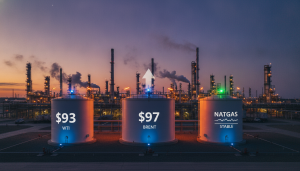
However, the energy sector is currently experiencing its own, more immediate pressures. As of today, Brent Crude trades at $90.38, down a significant 9.07% for the day, with an intra-day range between $86.08 and $98.97. Similarly, WTI Crude stands at $82.59, marking a 9.41% decline, fluctuating between $78.97 and $90.34. This recent volatility follows a notable downtrend for Brent, which has fallen by nearly 20% from $112.78 just two weeks ago to its current level. Gasoline prices have also seen a dip, currently at $2.93, down 5.18%. This divergence between gold’s strength and crude’s recent dip raises a critical question for energy investors: Is this a temporary correction, or does it signal a decoupling? We believe this short-term softness in crude could represent a strategic entry point, particularly if the broader “Commodities Supercycle 2.0” narrative gains traction.
Supercycle 2.0: Gold’s Signal for Energy
The concept of a “Commodities Supercycle 2.0” is gaining significant traction among analysts, with gold explicitly identified as the “flagship trade.” This thesis posits that we are at the early stages of a multi-year bull market across raw materials, echoing the powerful commodity booms of the past, such as the 1976–1980 period when gold quadrupled in value. For the energy sector, this supercycle implies that while gold benefits from central bank hoarding and financial demand, crude oil, natural gas, and refined products could see their own demand-supply imbalances exacerbated. Factors like underinvestment in new production, geopolitical tensions, and the energy transition’s complex demands all contribute to a tightening supply outlook for traditional energy sources.
Investors are clearly focused on these long-term dynamics. Our proprietary data indicates a strong interest in questions surrounding future oil prices, with many readers asking “what do you predict the price of oil per barrel will be by end of 2026?” This reflects an understanding that current market fluctuations are part of a larger trend. The comparison with historical supercycles suggests that even with short-term demand concerns, persistent supply deficits and the sheer scale of global energy consumption could drive significant gains for oil. The gold market, with its surging institutional demand and widening supply deficits, offers a potent template for how capital can flow into commodities when macro conditions align.
Upcoming Events to Watch in the Energy Market
While the long-term supercycle narrative unfolds, several near-term events will shape the immediate trajectory of oil and gas prices. The most significant of these is the upcoming OPEC+ Ministerial Meeting scheduled for April 19th. This gathering will be crucial in determining the collective production quotas, a topic that frequently surfaces in our reader queries, specifically “What are OPEC+ current production quotas?”. Any adjustments to output levels, or even strong signals from key producers regarding future supply policy, could significantly impact market sentiment and price action, especially in light of the recent crude price declines.
Beyond OPEC+, investors should closely monitor weekly inventory data. The API Weekly Crude Inventory reports on April 21st and April 28th, followed by the EIA Weekly Petroleum Status Reports on April 22nd and April 29th, will provide critical insights into U.S. supply and demand balances. Unexpected builds or draws in crude and product inventories can trigger rapid price movements. Furthermore, the Baker Hughes Rig Count, released on April 24th and May 1st, offers a barometer for future domestic production activity. These events, occurring within the next 14 days, are pivotal for assessing whether the current dip in crude prices is fundamentally justified or merely a temporary deviation from the broader commodity tailwind. For investors tracking specific companies, understanding these macro and micro catalysts is vital; for instance, the question of “How well do you think Repsol will end in April 2026” underscores the need to connect these broader market movements to individual equity performance.
Connecting Gold’s Momentum to Energy Equities
The accelerating gold bull market, fueled by expectations of lower rates and a weaker dollar, doesn’t just impact physical commodities; it also has profound implications for energy equities. A generalized commodity supercycle suggests that the valuation multiples for oil and gas producers could expand, as their underlying assets become more valuable. Lower interest rates, as projected by the OECD, also mean reduced borrowing costs for energy companies, potentially easing the burden of debt and making capital expenditures more attractive. This environment could allow companies to maintain or even increase production, or to return more capital to shareholders, even amidst a slowing global growth backdrop.
For investors, the recent dip in crude prices, coupled with the robust performance of gold, presents a unique opportunity to re-evaluate exposure to the energy sector. If gold is indeed signaling a broader commodity re-rating, then the current valuations of many oil and gas companies might not fully reflect the impending tailwinds. We encourage investors to look beyond the immediate price fluctuations and consider the confluence of macro-economic drivers, supply-side constraints, and the potential for a sustained commodity upcycle. The smart money is increasingly looking at the bigger picture, positioning for an environment where hard assets outperform, and energy is poised to be a key beneficiary.