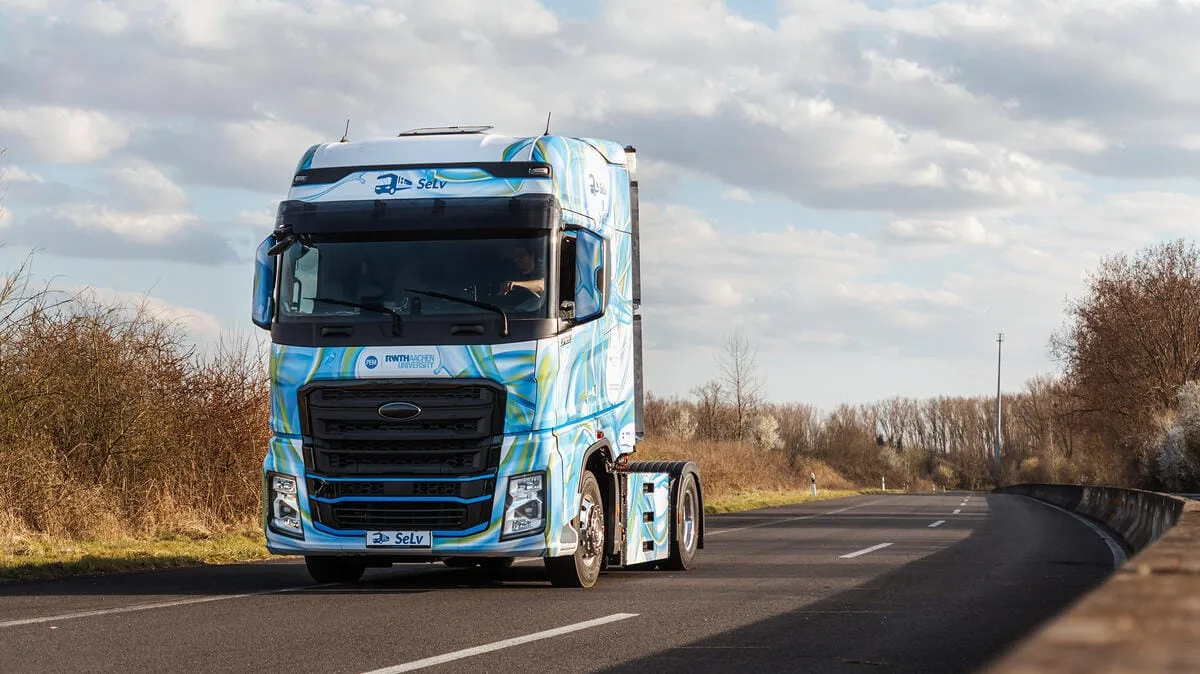
The energy landscape is in constant flux, but few sectors face as profound a transformation as heavy-duty transport. As global decarbonization efforts intensify, the spotlight is increasingly turning to alternatives for diesel-powered trucks, a critical segment responsible for a significant portion of transportation-related emissions. A recent development out of Germany signals a tangible step forward in this transition: a fuel cell truck prototype, developed by the Chair of Production Engineering of E-Mobility Components (PEM) at RWTH Aachen University, has received official road approval. This milestone, while localized, carries significant implications for oil and gas investors, hinting at long-term shifts in demand dynamics and opening new avenues for strategic investment in the burgeoning hydrogen economy.
Hydrogen Gains Traction in Heavy Transport: A Glimpse into Future Demand
The road approval of RWTH Aachen University’s modular fuel cell drive system for trucks marks a crucial point in the viability of hydrogen as a heavy-duty fuel. This prototype, developed under the federally funded SeLV research project since 2021, integrates a fuel cell with an electric drive, offering a flexible powertrain that can be configured for various uses, including retrofitting existing commercial fleets. The researchers emphasize the inherent advantages of fuel cells for heavy-duty applications: their high energy requirements allow for optimal exploitation of fuel cells’ technological benefits, particularly long range and high payload capacity, addressing key limitations of battery-electric alternatives for long-haul operations.
This development is not merely an academic exercise; it directly addresses the imperative to decarbonize heavy goods transport, a sector that contributes substantially to greenhouse gas emissions. In Germany alone, approximately 20% of greenhouse gases stem from the traffic and transport sector, with trucks and vans accounting for a significant 35% of that figure. As the prototype gears up for real-world testing following its exhibition at the NUFAM trade fair in Karlsruhe from September 25 to 28, investors should recognize this as a tangible step towards displacing conventional fossil fuels in a high-demand segment. The ability to bring innovative research prototypes to practical suitability and potentially series production in a relatively short period, as highlighted by PEM Director Professor Achim Kampker, underscores the accelerating pace of energy transition technologies and the competitive pressures they will exert on traditional energy sources.
Current Market Headwinds and the Long-Term Hydrogen Play
While hydrogen fuel cell technology makes incremental progress, the broader energy market continues to grapple with volatility that influences investment decisions across the board. As of today, Brent Crude trades at $90.38 per barrel, marking a substantial 9.07% decline within the day, with WTI Crude mirroring this trend at $82.59 per barrel, down 9.41%. Gasoline prices have also seen a notable dip to $2.93, a 5.18% decrease. This daily snapshot follows a broader trend, with Brent having fallen from $112.78 on March 30 to $91.87 just yesterday, representing an 18.5% drop over the past two weeks.
Such market swings naturally draw investor attention to immediate supply-demand dynamics and geopolitical factors. However, for sophisticated oil and gas investors, these short-term fluctuations should not overshadow the long-term structural shifts driven by advancements like the RWTH Aachen fuel cell truck. While lower crude prices might temporarily reduce the economic incentive for some to switch to alternative fuels, the strategic imperative for decarbonization remains firm. Investment in hydrogen infrastructure and technology continues, propelled by regulatory mandates, corporate ESG goals, and the pursuit of energy independence. This dual reality means that while oil and gas companies navigate immediate price pressures, they must also strategically position themselves for a future where hydrogen-powered heavy transport, though nascent, will increasingly chip away at traditional fuel demand.
Upcoming Market Signals and Investor Outlook on Energy Transition
The intersection of immediate market dynamics and long-term energy transition plays out vividly in upcoming calendar events and the questions investors are actively posing. Our proprietary data indicates a strong focus on future price trajectories and the actions of key market players. For instance, many investors are asking about the predicted price of oil per barrel by the end of 2026 and OPEC+’s current production quotas. These questions underscore a fundamental tension: how will traditional supply management respond to the gradual, yet inevitable, erosion of demand from technologies like hydrogen fuel cells?
Upcoming events, such as the OPEC+ JMMC meeting on April 18 and the Full Ministerial meeting on April 19, are critical for understanding short-to-medium-term crude supply strategies. While these meetings will focus on immediate market balances, the long-term discussions within OPEC+ must increasingly account for the growing viability of alternative fuels in sectors like heavy transport. Similarly, the EIA Weekly Petroleum Status Reports on April 22 and April 29, along with API Weekly Crude Inventory data on April 21 and April 28, will provide crucial insights into current demand trends. Although these reports track traditional petroleum, astute investors are looking beyond the headlines to gauge the underlying resilience of demand in the face of accelerating energy transition efforts. The Baker Hughes Rig Count on April 24 and May 1 will also offer signals on future production capacity, further informing the supply side of the equation. For companies like Repsol, which some investors are keenly asking about, their ability to navigate this evolving landscape by diversifying into new energy vectors, including hydrogen, will be key to their performance and investor confidence in the coming years. The approval of the fuel cell truck, therefore, is not an isolated event but a data point reinforcing the long-term energy transition narrative that will increasingly influence these macro oil and gas dynamics.
Strategic Positioning in a Decarbonizing Transport Sector
For oil and gas investors, the road approval of the RWTH Aachen fuel cell truck serves as a potent reminder of the strategic imperative to adapt. While the immediate impact on global oil demand from a single prototype is negligible, its significance lies in validating a technology poised to disrupt a critical demand segment. Heavy-duty transport, with its challenging energy requirements, has historically been considered one of the harder-to-decarbonize sectors. The demonstrated progress in fuel cell technology for this application suggests that even these bastions of fossil fuel consumption are vulnerable to the energy transition.
This necessitates a two-pronged investment approach. On one hand, investors must continue to monitor the conventional oil and gas market with vigilance, understanding the interplay of OPEC+ decisions, inventory reports, and rig counts that drive short-term profitability. On the other hand, a forward-looking strategy demands an increased allocation to companies actively investing in the hydrogen value chain – from green hydrogen production to distribution infrastructure and the manufacturing of fuel cell components. Major oil and gas companies are already diversifying into hydrogen projects, recognizing it not as a threat, but as an opportunity to remain relevant in a decarbonized future. The RWTH Aachen truck’s journey from research prototype to road-approved vehicle underscores that the era of hydrogen-powered heavy transport is not a distant fantasy, but a rapidly approaching reality, shaping the long-term investment landscape for the entire energy sector.


