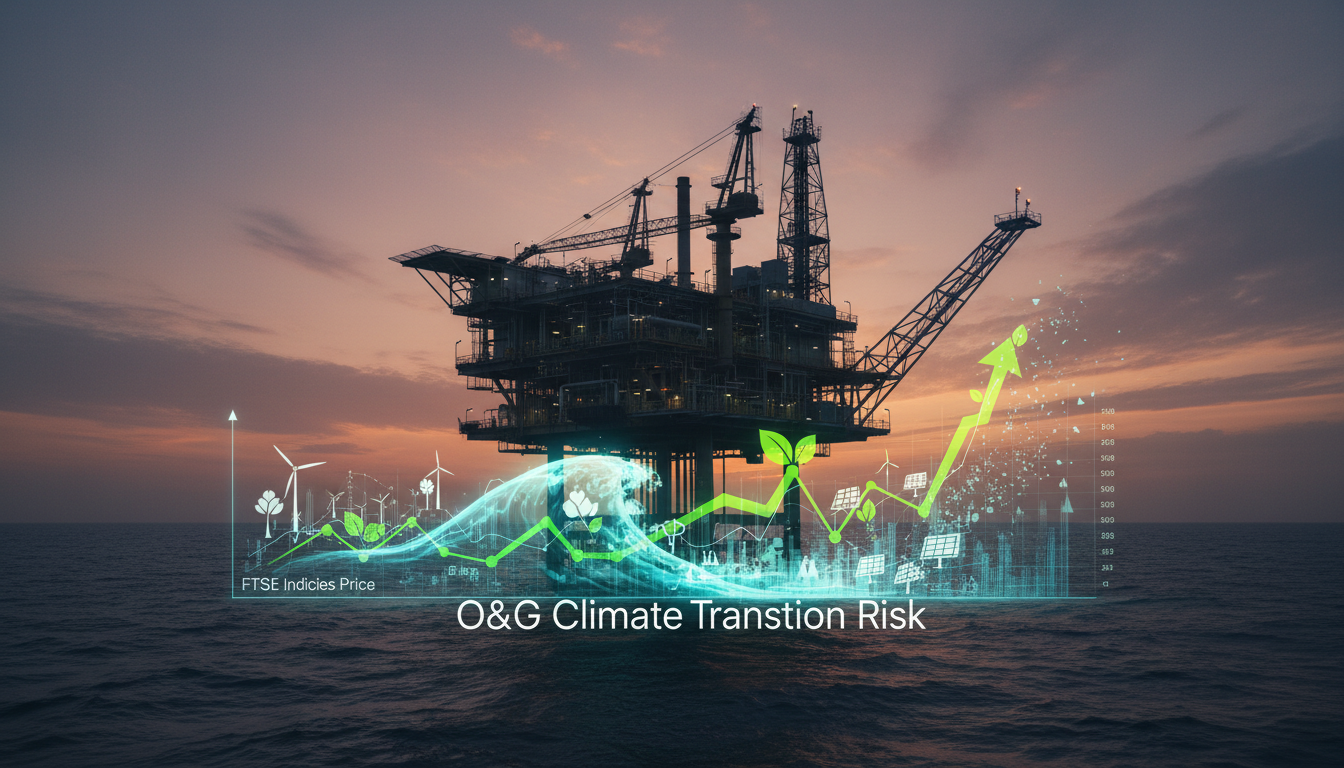
New Climate Risk Indices Set to Transform Energy Investor Strategies
A landmark collaboration between global index provider FTSE Russell and climate-risk analytics pioneer Planetrics is poised to fundamentally reshape how institutional investors, particularly those with substantial stakes in the energy sector, evaluate and mitigate climate-related financial risks. This strategic alliance, formalized through a Memorandum of Understanding, aims to introduce a new generation of climate-scenario based indices and sophisticated analytics, offering a critical lens into how physical climate shocks and the ongoing energy transition could impact investment portfolios.
In today’s volatile market, London-based FTSE Russell, a division of LSEG, and Planetrics, SLR’s specialized climate-risk analytics platform, recognize an urgent investor demand for more precise instruments. Traditional ESG screening often proves inadequate in forecasting the complex financial repercussions stemming from a rapidly changing climate and the accelerating shift towards a low-carbon economy. For investors in oil and gas, utilities, and other carbon-intensive industries, understanding future exposures to these evolving risks is not just a compliance exercise but a core component of sustainable capital allocation and long-term value preservation.
The Imperative for Advanced Climate Risk Assessment
The financial landscape is grappling with climate risk no longer as a peripheral environmental concern, but as a central driver of investment performance. Rising physical losses from extreme weather events, coupled with uneven global policy actions and sector-specific transition pressures, are increasingly influencing capital allocation decisions across all asset classes. For asset owners, insurers, banks, and fund managers deeply invested in the energy complex, the critical question has moved beyond mere disclosure to assessing portfolio resilience across a spectrum of potential climate futures. This partnership directly addresses that need, aiming to provide robust, transparent frameworks that empower investors to navigate these complex scenarios.
For energy investors, the stakes are exceptionally high. Climate considerations directly impact asset valuations, operational continuity, and future revenue streams within the oil and gas sector. The impending indices promise to offer tools that translate broad climate projections into actionable financial signals, allowing for more informed risk budgeting and strategic adjustments to portfolios that heavily rely on traditional energy sources.
Planetrics Delivers Granular Risk Modeling Capabilities
Under the terms of this crucial partnership, Planetrics will contribute its cutting-edge proprietary physical and transition climate risk analytics. These sophisticated modeling and scenario tools will form the bedrock for developing indices spanning diverse asset classes. The collaboration will meticulously address both the direct, tangible effects of a changing climate and the broader market implications of the global pivot towards a low-carbon economy.
Physical risks represent immediate threats, encompassing severe weather events, prolonged heat stress, pervasive flooding, and direct infrastructure damage. For the oil and gas industry, this translates to potential disruptions at extraction sites, damage to extensive pipeline networks, and vulnerability of coastal processing facilities. Transition risks, conversely, stem from policy, market, and technological shifts, including carbon pricing mechanisms, stringent new regulations, disruptive technological innovations in renewables, evolving energy demand patterns, and increasing operational cost pressures. These risks hold significant implications for the profitability and long-term viability of fossil fuel companies.
The inherent value for investors lies in converting these multifaceted risks into clear, actionable company-level and portfolio-level signals. Climate scenarios will illustrate how different sectors, particularly energy, may respond to drastic policy shifts, regional supply chain disruptions, or unforeseen cost shocks. This granular insight is indispensable for long-term capital planning, precise risk budgeting, and proactive corporate stewardship, especially for portfolios with deep exposure to energy and natural resource markets.
FTSE Russell to Oversee Governance and Market Distribution
The collaboration outlines a clear division of responsibilities: while both organizations will jointly craft the analytical frameworks and data inputs underpinning the new indices, FTSE Russell will assume responsibility for their governance and commercial distribution. Planetrics will continue to lend its extensive research expertise, deep market knowledge, and technical prowess to support the initiative.
FTSE Russell’s role in governance is paramount, given the increasing adoption of climate indices as benchmarks, critical risk assessment tools, and investment products. The integrity of index methodology, the quality of underlying data, and the robustness of scenario assumptions directly influence asset allocation decisions and portfolio construction strategies. Investors will closely scrutinize how these indices define climate pathways, weigh physical versus transition exposures, and account for sector-specific and regional variances. These methodological choices carry direct implications for which energy companies enter or exit a benchmark, how portfolio risk is interpreted, and how climate strategies are articulated to stakeholders.
Stephanie Maier, Head of Sustainable at FTSE Russell, emphasized the partnership’s alignment with market demands, stating that the collaboration underscores their commitment to innovation, developing transparent indices grounded in robust research, and ultimately empowering clients to invest effectively through the low-carbon transition. New indices are anticipated for launch later this year, promising to deliver critical new tools to the investment community.
From Climate Awareness to Actionable Pricing Mechanisms
This proposed collaboration marks a significant evolution within sustainable finance, shifting the focus of climate risk tools beyond mere disclosure support towards concrete pricing mechanisms, strategic allocation, and sophisticated portfolio construction. The era of simply acknowledging climate risk is giving way to a new imperative: pricing its financial implications.
Thomas Bremner Bligaard, Executive Director at Planetrics, part of SLR, highlighted this evolution, noting that their modeling captures a spectrum of plausible futures, encompassing both physical shocks and the uneven transitions expected across different regions and economic sectors. He explained that these models trace how costs, supply chains, and competitive positions evolve at a granular company level, translating into precise portfolio signals that facilitate superior allocation decisions and strengthen risk management frameworks. For investors in the energy sector, this level of detail offers an unprecedented opportunity to differentiate between companies that are truly resilient and those facing existential threats.
For executive leadership in the energy sector, this development signals a more rigorous investment environment. Companies will increasingly face assessment not solely on their emissions targets, but on their quantifiable exposure to climate shocks, potential regulatory changes, and projected transition costs. For discerning investors, the ultimate test for these advanced climate scenario tools lies in their ability to tangibly improve risk-adjusted decision-making without introducing opaque or overly complex benchmarks. Should these indices achieve widespread adoption, they possess the transformative potential to integrate climate analysis more deeply into mainstream portfolio construction, moving scenario-based risk from a reporting obligation to a fundamental financial discipline with profound global market implications for all energy investments.


