The financial markets are currently witnessing an extraordinary phenomenon: a gold rally of historic proportions that transcends mere momentum. As a senior analyst focused on energy investments, it’s imperative to dissect this macro signal, understanding its implications for crude oil, natural gas, and the broader commodity landscape. Gold’s relentless ascent often reflects deeper currents of inflation, geopolitical uncertainty, and shifts in monetary policy, creating a complex backdrop against which energy assets must be evaluated. This analysis delves into what this gold supercycle means for your energy portfolio, combining proprietary market data with forward-looking insights to help investors navigate these turbulent waters.
The Gold Supercycle: A Macro Signal for Energy
Gold has not just been rallying; it has entered an unprecedented supercycle, delivering consistent quarterly gains and shattering all-time highs with remarkable frequency. Since January 2025, the precious metal has logged an astounding 35 record closes in just nine months, averaging nearly one new peak every week. This isn’t a gradual climb; it’s a vertical breakout. Year-to-date, gold prices have soared by almost 40%, climbing from $2,672 an ounce in January to surpass $3,685 this week. Even more dramatically, gold has more than doubled in just two years, posting an astonishing 103% gain since October 2023 when it traded near $1,800 an ounce. This sustained strength, including nine consecutive quarters of record highs, signals a profound shift in investor sentiment – a flight to tangible assets often driven by concerns over currency devaluation, persistent inflation, or escalating global instability. For energy investors, this gold supercycle is a critical macro indicator, suggesting underlying economic pressures that could eventually bolster or challenge crude oil demand and pricing dynamics, depending on the specific drivers.
Current Energy Market Dynamics Amidst Gold’s Ascent
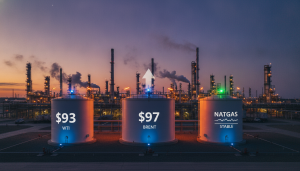
While gold stages its historic rally, the energy market presents a more nuanced picture. As of today, Brent crude trades at $98.36 per barrel, reflecting a 1.04% decline within its daily range of $97.92 to $98.67. WTI crude follows a similar trajectory, priced at $89.96 per barrel, down 1.33% today within its $89.57-$90.26 range. Gasoline prices, however, are holding relatively steady at $3.08 per gallon, down a modest 0.32% for the day. This recent softness in crude prices comes after a significant correction: Brent crude has shed approximately $14, or 12.4%, from its recent high of $112.57 observed on March 27th, just three weeks prior. This divergence between a surging gold market and a retreating oil market merits close attention. Is the energy sector merely undergoing a healthy correction after strong gains, or is it experiencing demand concerns amidst broader economic uncertainty that gold is reacting to differently? The interplay between inflation expectations, monetary policy signals, and actual crude demand will dictate whether this current dip is a buying opportunity or a signal of more significant headwinds ahead for energy.
Investor Focus: Navigating Supply, Demand, and Data Clarity
In an environment where macro signals like gold’s supercycle hint at deeper economic shifts, investors are naturally seeking clarity on fundamental drivers. Our proprietary reader intent data highlights a strong emphasis on understanding the bedrock of energy markets: supply management and reliable pricing information. Investors are actively inquiring about critical details such as OPEC+’s current production quotas and the methodologies powering our real-time Brent crude price data. This focus underscores a desire for concrete, verifiable information to anchor investment decisions amidst volatility. The stability offered by OPEC+’s production policy remains a pivotal factor in balancing global supply, directly influencing price floors and ceilings. As gold signals inflation concerns, the market’s reliance on disciplined supply management from major producers becomes even more pronounced. Furthermore, the persistent questions around data sources and models reflect a heightened demand for transparency and accuracy, essential for building robust investment theses in a rapidly evolving commodity landscape.
Forward Outlook: Key Events Shaping Energy’s Path
The coming fortnight is packed with pivotal events that will undoubtedly shape energy market sentiment and potentially realign crude prices with the broader commodity narrative signaled by gold. Investors should mark their calendars for the critical OPEC+ Joint Ministerial Monitoring Committee (JMMC) meeting on April 18th, swiftly followed by the full OPEC+ Ministerial Meeting on April 20th. These gatherings are paramount, as member nations will assess current market conditions, including the recent price correction, and determine future production quotas. Any decision to maintain current cuts, ease them, or even deepen them will send immediate ripples through the market. Parallel to OPEC+’s deliberations, the market will closely watch the weekly inventory reports: the API Crude Inventory on April 21st and 28th, and the EIA Weekly Petroleum Status Report on April 22nd and 29th. These provide crucial insights into U.S. demand and supply dynamics, offering a snapshot of actual consumption and stock levels. Additionally, the Baker Hughes Rig Count reports on April 17th and 24th will indicate future drilling activity, revealing whether U.S. producers are responding to current prices with increased or decreased exploration. These events, occurring against the backdrop of gold’s sustained strength, will be instrumental in determining whether the recent dip in crude is a transient blip or a more fundamental re-evaluation of energy’s trajectory within the unfolding supercycle.