Russia’s role as a pivotal global energy supplier is facing increasing headwinds, with recent data revealing a concerning stagnation in seaborne crude oil exports. Despite opportunities to boost output and a dynamic global market, Moscow’s ability to monetize its vast hydrocarbon resources appears constrained by a complex interplay of international sanctions, domestic demand, and sharply declining oil prices. For investors tracking the intricate balance of global supply and demand, understanding these underlying pressures is crucial, as Russia’s struggles reverberate through energy markets and influence strategic decisions by major producers.
The Export Conundrum Amidst Market Volatility
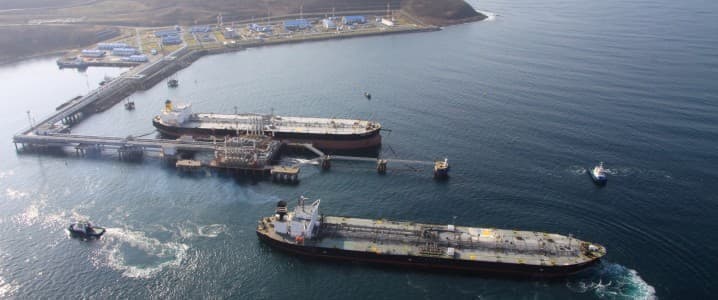
Recent tracking data highlights Russia’s seaborne crude exports holding near two-month lows through late June. In the four weeks leading up to June 29, crude exports averaged just 3.21 million barrels per day (bpd), a marginal 1% increase from the prior four-week period. Weekly volumes similarly hovered around 3 million bpd, showing little change. While major terminals like Primorsk and Kozmino managed to increase flows, declines from smaller ports, including Novorossiysk and Murmansk, effectively nullified these gains, resulting in an overall flat export trajectory. A total of 28 tankers carried 21 million barrels during the final week of June, only marginally down from the preceding week’s 21.89 million barrels.
This export stagnation has occurred against a backdrop of significant price volatility. As of today, Brent crude trades at $90.38 per barrel, marking a substantial 9.07% decline within the day, with WTI crude similarly pressured at $82.59, down 9.41%. This steep intraday fall follows a broader market downturn, with Brent having shed 18.5% from $112.78 just two weeks prior. This current market weakness, mirroring the earlier price slump, directly impacts the value of Russian export revenues. The gross value of Russia’s weekly crude exports plummeted 8% to $1.27 billion, reaching its lowest point in a month. The primary culprit was sharply lower prices for key Russian grades, with Urals crude dropping to around $58.50 per barrel and ESPO crude falling to $63.80. Even delivered prices to India slipped to $68.53, compressing the margins vital for Russia’s state budget.
Domestic Demand and OPEC+ Production Puzzles
A significant factor diverting crude away from export channels is Russia’s robust domestic refining activity. Refinery runs within the country have remained strong, averaging 5.33 million bpd in the first 25 days of June. This figure stands 130,000 bpd above last year’s levels for the same period, indicating a prioritized focus on meeting internal fuel demand and potentially reducing reliance on imported refined products. This internal consumption strategy, while supporting domestic needs, limits the crude available for international sales, thereby influencing global supply dynamics.
For investors frequently inquiring about OPEC+ production quotas, the Russian situation presents a compelling case study. Russia was cleared to boost its output by 100,000 bpd from March through June, with an additional 50,000 bpd bump slated to begin in July. Yet, these allocated quota increases have not translated into higher seaborne exports. This disconnect suggests several possibilities: either a deliberate diversion of crude to satisfy strong domestic refining demand, logistical bottlenecks impeding export capabilities, or challenges in finding willing international buyers at favorable prices given persistent market discounts on Russian oil. The sustained strong domestic runs mean that even if Russia were to increase its overall production, a significant portion might continue to be absorbed internally, impacting its ability to contribute meaningfully to global crude supply via exports.
Financial Strain and The Path Ahead
The combination of stagnant exports and lower prices has inflicted severe financial strain on Russia’s oil and gas sector. Rosstat data indicates that Russia’s oil and gas profits in Q1 2025 plunged 45% year-on-year to $9.9 billion. This trend continued into May, with oil and gas revenues down over 35% from a year earlier. In response to the persistent oil price crash, Moscow has been forced to cut its full-year oil and gas revenue forecast by a significant 24%. These figures underscore the acute pressure on the national budget, heavily reliant on hydrocarbon revenues.
This financial distress sets a critical backdrop for upcoming energy market events. The OPEC+ Joint Ministerial Monitoring Committee (JMMC) meeting this Saturday, April 18th, followed by the full Ministerial Meeting on Sunday, April 19th, will be closely scrutinized by investors. Given Russia’s evident inability to fully capitalize on prior quota increases and its dire revenue situation, Moscow will likely advocate for a strategy that prioritizes market stability and, ideally, price recovery. This could involve pushing for stricter adherence to current quotas by all members or even proposing further collective production cuts to buoy prices. Many of our readers are asking about the trajectory of oil prices, with a common question being, “What do you predict the price of oil per barrel will be by end of 2026?” The outcomes of these pivotal OPEC+ meetings, coupled with ongoing insights from weekly inventory reports from API (April 21st, 28th) and EIA (April 22nd, 29th), as well as Baker Hughes Rig Count updates (April 24th, May 1st), will provide crucial signals for the market. If OPEC+ maintains discipline and global demand holds firm, prices could find renewed support. However, Russia’s internal challenges and its constrained export capacity add another layer of complexity, potentially limiting its ability to fully participate in any coordinated supply adjustments. Investors should monitor these events closely for shifts in global supply-demand fundamentals, as they will dictate the future direction of oil and gas investing.


