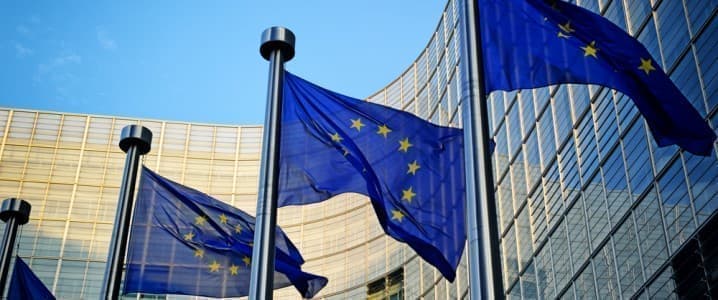
The European Union’s ambitious push for net-zero emissions is on a collision course with global energy giants, creating significant headwinds for international oil and gas investors. ExxonMobil CEO Darren Woods recently voiced strong criticism of the EU’s proposed Corporate Sustainability Due Diligence Directive, describing its potential penalties as “bone-crushing” and a severe threat to manufacturing and economic growth. This legislation, designed to enforce human rights and environmental standards across value chains, has ignited a fierce debate about the economic viability of Europe’s climate agenda and its broader implications for international trade. For investors navigating the complex energy landscape, understanding these regulatory risks is as crucial as monitoring market fundamentals and geopolitical shifts.
Brussels’ Regulatory Onslaught Challenges Global Energy
ExxonMobil’s leadership has been unequivocal in its condemnation of the EU’s climate legislation. CEO Darren Woods has characterized the Corporate Sustainability Due Diligence Directive as an unprecedented regulatory burden, citing its potential to impose fines of up to 5% of a company’s global revenue for non-compliance. Such penalties, he argues, could be financially devastating for any corporation, irrespective of its size. Woods’ concerns extend beyond the financial aspect, encompassing a broader critique that the EU’s “crusade” toward net-zero is actively “killing the manufacturing sector and frankly smothering economic growth,” driven by a perceived desire to eliminate oil and gas as an energy source. These sentiments echo those of U.S. Energy Secretary Chris Wright, who warned earlier this month that the EU’s rules significantly jeopardize the ability to implement the agreed-upon US-EU trade deal. The cumulative effect of these strictures, combined with potential “border taxes” or levies, is already prompting non-EU companies to consider withdrawing from the European market rather than facing prohibitive compliance costs. This environment signals a heightened regulatory risk for investors with exposure to international energy markets, necessitating close scrutiny of legislative developments in Brussels.
Market Dynamics Underpin Regulatory Impact
The timing of these regulatory challenges couldn’t be more critical, as global energy markets grapple with their own set of pressures. As of today, Brent crude trades at $98.17, marking a 1.23% decline within a day range of $97.92 to $98.67. Similarly, WTI crude is down 1.55% at $89.76, trading between $89.57 and $90.26. Gasoline prices reflect this market softness, currently at $3.08 per gallon, down 0.32% for the day. This immediate snapshot follows a more pronounced trend: Brent crude has seen a significant downturn over the past two weeks, dropping by $14, or 12.4%, from $112.57 on March 27 to $98.57 on April 16. This softening price environment underscores the precarious financial position of energy companies. When profit margins are already under pressure from fluctuating commodity prices, the prospect of substantial regulatory fines becomes even more daunting. For investors, this juxtaposition highlights the dual threat of market volatility and aggressive environmental policy, making capital allocation in the oil and gas sector a more complex proposition. The “bone-crushing” penalties, as Woods describes them, would exert an outsized impact on balance sheets in an already challenging pricing landscape.
Investor Focus on Supply and Upcoming Catalysts
Our proprietary reader intent data reveals a clear focus among investors on the immediate drivers of crude prices and supply dynamics. Questions like “What are OPEC+ current production quotas?” and “What is the current Brent crude price and what model powers this response?” dominate investor queries this week. This intense interest in supply-side fundamentals and real-time pricing underscores the market’s sensitivity to even minor shifts. Against this backdrop, several key events in the coming days will be critical for shaping investor sentiment and market direction. The OPEC+ Joint Ministerial Monitoring Committee (JMMC) meeting on April 17 and the full Ministerial Meeting on April 18 are paramount. Any pronouncements regarding production quotas, whether reaffirming current cuts or signaling future adjustments, will have an immediate impact on global supply and, consequently, crude prices. Investors will be seeking clarity on whether the alliance intends to support prices amidst the recent downturn. Furthermore, the API Weekly Crude Inventory report on April 21 and the EIA Weekly Petroleum Status Report on April 22 will offer crucial insights into U.S. demand and supply levels. These reports, alongside the Baker Hughes Rig Count on April 24, provide a granular view of North American production activity. These upcoming catalysts will significantly influence the near-term financial health of energy companies, making their ability to absorb EU-imposed regulatory costs a central concern for investors.
Strategic Implications for US-EU Trade and Corporate Resilience
The EU’s climate directive poses a fundamental challenge to the established frameworks of US-EU trade and forces a strategic re-evaluation for multinational corporations. The warnings from U.S. Energy Secretary Chris Wright about the threat to the transatlantic trade deal are not to be underestimated. Should the proposed penalties and compliance burdens prove too onerous, the risk of companies choosing to exit the European market, rather than subject themselves to what many perceive as an economically punitive regulatory regime, becomes increasingly real. This sentiment has been expressed by numerous companies outside the EU, signaling a potential fracturing of global supply chains and trade relationships. Interestingly, the debate is not confined to external critics; internal EU discussions are also active. European lawmakers are reportedly considering amendments to the ESG directive, prompted by concerns from major economies like Germany and France, who fear the legislation could further undermine the EU’s already weakened competitiveness. For energy companies like ExxonMobil, these developments necessitate complex strategic planning: optimizing supply chains, assessing the viability of European market participation, or making significant investments in compliance infrastructure. The observation that “few people who understand the implications” truly grasp the full scope of these regulations highlights a critical disconnect that investors must monitor closely, as it represents a significant source of ongoing regulatory risk and uncertainty for global oil and gas operations.


