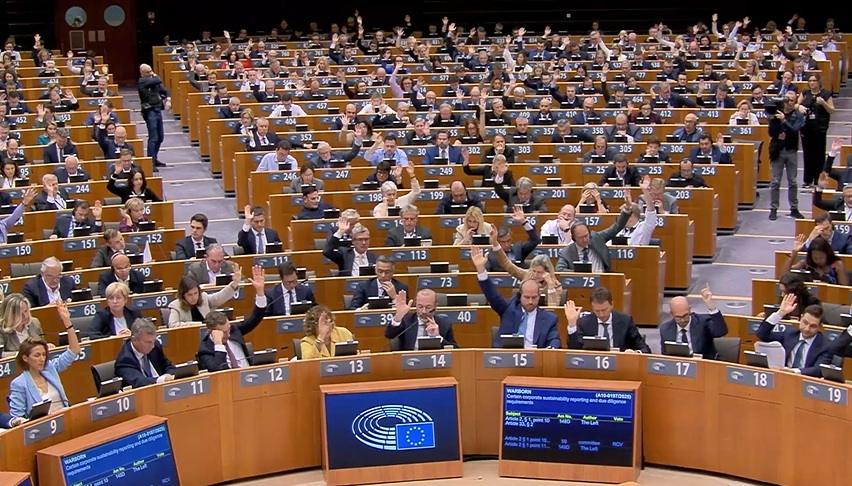
The European Parliament has delivered a significant policy reversal, dramatically scaling back the scope and burden of its sustainability reporting and due diligence directives. This move, driven by a desire to boost European competitiveness and ease compliance, signals a strategic pivot that carries profound implications for the oil and gas sector and its investors. For years, European energy companies have grappled with an escalating torrent of environmental, social, and governance (ESG) regulations, often diverting substantial capital and operational focus towards reporting and compliance. This latest parliamentary decision, achieved with 382 MEPs in favor and 249 opposed, represents a clear shift in priorities, potentially reshaping investment theses across the continent’s energy landscape.
EU’s Regulatory Backpedal: A New Era for Corporate Compliance
The core of this legislative shift lies in the substantial reduction in the number of companies subject to the Corporate Sustainability Reporting Directive (CSRD) and the Corporate Sustainability Due Diligence Directive (CSDDD). Previously, the CSRD covered companies with as few as 250 employees. The new parliamentary position dramatically raises this threshold to companies with 1,750 employees and €450 million in revenues, effectively exempting a vast swathe of businesses from the stringent reporting requirements. Furthermore, a critical change for energy companies is the outright elimination of the obligation to prepare climate transition plans. This offers a newfound degree of operational flexibility, allowing companies to allocate capital and strategic focus based more directly on market dynamics and shareholder returns rather than prescriptive regulatory mandates. This move follows a protracted political struggle, including the rejection of a less aggressive compromise deal, ultimately pushing the European People’s Party (EPP) to align with farther-right factions to secure these significant cuts.
Market Dynamics Amidst Policy Shifts: What Investors Are Asking
This European regulatory recalibration unfolds against a backdrop of significant volatility in global energy markets. As of today, Brent crude trades at $90.38, reflecting a notable 9.07% daily downturn, while WTI crude mirrors this trend at $82.59, down 9.41%. These sharp corrections are particularly striking given Brent’s recent trajectory, having declined by nearly 20% from $112.78 just weeks ago. Our proprietary reader intent data reveals a keen focus among investors on these price movements, with many asking about the near-term trajectory of WTI crude and the broader outlook for oil prices by the end of 2026. While the EU’s policy shift doesn’t directly influence crude fundamentals, it subtly alters the investment calculus for European energy firms. Reduced compliance costs could enhance their operational efficiency and free up capital, potentially making them more attractive in a market where every basis point of efficiency counts. Investors are keenly watching how companies like Repsol, a prominent European player, might leverage this reduced burden to improve their financial performance in the coming months.
Strategic Implications for European Oil & Gas Operators
For European oil and gas companies, the implications of this regulatory easing are overwhelmingly positive. Less stringent ESG reporting translates directly into reduced administrative overheads and lower compliance costs. The removal of mandatory climate transition plans is particularly impactful, granting companies greater autonomy in their long-term strategic planning and capital expenditure decisions. This newfound flexibility could see a re-prioritization of traditional hydrocarbon projects or investments in carbon capture and storage (CCS) technologies that offer tangible returns, rather than being solely driven by reporting requirements. While the Taxonomy Regulation and Carbon Border Adjustment Mechanism (CBAM) remain in place, the broader signal from the Parliament suggests a pivot towards balancing environmental goals with economic competitiveness. This could lead to a re-evaluation of European energy stocks, potentially making them more appealing to a wider range of investors who might have previously been deterred by the continent’s stringent regulatory environment. The strategic capital now freed from extensive reporting could be re-deployed into exploration, production optimization, or even shareholder returns, offering a tangible boost to bottom lines.
Upcoming Catalysts and Forward-Looking Analysis
The timing of this EU policy shift is particularly pertinent as critical energy market events loom. The upcoming OPEC+ Joint Ministerial Monitoring Committee (JMMC) and Ministerial Meetings on April 19th and 20th, respectively, will set the tone for global oil supply in the immediate future. While European ESG policy doesn’t directly influence OPEC+’s quota decisions, a more business-friendly environment for European energy companies could empower them to adapt more effectively to whatever supply-side strategies emerge from these gatherings. Furthermore, the EIA Weekly Petroleum Status Reports on April 22nd and 29th, alongside the Baker Hughes Rig Counts on April 24th and May 1st, will offer crucial insights into the real-time supply and demand dynamics. For investors tracking these reports, the European regulatory pivot provides a new lens through which to assess the health and responsiveness of the continent’s energy sector. Any capital freed up by reduced compliance burdens could, in the longer term, be channeled into upstream activities, potentially contributing to future production capacity. This legislative easing, therefore, acts as a subtle but significant backdrop, influencing how European operators navigate the immediate market challenges and position themselves for future growth.


