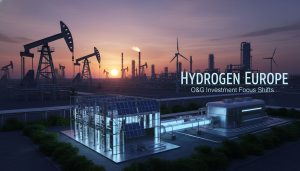
Europe stands at a critical juncture, navigating the complex interplay between ambitious climate goals and the pressing economic realities faced by its industrial base. The continent’s drive to lead global climate protection efforts, while commendable, is confronting significant headwinds: persistently high energy costs, underdeveloped infrastructure, and a palpable decline in industrial competitiveness. This inherent conflict extends to the transportation sector, the very lifeblood of European commerce and society. Investors are increasingly scrutinizing how this delicate balancing act will unfold, seeking clarity on sustainable, economically viable solutions that integrate seamlessly into the broader energy system. Our analysis suggests that the answer lies not solely in green electricity, but significantly in the strategic deployment of a key molecule: hydrogen.
Europe’s Industrial Conundrum and the Energy Transition
The tension between Europe’s decarbonization agenda and its industrial health is a defining theme for global energy markets. Industries across the continent are struggling under the weight of elevated energy expenses, a factor that directly impacts their global competitive standing. This is not merely a theoretical debate; it’s a tangible challenge affecting production costs, investment decisions, and ultimately, economic growth. While the long-term vision of a CO₂-free economy is both necessary and ambitious, achieving it requires more than just renewable electricity generation. Our proprietary reader intent data reveals a keen investor focus on the future trajectory of energy prices, with questions like “what do you predict the price of oil per barrel will be by end of 2026?” frequently surfacing. This underscores the deep-seated concern about long-term energy cost stability, which is paramount for industrial planning and investment. The current situation demands a dual approach: mitigating immediate cost pressures while simultaneously investing in future-proof energy solutions that can sustain industrial activity without compromising climate objectives. The quest for “green molecules” like hydrogen represents a strategic pivot to address this multifaceted challenge, particularly where electricity alone falls short in areas like energy storage, transport, and flexible large-scale supply.
Navigating Volatility: The Current Market Landscape
The immediate energy market context adds another layer of complexity to Europe’s energy dilemma. As of today, Brent Crude trades at $94.79, reflecting a -0.72% dip within a daily range of $93.98 to $95.69. Similarly, WTI Crude is priced at $86.47, down -1.09% for the day, fluctuating between $85.5 and $86.78. Gasoline prices stand at $3.02, down -0.33%, with a daily range of $3 to $3.04. This daily volatility is a constant feature, but a broader trend has also emerged: Brent crude has seen a significant decline over the past two weeks, dropping from $118.35 on March 31st to $94.86 on April 20th – a substantial reduction of $23.49 or nearly 20%. Such a sharp downturn in crude prices, while potentially offering a temporary reprieve for Europe’s energy-intensive industries by lowering input costs, also highlights the inherent unpredictability of the global energy market. Investors are keenly attuned to these swings, as evidenced by direct questions in our platform like “is wti going up or down?” This volatility underscores the urgency for Europe to diversify its energy mix and reduce its reliance on fossil fuels, even as lower prices might tempt a short-term deferral of high-cost green investments. The challenge remains to balance immediate economic relief with the long-term strategic imperative for energy independence and decarbonization.
Hydrogen: The Critical Molecule for Industrial Decarbonization
In the pursuit of a net-zero economy, green electricity is undoubtedly foundational, but it faces inherent limitations, particularly in Central Europe, when it comes to the storage, transport, and flexible delivery of vast amounts of energy precisely when and where it’s needed. This is where hydrogen (H₂) emerges as a pivotal “molecule” for the energy transition. Its versatility positions it to play a crucial role not just in transportation, but across nearly all energy-intensive sectors – from steelmaking and chemicals to heavy-duty logistics. The recent “Hydrogen Week” in Germany served as a clear signal of the intensifying focus on this energy carrier at the highest policy levels, indicating a strategic commitment to developing a hydrogen economy. For investors, this translates into burgeoning opportunities within the production, transport, and end-use sectors of hydrogen. However, the scale of investment required for infrastructure development – pipelines, storage facilities, and new industrial processes – is immense. Companies that can innovate in hydrogen production (especially green hydrogen), develop efficient distribution networks, or successfully integrate hydrogen into industrial processes are likely to see significant investor interest. Readers frequently ask about the performance of specific companies, such as “How well do you think Repsol will end in April 2026,” reflecting a desire to identify the players best positioned to capitalize on these evolving energy paradigms. The transition to hydrogen is not without its hurdles, but its potential to bridge the gap between renewable electricity and hard-to-abate sectors makes it an indispensable component of Europe’s long-term energy strategy.
Upcoming Catalysts and Investor Forward View
The next two weeks are packed with key energy events that will undoubtedly shape investor sentiment and provide critical data points for the market’s trajectory. Tomorrow, April 21st, the OPEC+ Joint Ministerial Monitoring Committee (JMMC) convenes. Their decisions on production quotas directly influence global supply dynamics and, consequently, crude prices, impacting Europe’s industrial energy costs. Following this, the EIA Weekly Petroleum Status Reports on April 22nd and April 29th, alongside the API Weekly Crude Inventory reports on April 28th and May 5th, will offer crucial insights into U.S. inventory levels and demand trends. These reports are closely watched as proxies for global market health. The Baker Hughes Rig Counts on April 24th and May 1st will provide an indication of future production activity. Perhaps most significantly, the EIA’s Short-Term Energy Outlook (STEO) on May 2nd will offer a comprehensive forecast for energy markets, including oil and gas prices, production, and consumption, providing essential context for long-term investment strategies. These events provide tangible data for investors asking about future price movements and company performance. For Europe, the outcomes of these global events will continue to influence the cost of traditional fuels, thereby impacting the economic viability and urgency of accelerating the transition towards green molecules like hydrogen. Savvy investors will monitor these catalysts closely, not just for short-term trading signals, but to refine their understanding of the broader energy landscape and identify strategic opportunities in both conventional and emerging energy sectors.