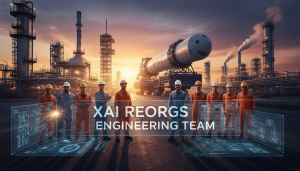
The energy sector stands at the precipice of a profound transformation, driven not by geopolitics or commodity price volatility, but by the relentless advancement of artificial intelligence. While much of the buzz around AI originates from the tech giants, its implications for heavy industries like oil and gas are far-reaching, fundamentally reshaping workforce dynamics, operational efficiency, and, crucially, cost structures. Investors monitoring the energy landscape must recognize that AI is not a distant future concept; it is actively redefining the competitive advantage of O&G companies today.
AI Redefines the Energy Workforce Skillset
Insights from leading AI development firms signal a significant shift in the employment landscape, particularly for entry-level roles. A prominent figure in AI product development, who also co-founded a major social media platform, recently articulated concerns about the challenging job market facing new graduates. His company, at the forefront of AI innovation, prioritizes hiring experienced engineers, expressing reservations about integrating entry-level workers into its current structure. This trend, while observed in the tech sector, carries direct relevance for oil and gas. The industry’s complex operations, from intricate geological modeling to sophisticated drilling and production management, have always demanded deep, specialized expertise. As AI tools become more prevalent, the value proposition of seasoned O&G professionals who can leverage these technologies will only intensify.
The traditional career path for aspiring engineers and field technicians in oil and gas could see dramatic alterations. Entry-level positions that once focused on routine data analysis, basic equipment monitoring, or manual process oversight are ripe for automation. Instead of performing these tasks, the next generation of O&G professionals will need to master the art of interacting with AI systems, interpreting their outputs, and making strategic decisions based on AI-driven insights. This transition demands a workforce capable of “coming up with the right ideas, doing the right user interaction design, figuring out how to delegate work correctly, and then figuring out how to review things at scale,” as one tech leader described the evolving role of software engineers. For O&G, this translates to engineers focusing on novel extraction methods, optimizing energy transition projects, or designing complex automation sequences, rather than sifting through endless spreadsheets.
Productivity Multipliers and Cost Efficiency in O&G
The true power of AI for the oil and gas sector lies in its capacity to act as a significant productivity multiplier, directly impacting the bottom line. Consider the example of an AI chatbot, renowned for its coding prowess, which can enable individuals to achieve the productivity levels of a senior engineer. Translating this to O&G, imagine AI systems that can rapidly analyze vast seismic datasets, predict equipment failures before they occur, or optimize drilling paths with unprecedented precision. An engineer, equipped with such an AI assistant, could potentially complete weeks of analysis in days, identifying optimal well placements or maintenance schedules with higher accuracy and efficiency. Companies that empower their workforce with advanced AI tools will gain a substantial operational edge, reducing downtime, minimizing human error, and dramatically accelerating project timelines.
The economic implications are stark. One AI industry CEO has warned that the technology could eliminate up to 50% of entry-level jobs across various sectors. While specific numbers for O&G will vary, the underlying principle holds: AI can automate a significant portion of repetitive, data-intensive, or even physically demanding tasks. For oil and gas investors, this translates directly into potential for substantial cost reduction. Less manual labor, optimized logistics, predictive maintenance averting costly breakdowns, and more efficient resource allocation driven by AI analytics all contribute to leaner operations and improved profit margins. Companies that proactively integrate AI into their core operations, from upstream exploration to downstream refining, are poised to demonstrate superior capital efficiency and attractive investor returns.
The Talent Imperative: Reskilling and Strategic Hiring
The shift towards AI-centric operations places a premium on specialized talent. Just as a leading AI firm seeks to fill the vast majority of its hundreds of open roles with candidates boasting five or more years of experience, the oil and gas industry will increasingly value seasoned professionals who possess both deep domain knowledge and proficiency in AI tools. This creates a dual challenge and opportunity for O&G companies: reskilling their existing, experienced workforce and strategically hiring new talent with cutting-edge AI competencies. Investment in robust training programs, fostering a culture of continuous learning, and attracting data scientists and AI specialists will be critical for maintaining competitiveness.
The assertion that “AI is starting to get better than humans at almost all intellectual tasks” by a prominent AI CEO underscores the urgency of this transformation. Oil and gas companies must grapple with the reality that intellectual capital, traditionally embodied solely by human experts, is now being augmented and, in some cases, surpassed by intelligent systems. Companies that fail to adapt their talent strategies risk falling behind, while those that successfully integrate human expertise with AI capabilities will forge a powerful, synergistic workforce. This involves not just purchasing AI software, but fundamentally rethinking organizational structures and the roles within them.
Navigating the Future: Investment Insights for O&G
For investors, the AI revolution in oil and gas presents a critical lens through which to evaluate portfolio companies. The companies best positioned for long-term success will likely exhibit several key characteristics:
- Proactive AI Integration: Look for companies making tangible investments in AI and machine learning across their value chain, from exploration and drilling to production optimization, supply chain management, and environmental monitoring.
- Strategic Workforce Development: Companies that are actively reskilling their workforce, establishing partnerships with AI education providers, and attracting AI-savvy talent will have a significant advantage.
- Focus on Efficiency and Cost Reduction: AI adoption should translate into measurable improvements in operational efficiency, reduced operating expenses, and enhanced capital allocation.
- Leadership Vision: Strong leadership that understands and champions the strategic importance of AI, not just as a technology, but as a fundamental driver of business transformation, is paramount.
While the current labor market may grant workers leverage over CEOs in some sectors, the accelerating pace of AI development suggests a future where technological prowess will increasingly dictate corporate success. Investors in the oil and gas sector must recognize that AI is not merely an incremental improvement; it is a disruptive force reshaping the industry’s cost structures, talent requirements, and ultimately, its profitability. Identifying and backing companies that are effectively harnessing this technological wave will be key to unlocking superior returns in the evolving energy landscape.