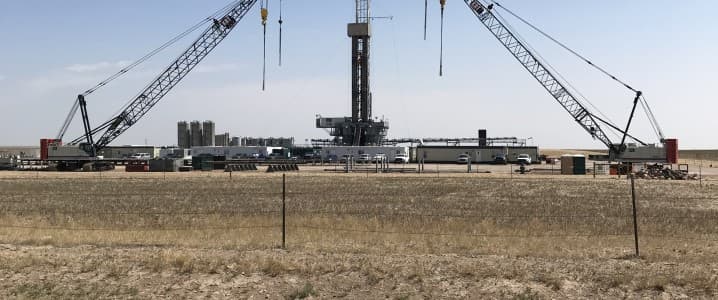
The global oil market stands at a critical juncture, with new data from the Energy Information Administration (EIA) painting a complex picture for investors. While U.S. crude production is poised to shatter records, the very success of American producers risks creating an unprecedented supply glut, threatening to drag oil prices significantly lower in the coming months and years. This forecast presents a stark challenge, requiring a meticulous re-evaluation of investment strategies as the industry potentially shifts from managing scarcity to contending with surplus.
America’s Production Boom: A Double-Edged Sword
The latest EIA outlook delivers a bullish assessment of American crude output, projecting U.S. production to reach an impressive 13.53 million barrels per day (bpd) in 2025. This represents a notable increase from prior forecasts of 13.44 million bpd and comfortably surpasses the 13.23 million bpd record set last year. The surge is attributed to stronger-than-expected output observed in July and the accelerated ramp-up of new offshore projects in the Gulf of Mexico. Specifically, the Gulf region is now expected to contribute an average of 1.89 million bpd this year, a 50,000-barrel increase over previous estimates, as several developments came online ahead of schedule.
While this robust production ensures global markets remain well-supplied, the EIA cautions that it simultaneously risks tipping the delicate balance towards a significant surplus. The agency explicitly warns of global oil inventories rising consistently through 2026, a trend that would exert “significant downward pressure on oil prices.” Although U.S. crude output reached 13.2 million bpd in 2024, primarily driven by the prolific Permian Basin and the Gulf of Mexico, the EIA notes a deceleration in growth compared to the million-barrel annual surges seen during the peak shale years. This suggests that U.S. producers may be approaching their maximum capacity gains, but even at a slower pace, the sheer volume of new supply is a formidable market force.
Current Market Dynamics Versus Future Projections: A Disconnect Investors Must Heed
The EIA’s long-term price forecasts stand in stark contrast to the immediate market reality, posing a critical question for energy investors. As of today, Brent crude trades at $96.31 per barrel, reflecting a 2.93% gain within its intraday range of $96.31-$98.97. West Texas Intermediate (WTI) crude, meanwhile, sits at $87.8 per barrel, experiencing a 3.7% decline today within a range of $87.76-$90.34. This divergence between Brent and WTI day-to-day indicates underlying volatility and complex factors at play, yet both benchmarks remain considerably elevated compared to the EIA’s projections.
The agency anticipates WTI crude to average approximately $65 per barrel in 2025 – a substantial 15% below its 2024 levels – with Brent projected to average $68.64 per barrel. This significant delta between current trading prices and the EIA’s outlook suggests that the market may not yet be fully pricing in the risks of future oversupply. Examining the recent past provides further context: Brent crude has seen a notable decline over the last two weeks, falling from $112.57 on March 27th to $98.57 on April 16th, a drop of over 12%. While this downward trend aligns with the EIA’s warning of price pressure, current levels are still far from the mid-$60s range predicted for next year. Investors must critically evaluate whether current prices are sustainable in the face of such bearish long-term supply forecasts, or if a significant correction is inevitable should the predicted inventory build materialize.
Navigating OPEC+ Decisions and Key Market Signals
As investors grapple with the implications of burgeoning U.S. supply, a recurring question from our readers concerns the role and influence of OPEC+ on current market dynamics, particularly regarding their production quotas. The EIA’s forecast hinges on a crucial assumption: only a portion of OPEC+’s planned production increases will actually materialize due to limitations in spare capacity among member nations. Despite this conservative estimate, the agency still projects global inventories to swell by an average of 2.1 million bpd in the fourth quarter of 2025, which would be more than enough to keep supply comfortably ahead of demand and further depress prices.
This makes the upcoming OPEC+ meetings absolutely critical for market direction. The Joint Ministerial Monitoring Committee (JMMC) convenes on April 17th, followed by the Full Ministerial Meeting on April 18th. Decisions made during these sessions regarding current production quotas and future output strategies will directly impact the supply-demand balance and could either exacerbate or mitigate the forecasted inventory build. Beyond these high-level discussions, investors will closely monitor a series of recurring data points that provide real-time insights into market health. The API Weekly Crude Inventory report on April 21st and 28th, alongside the EIA Weekly Petroleum Status Report on April 22nd and 29th, will offer crucial indicators of U.S. inventory levels. Furthermore, the Baker Hughes Rig Count on April 24th and May 1st will shed light on drilling activity, helping investors gauge the potential for continued U.S. production growth against the backdrop of the EIA’s capacity warnings.
Investment Outlook: Preparing for a Potential Price Revaluation
The convergence of record U.S. oil production and the EIA’s stark warning of a significant global supply surplus presents a formidable challenge for oil and gas investors. The agency’s projections of WTI averaging $65 per barrel and Brent $68.64 per barrel in 2025 imply a substantial revaluation of crude prices from current levels. This shift from a narrative of scarcity to one of potential oversupply demands a proactive approach to portfolio management.
Companies with higher breakeven costs or significant debt loads could face considerable pressure in a sustained low-price environment. Investors should scrutinize balance sheets and operational efficiencies, favoring producers with robust cost structures and strong hedging programs. Furthermore, the slowing pace of U.S. shale growth, even as records are broken, suggests that the industry may be entering a more mature phase of development, potentially shifting investment focus towards capital discipline over aggressive expansion. As the market digests these complex signals, monitoring OPEC+ actions and weekly inventory data will be paramount. The next big challenge for the oil market, as the EIA suggests, may indeed be managing abundance rather than scarcity, necessitating a fundamental recalibration of investment theses across the energy sector.


