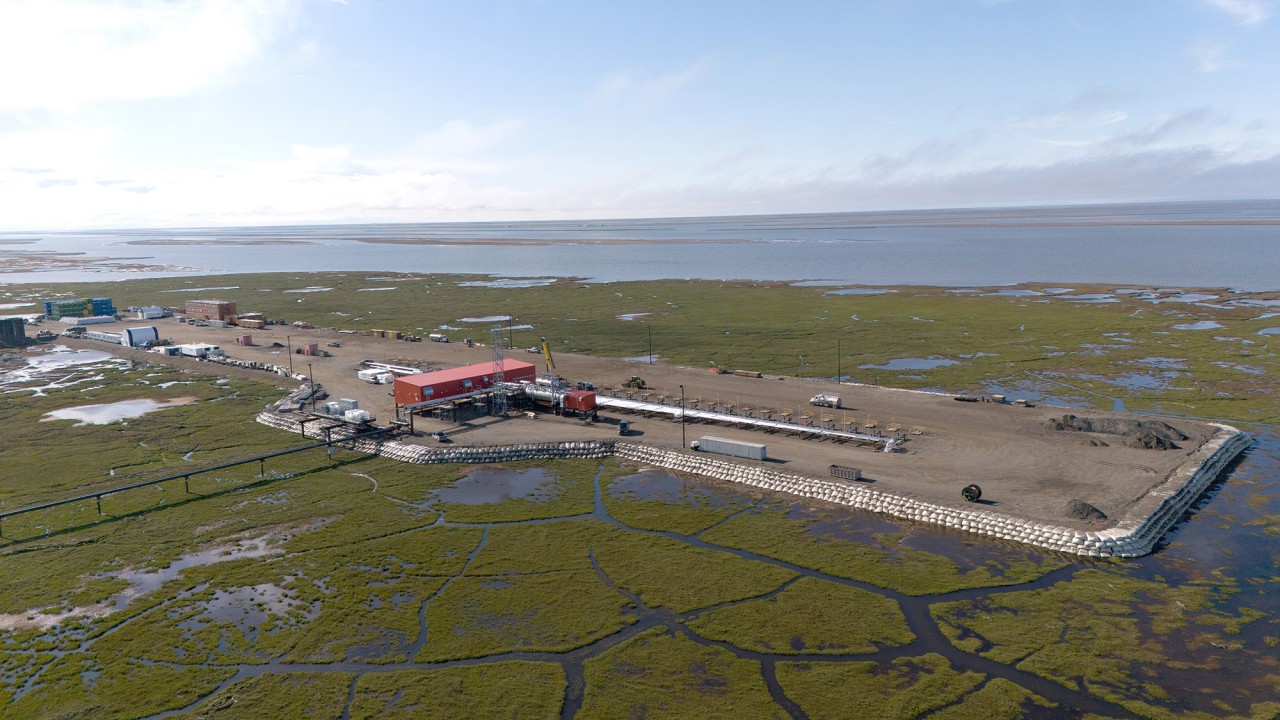
Alaska’s oil production is on the cusp of a significant resurgence, poised to deliver its largest annual growth since the 1980s. This isn’t merely a statistical blip; it represents a strategic shift in the U.S. crude oil landscape, driven by key North Slope developments that warrant close attention from energy investors. The U.S. Energy Information Administration (EIA) projects Alaska’s output to reach 477,000 barrels per day (bpd) in 2026, a robust 13% increase over 2025 levels and the highest since 2018. This impending supply injection comes at a critical juncture for global energy markets, offering both new investment opportunities and a potential balancing force amidst ongoing price volatility.
Alaska’s Production Renaissance: Driving Forces and Investment Horizons
The anticipated surge in Alaskan crude oil production is primarily attributed to two major projects: ConocoPhillips’ Nuna development and the Santos and Repsol joint Pikka Phase 1 project. Nuna, which commenced production in late 2024, is expected to reach a peak of 20,000 bpd, having already contributed 7,000 bpd by August 2025 and effectively offsetting declines from the state’s more mature fields. The more substantial impact, however, is projected from Pikka Phase 1. Slated to begin operations in early 2026, this project is forecast to achieve a peak production of approximately 80,000 bpd by mid-2026, potentially accounting for nearly 20% of Alaska’s total crude output for that year. These figures are not just aspirational; the EIA’s upward revision reflects strong well test results and an accelerated ramp-up schedule for Pikka Phase 1, indicating a high degree of confidence in these projects’ capabilities. For investors tracking upstream opportunities, the ramp-up schedules and operational efficiencies of these projects, particularly those backed by Santos and Repsol, will be key performance indicators.
Navigating Volatility: Alaska’s Role in a Dynamic Crude Market
The impending increase in Alaskan supply enters a global oil market characterized by significant volatility. As of today, Brent crude trades at $90.71, down a significant 8.73% on the day, having ranged from $86.08 to $98.97. WTI similarly dipped 9.07% to $82.90, fluctuating between $78.97 and $90.34. This immediate downturn follows a broader trend, with Brent having declined from $112.57 just two weeks ago to $98.57 yesterday, representing a 12.4% drop. Such sharp movements highlight the sensitivity of crude prices to various geopolitical, economic, and supply-side factors. The additional 100,000 bpd from Alaska by mid-2026, while substantial for the state, will be absorbed into a market that constantly reassesses its supply-demand balance. Investors are actively questioning the trajectory of oil prices, with many asking about the projected price per barrel by the end of 2026. Alaska’s output, alongside broader trends in U.S. shale and global demand, will be a critical variable in this complex equation, potentially offering a counterweight to supply disruptions elsewhere or tempering price spikes.
Strategic Implications and Upcoming Market Catalysts
For investors, Alaska’s renewed output presents both direct and indirect investment considerations. Companies with significant Alaskan exposure, notably ConocoPhillips, Santos, and Repsol, stand to benefit from increased production volumes and potentially improved economies of scale. The strong well test results from these new projects, averaging about 480 barrels of oil equivalent per day (boed) compared to the 78% of existing Alaskan wells that produced below 400 boed in 2023, underscore the efficiency and technological advancements driving this growth. This improved capital efficiency in a mature basin could translate to attractive returns. Furthermore, the broader market context remains crucial. With the OPEC+ Joint Ministerial Monitoring Committee (JMMC) meeting scheduled for tomorrow, April 17th, followed by the full Ministerial meeting on April 18th, investors are keenly focused on potential production quota adjustments. These decisions will directly impact the market’s perception of oversupply or undersupply, setting the tone for pricing alongside the new Alaskan barrels. Weekly data from API and EIA, due on April 21st/22nd and April 28th/29th respectively, will provide critical inventory insights, further shaping sentiment. Understanding how these events interact with the new Alaskan supply is vital for crafting a robust energy investment strategy.
Beyond the Headlines: The Efficiency of New-Generation Arctic Projects
The success of the Nuna and Pikka Phase 1 projects is not just about volume; it’s about the efficiency and technological prowess applied to a historically challenging operating environment. The fact that new wells from these projects are averaging roughly 480 boed, significantly outperforming the majority of existing wells on the North Slope (where 78% produced below 400 boed in 2023), speaks volumes about modern upstream capabilities. This performance suggests that despite the perceived maturity of the Alaskan North Slope, targeted investment in advanced drilling and production techniques can yield highly productive assets. For investors, this translates into potentially lower lifting costs per barrel and more resilient cash flows for the operators involved. The ability of these projects to not only add new supply but also to effectively offset declines from legacy fields underscores their strategic importance in maintaining and growing domestic crude production. This efficiency narrative is a key differentiator for these Alaskan ventures and should be a central consideration for anyone evaluating long-term investment in Arctic energy development.
In conclusion, Alaska’s impending oil production boom, driven by high-efficiency projects like Nuna and Pikka Phase 1, marks a pivotal moment for the U.S. energy landscape. While global crude markets remain subject to significant volatility, as evidenced by recent price movements, this new supply offers a concrete growth story for investors. The strategic timing, coupled with upcoming OPEC+ decisions and weekly inventory reports, demands a nuanced understanding of market dynamics. For those seeking exposure to resilient, technologically advanced upstream assets, the Alaskan renaissance presents compelling opportunities, reinforcing the importance of granular project analysis within the broader energy investment thesis.