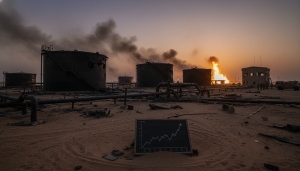
The global oil market faces a potential oversupply scenario in the latter half of the year, a risk underscored by the chief executive of Diamondback Energy in a recent communication to investors. This outlook suggests a significant increase in worldwide crude production, challenging the market’s current equilibrium.
Kaes Van’t Hof, Diamondback’s CEO, noted in his letter that, at prevailing price levels, crude output from the U.S. shale patch has reached its zenith. While acknowledging that the specter of a dual “massive oil supply glut combined with an oil demand shock” has largely receded on the demand side, he cautioned against complacency regarding supply. Van’t Hof articulated, “The projected increase in global oil supply in the second half of this year is hard to ignore.” He likened the current market signal to a “yellow light,” an evolution from the “stop light” analogy previously used, indicating a need for heightened caution despite the inherent inaccuracies often found in sector projections, especially when consensus leans uniformly in one direction.
In response to this cautious outlook, Diamondback Energy has outlined a strategic plan for the current year. The company intends to maintain a flat production profile, signaling a disciplined approach to growth amidst market uncertainties. Furthermore, Diamondback plans to reduce its capital expenditure, demonstrating fiscal prudence. A key component of this strategy involves preserving a substantial inventory of drilled but uncompleted (DUC) wells. This DUC inventory offers operational flexibility, allowing the company to rapidly bring production online should market conditions improve, without committing to new drilling in a potentially oversupplied environment.
Diamondback Energy holds a significant position within the U.S. energy landscape as the largest independent producer operating in the prolific Permian Basin. The company reported an average daily production of 496,000 barrels in the second quarter. While adjusting its full-year crude production guidance downwards, Diamondback simultaneously revised its natural gas production outlook upwards, attributing this to enhanced gas capture efficiencies observed during the second quarter.
The broader trend across the U.S. shale sector mirrors Diamondback’s cautious stance. A slowdown in activity has become evident, largely driven by persistent price pressures. This deceleration includes a noticeable reduction in hiring across the industry. Energy market forecasters generally anticipate a more subdued growth trajectory for U.S. oil production this year and next, a direct consequence of lower commodity prices impacting investment decisions and operational tempo.
The Energy Information Administration (EIA), a key source for U.S. energy data, projects a modest decline in domestic crude output over the coming two years. Specifically, the EIA’s June forecast indicated that total U.S. oil production is expected to decrease from 13.5 million barrels per day (bpd) in the second quarter of the current year to approximately 13.3 million bpd by the conclusion of 2026. This forecast underscores a period of retrenchment or at least stagnation after years of robust growth.
Adding further weight to this outlook, Kpler, a prominent energy data analytics provider, recently revised its U.S. oil production growth forecast downwards. Citing the impact of prevailing oil prices, Kpler lowered its projected growth by 120,000 bpd, bringing the revised growth estimate to 170,000 bpd. Such revisions from reputable analytical firms provide a clearer picture for investors, highlighting a consensus view that the era of rapid, unconstrained growth in U.S. shale production may be temporarily paused.
For investors, these developments signal a pivotal moment in the oil and gas sector. The cautious tone from a major Permian player like Diamondback, combined with broader industry trends and authoritative forecasts, suggests that supply-side dynamics warrant close monitoring. While demand recovery has absorbed some previous concerns, the potential for a global supply surplus in the near term could introduce new volatility. Companies demonstrating capital discipline, strategic flexibility through DUC inventories, and a focus on efficiency, such as Diamondback Energy, may be better positioned to navigate this evolving market landscape. Understanding these nuanced shifts in supply and production strategy is crucial for making informed investment decisions in the current energy market.