The global crude oil market continues to present a complex picture for investors, caught between persistent demand concerns and an ever-present specter of supply disruption. While recent trading sessions have seen relatively modest daily price movements, the broader narrative for crude has been one of significant annual declines, driven largely by an environment of perceived oversupply. As a senior investment analyst for OilMarketCap.com, we leverage our proprietary data to cut through the noise, offering an incisive look at the forces shaping the energy landscape and what they mean for your portfolio.
Recent Market Dynamics: Navigating Persistent Oversupply Signals
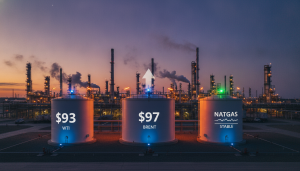
Investors tracking crude oil performance are keenly aware of the challenging environment that has defined recent periods. West Texas Intermediate (WTI) crude, a key benchmark for North American oil, is on track for a substantial 19% annual decline. Similarly, Brent crude, the international benchmark, faces the prospect of concluding its third consecutive year of losses – an unprecedented losing streak. This overarching bearish sentiment has been fueled by concerns over global demand growth failing to absorb available supply, pushing nearby futures contracts to multi-year lows in December. However, recent trading has shown some stabilization. As of today, Brent Crude trades at $90.4 per barrel, reflecting a slight daily dip of 0.03%, though its daily range saw it touch highs of $95.69. WTI Crude is currently at $86.8, down 0.71% for the day, having traded between $85.5 and $87.49. While these daily movements appear contained, our proprietary 14-day Brent trend data reveals a more significant underlying shift: Brent has dropped from $118.35 on March 31st to $94.86 on April 20th, representing a sharp 19.8% decline. This recent sharp downward pressure, even more pronounced than the annual figures suggest, underscores the market’s current vulnerability to bearish sentiment despite geopolitical tensions that historically offer price support.
The 2026 Outlook: A Cautious Start with Geopolitical Wildcards
Looking ahead to 2026, our analysis suggests a bifurcated path for crude prices. The first quarter is likely to remain challenging, with WTI potentially hovering in the $50.00 to $55.00 per barrel range as the market continues to digest supply overhangs and potential economic headwinds. However, we anticipate a recovery later in the year, bringing WTI back to the $60.00 to $65.00 level. This projected rebound is not without significant caveats. A critical factor limiting any prolonged downside below the $50.00 mark is the proactive stance of OPEC+. Our models indicate that should prices fall substantially, the cartel would likely intervene with production cuts, effectively establishing a floor. Conversely, volatility is skewed heavily to the upside. The persistent geopolitical flashpoints around the globe, coupled with the ever-present risk of prolonged supply disruptions, could swiftly push prices beyond the $65.00 threshold for extended periods. Investors must recognize that while fundamental oversupply concerns dominate the short-term narrative, the potential for an external shock remains a potent, unquantifiable risk that could dramatically alter the trajectory of crude prices.
Investor Insights and Imminent Market Catalysts
Our direct interactions with OilMarketCap.com readers via our AI assistant, EnerGPT, reveal a clear investor focus on market direction and forward price predictions. Questions like “is WTI going up or down?” and “what do you predict the price of oil per barrel will be by end of 2026?” highlight the prevalent uncertainty and the demand for clarity. Investors are actively seeking to understand the short-term movements and the longer-term outlook, particularly given the recent volatility. The next two weeks are packed with critical events that will provide crucial data points and potential catalysts for price action. Tomorrow, on April 21st, the OPEC+ JMMC Meeting is scheduled, offering the first real opportunity for the cartel to signal its intentions regarding current production policy. Any hint of further cuts or adherence to existing agreements will significantly influence market sentiment. Following this, the EIA Weekly Petroleum Status Report on April 22nd and April 29th will provide fresh insights into U.S. crude inventories, refinery utilization, and demand indicators. Surprising builds or drawdowns could swing prices. The Baker Hughes Rig Count on April 24th and May 1st will shed light on North American drilling activity, hinting at future supply. Finally, the EIA Short-Term Energy Outlook on May 2nd will offer a comprehensive government forecast, which often recalibrates market expectations. These events are not just dates on a calendar; they are inflection points that will shape the narrative around supply, demand, and ultimately, crude oil investment returns.
Strategic Considerations for Energy Investors
For investors navigating this complex landscape, a clear understanding of both historical trends and forward-looking catalysts is paramount. While WTI’s 19% annual decline and Brent’s multi-year losing streak underscore the challenges of oversupply, the market is also characterized by a robust floor provided by OPEC+ and significant upside potential from geopolitical risks. Our proprietary data, including the recent 19.8% drop in Brent over 14 days, illustrates that recent downside momentum is strong. However, this is precisely when investors should be evaluating entry points, keeping in mind the Q1 bearish outlook transitioning into a potential recovery later in 2026, targeting WTI between $60.00 and $65.00. Monitoring upcoming events like the OPEC+ JMMC meeting and EIA reports will be critical for gauging immediate market reactions and adjusting investment strategies. The interest from our readers in specific company performance, like Repsol, further indicates a move beyond just crude prices to broader energy sector investments. Therefore, investors should consider not only direct crude exposure but also integrated energy companies that can better withstand price volatility due to diversified operations. In an environment defined by both demand anxieties and supply fragility, a disciplined, data-driven approach remains the most prudent path for capital allocation in the oil and gas sector.