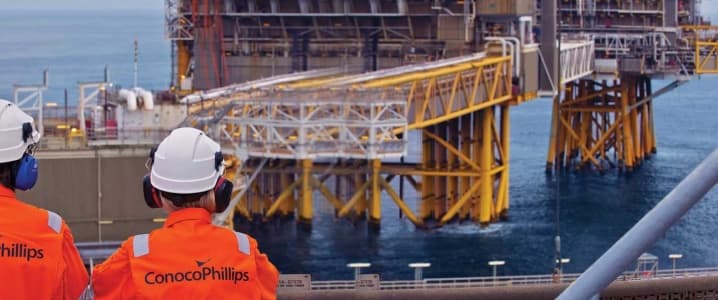
ConocoPhillips’ Workforce Reduction: A Strategic Move Amidst Tumultuous Oil Markets
ConocoPhillips (COP), a major player in the global oil and natural gas sector, has announced plans to reduce its workforce by 20% to 25%, impacting both employees and contractors, with the majority of these cuts slated for this year. This significant restructuring follows the company’s $17 billion acquisition of Marathon Oil Corp. in November, an integration move projected to yield $500 million in cost and capital savings within the first year. For investors, this isn’t merely a headline about job cuts; it’s a critical signal about strategic repositioning, operational efficiency, and the company’s adaptability in an increasingly volatile energy landscape. Our analysis delves into the implications of this decision, set against the backdrop of rapidly shifting crude prices and pivotal upcoming market events.
Strategic Realignment Amidst Market Headwinds
The decision by ConocoPhillips to streamline its operations through a substantial workforce reduction is a clear indicator of management’s commitment to efficiency and shareholder value, especially in the wake of a significant acquisition. While spokesman Dennis Nuss noted the ongoing pursuit of efficiency, the timing is particularly poignant given the current market climate. As of today, Brent crude trades at $90.38 per barrel, representing a dramatic 9.07% decline within a single trading day. WTI crude has mirrored this sentiment, sitting at $82.59, marking a sharp 9.41% drop. This isn’t an isolated blip; the 14-day trend for Brent shows a significant retreat, plummeting from $112.78 on March 30th to $91.87 just yesterday, shedding over $20 or 18.5% of its value. Such a pronounced downturn puts immense pressure on exploration and production (E&P) companies to optimize their cost structures, making ConocoPhillips’ proactive measures appear both strategic and necessary.
The M&A Playbook: Synergies and Investor Scrutiny
The acquisition of Marathon Oil Corp. last November was a bold move, positioning ConocoPhillips for expanded scale and operational synergies. The projected $500 million in cost and capital savings formed a cornerstone of the investment thesis for this deal. The announced workforce reduction, which includes both employees and contractors, directly addresses the realization of these synergies. It’s worth noting that Marathon Oil had already signaled its own workforce adjustments, warning of layoffs involving over 500 employees in the month prior to the acquisition. This suggests a pre-existing drive for efficiency that ConocoPhillips is now accelerating and expanding across the combined entity. Investors will be keenly watching the upcoming town hall meeting scheduled for Thursday for further clarity on the specifics and the strategic rationale behind these cuts. ConocoPhillips shares experienced a 4.6% decline yesterday, echoing the broader energy sector’s reaction to the sharp fall in crude prices, underscoring the market’s sensitivity to both company-specific news and macro trends.
Navigating Future Volatility: Upcoming Events and Investor Outlook
A key concern among our readership, evidenced by recent inquiries, revolves around the future trajectory of oil prices, with many asking what to predict for Brent crude by the end of 2026, and the stability of OPEC+ production quotas. These questions underscore the market’s thirst for clarity in an uncertain environment. The immediate horizon holds critical events that could significantly influence these dynamics. The OPEC+ Joint Ministerial Monitoring Committee (JMMC) meeting is slated for tomorrow, April 18th, followed by the Full Ministerial meeting on April 19th. Any signals or decisions from these gatherings regarding production levels could either exacerbate or alleviate the current downward pressure on crude prices. Investors will also be closely monitoring the API Weekly Crude Inventory reports on April 21st and 28th, alongside the EIA Weekly Petroleum Status Reports on April 22nd and 29th, for insights into demand and supply fundamentals. Furthermore, the Baker Hughes Rig Count on April 24th and May 1st will provide crucial data on upstream activity. ConocoPhillips’ move to streamline operations now could position it to be more resilient to potential price shocks or more agile in capitalizing on any market recovery driven by these upcoming events.
What This Means for Your Energy Portfolio
For investors holding ConocoPhillips or considering an entry point, this workforce reduction signifies a strong commitment to operational excellence and financial discipline, particularly important in a volatile commodity price environment. The company is actively working to integrate its recent acquisition and extract the promised value, which includes significant cost savings. While the short-term market reaction can be influenced by broader crude price movements, the long-term thesis for ConocoPhillips will increasingly hinge on its ability to demonstrate successful integration, realization of its synergy targets, and sustained free cash flow generation. The broader E&P sector might also see similar efficiency drives as companies respond to the ongoing pressure for improved returns and capital discipline. As an investor, it’s prudent to keep a close eye not only on ConocoPhillips’ execution but also on the macro signals emanating from the upcoming OPEC+ meetings and inventory data, which will undoubtedly shape the operating landscape for the entire industry through the remainder of 2026 and beyond.


