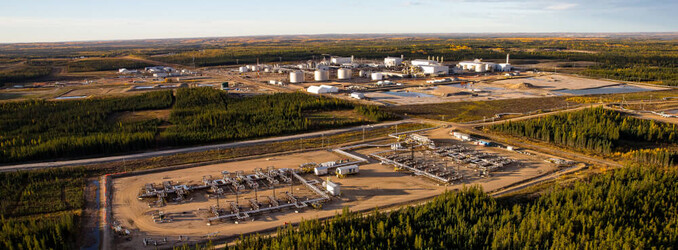
Cenovus Energy has decisively expanded its formidable oil sands portfolio with the successful completion of its acquisition of MEG Energy. This strategic transaction immediately adds a substantial 110,000 barrels per day (bpd) of long-life, low-cost production capacity to Cenovus’s operational base, critically consolidating a core growth area in northern Alberta. The integration of MEG’s assets, located directly adjacent to Cenovus’s Christina Lake operations, represents a significant step towards enhancing operating scale, unlocking substantial project synergies, and solidifying Cenovus’s position with a top-tier collection of thermal oil assets. For investors, this move signals Cenovus’s commitment to long-term growth and efficiency in a sector often characterized by short-term volatility.
Navigating Production Growth Amidst Market Headwinds
This substantial production increase comes at a compelling time, requiring investors to scrutinize the market dynamics shaping the value proposition. As of today, Brent Crude trades at $90.38 per barrel, marking a significant decline of 9.07% within the day and a stark 19.9% drop from $112.78 just two weeks ago. WTI Crude mirrors this bearish trend, currently at $82.59, down 9.41%. This immediate market snapshot, coupled with gasoline prices also seeing a 5.18% decrease to $2.93, underscores a period of significant price contraction. Cenovus’s decision to boost its production capacity by 110,000 bpd through an acquisition valued at approximately $5.7 billion (comprising $752 million for initial share purchases, $3.44 billion to remaining shareholders, 143.9 million Cenovus common shares issued, and $800 million in assumed net debt) demonstrates a long-term conviction in the underlying value of its integrated oil sands assets. While short-term market sentiment is clearly negative, securing additional low-cost, long-life production in a consolidated operational area positions Cenovus to capitalize when crude prices inevitably recover, enhancing its leverage to future upswings and providing resilience during downturns.
Strategic Consolidation for Enhanced Operational Synergies
The strategic rationale behind the MEG acquisition extends far beyond simply adding barrels. Cenovus CEO Jon McKenzie highlighted the “exceptional strategic fit” and “highest quality” assets, emphasizing that the identified synergies will create significant value both in the short and long term. By integrating MEG’s operations directly adjacent to its existing Christina Lake asset, Cenovus can unlock substantial operational efficiencies. This includes optimizing infrastructure, sharing technical expertise, and streamlining supply chains, all of which contribute to lowering the per-barrel operating costs. In an environment where cost control is paramount to maintaining profitability, particularly for oil sands producers, this consolidation strategy is a powerful lever. The acquisition reinforces Cenovus’s focus on thermal oil assets, known for their predictable production profiles and long reserve lives, offering a stable foundation for consistent cash flow generation despite commodity price fluctuations. Investors should view this as a move to strengthen the company’s operational resilience and improve its competitive standing in the Canadian energy landscape.
Forward Outlook: Guidance and Macro Events Shaping Expectations
Investors are now keenly awaiting Cenovus’s updated production and capital guidance, which will be released alongside its 2026 budget announcement on December 11. This upcoming disclosure will provide the first detailed look at how the MEG integration is expected to impact Cenovus’s financial and operational outlook. However, the context for this guidance will be heavily influenced by a series of critical energy events unfolding in the coming weeks. The OPEC+ Joint Ministerial Monitoring Committee (JMMC) Meeting on April 19, followed by the full OPEC+ Ministerial Meeting on April 20, will be pivotal in determining global supply strategies and market sentiment. Any decisions regarding production quotas could significantly alter the supply-demand balance and, consequently, crude price trajectories. Furthermore, weekly data points such as the API Weekly Crude Inventory on April 21 and 28, and the EIA Weekly Petroleum Status Report on April 22 and 29, will provide crucial insights into U.S. demand and inventory levels, directly influencing short-term price movements. The Baker Hughes Rig Count reports on April 24 and May 1 will also offer a glimpse into future North American production trends. These collective events will form the backdrop against which Cenovus’s new guidance will be evaluated, making the December 11 announcement particularly significant for investors plotting their 2026 strategies.
Addressing Investor Concerns: Long-Term Value in a Volatile Market
Our proprietary reader intent data reveals a clear focus among investors on directional price movements, with questions like “Is WTI going up or down?” and “What do you predict the price of oil per barrel will be by end of 2026?” dominating discussions. This reflects a pervasive uncertainty regarding the future of crude prices. Cenovus’s acquisition of MEG Energy, characterized by its long-life, low-cost production profile, directly addresses these long-term concerns by enhancing the company’s resilience to price volatility. In a market where short-term price swings are a constant, strategic investments in high-quality, integrated assets can offer a degree of stability. The consolidation allows Cenovus to de-risk its asset base, improve cost structures, and secure predictable future cash flows from a larger, more efficient operation. For investors seeking long-term value in the energy sector, Cenovus’s move represents a commitment to enduring operational strength and capital discipline, positioning the company to generate returns regardless of immediate market fluctuations, and providing a more stable investment thesis in an otherwise unpredictable environment.