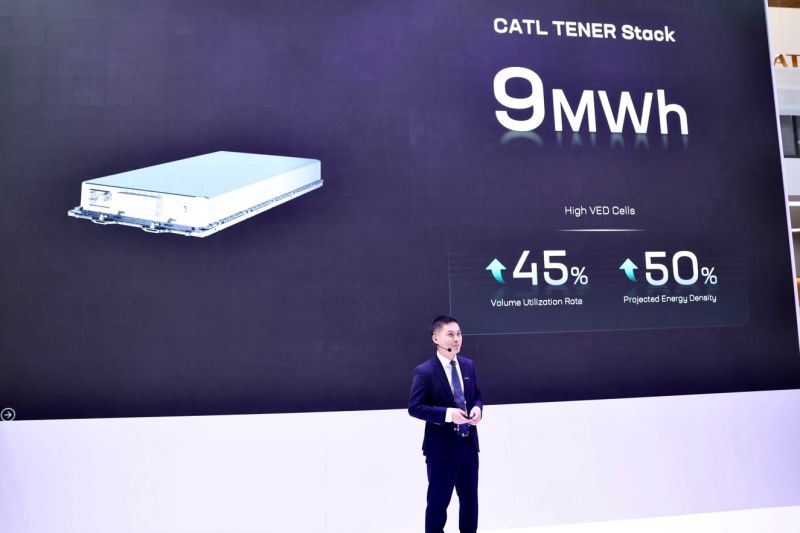
The energy landscape is undergoing a profound transformation, and nowhere is this more evident than in the rapid advancements of grid-scale energy storage. CATL’s recent unveiling of the TENER Stack, the world’s first 9MWh ultra-large capacity energy storage system solution poised for mass production, marks a pivotal moment. This isn’t just an incremental improvement; it represents a strategic leap in capacity, deployment flexibility, safety, and transportability, with direct implications for the long-term demand dynamics faced by traditional oil and gas sectors. For investors navigating this evolving market, understanding such innovations is critical to assessing future energy mixes and the enduring value of fossil fuel assets.
CATL’s TENER Stack: A New Benchmark for Grid Flexibility and Efficiency
The TENER Stack is engineered to tackle the burgeoning global energy demands, from powering AI-driven data centers to enabling widespread industrial electrification. At its core, the system integrates CATL’s high-energy-density cells, backed by an impressive five-year zero degradation technology. This translates into a 45% improvement in volume utilization and a 50% increase in projected energy density compared to conventional 20-foot container systems. With an internal capacity of up to 9MWh, capable of charging 150 electric cars or supplying an average German household for six years, the scale of this innovation is clear. The system’s support for both centralized and string Power Conversion System (PCS) architectures further enhances its compatibility and efficiency across diverse grid applications, allowing for seamless integration with mainstream AC-side equipment.
The economic value proposition is compelling. Deploying 800 MWh of storage using TENER Stack requires nearly one-third fewer containers than traditional 6 MWh systems. This significant reduction not only minimizes the number of PCS units and hidden costs associated with system oversizing but also boosts land-use efficiency by a remarkable 40%. Developers can realistically anticipate up to a 20% optimization in total station construction costs, making large-scale battery energy storage systems (BESS) even more competitive against traditional power generation sources and critical for grid stability as renewable penetration increases.
Logistical Innovation Driving Accelerated Deployment
One of the often-overlooked hurdles in large-scale energy storage deployment has been logistics. Traditional containers exceeding 36 tonnes face significant transport restrictions in many countries. CATL addresses this head-on with an ingenious “two in one” design for the TENER Stack. Each half-height unit is strictly controlled to remain under 36 tonnes, ensuring compliance with transport regulations across 99% of global markets. This seemingly minor design choice has major implications, allowing for standard shipping methods, including conventional container spreaders and liners. The result is a substantial reduction in waiting times and specialized transport costs, potentially by up to 35%. This logistical breakthrough makes the rapid deployment of grid-scale battery storage solutions far more feasible and cost-effective, directly accelerating the displacement of fossil fuels in grid applications where quick, flexible power is needed.
Market Dynamics: Oil Prices, Energy Transition, and Investor Focus
The introduction of highly efficient and deployable energy storage systems like the TENER Stack occurs within a dynamic energy market characterized by robust, yet volatile, oil prices. As of today, Brent crude trades at $95.16, showing a modest gain of 0.39% for the day, with a range between $91 and $95.79. WTI crude, on the other hand, is slightly down at $91.04, trading between $86.96 and $92.38. This robust pricing environment for crude, despite a notable 14-day decline of nearly 8.8% from $102.22 on March 25th to $93.22 yesterday, underscores the ongoing global energy demand and the immediate reliance on traditional fuels. However, our proprietary reader intent data highlights a keen investor focus on the future, with frequent queries like “Build a base-case Brent price forecast for next quarter” and “What is the consensus 2026 Brent forecast?” These questions reflect a broader anxiety about the long-term trajectory of oil demand in an era of accelerating energy transition. Innovations in grid-scale storage directly impact this by making renewable energy sources more reliable and reducing the need for fossil fuel-based peaker plants, thus slowly eroding the demand base for crude and natural gas in power generation.
The growing capacity and efficiency of battery storage solutions also influence the economics of industrial electrification. As industries seek to decarbonize, a stable and cost-effective renewable-powered grid, bolstered by advanced BESS, becomes more attractive. This indirectly reduces the demand for oil and gas across various industrial applications, posing a long-term challenge to the growth prospects of traditional energy companies. Investors are increasingly looking for signals on how quickly this transition will impact demand, making technologies like CATL’s TENER Stack a critical barometer.
Forward Outlook: Upcoming Events and the Pace of Change
The coming weeks are packed with events that will shape the immediate future of the oil and gas market, providing crucial context for the accelerating energy transition. Key industry indicators include the Baker Hughes Rig Count reports scheduled for April 17th and 24th, which will offer insights into North American production activity. More critically, the OPEC+ Joint Ministerial Monitoring Committee (JMMC) meeting on April 18th, followed by the Full Ministerial OPEC+ Meeting on April 20th, will dictate the near-term supply strategy of major producers. Any decisions on production cuts or increases will directly influence global crude prices and, consequently, the economic competitiveness of alternative energy solutions. Further insights into the demand side will come from the API Weekly Crude Inventory reports on April 21st and 28th, and the EIA Weekly Petroleum Status Reports on April 22nd and 29th.
These upcoming data points are vital for oil and gas investors, especially those asking about the future of Brent pricing. A sustained period of high oil prices, potentially driven by tight OPEC+ supply or robust demand reflected in inventory draws, would further incentivize the deployment of advanced battery storage solutions like the TENER Stack. Conversely, any signs of weakening oil demand or increased supply could temper the immediate urgency, though the fundamental shift towards cleaner energy, enabled by technologies like CATL’s, remains undeniable. The integration of such cutting-edge storage capabilities into grids globally will continue to apply long-term pressure on fossil fuel demand, making the energy transition a strategic imperative for all energy market participants.