The global energy landscape continues its dynamic evolution, and a significant development from China’s electric vehicle (EV) battery sector demands close attention from oil and gas investors. The recent announcement regarding new, stringent battery safety standards, coupled with a leading manufacturer’s immediate compliance claim, underscores the accelerating pace of technological advancement and market maturation within the electric mobility sphere. For those navigating traditional energy markets, these shifts are not mere periphery; they represent critical indicators for long-term demand projections and strategic capital deployment.
China’s Rigorous New Battery Mandate: A Game Changer for EV Safety
In a move poised to fundamentally reshape the electric vehicle battery industry, the Chinese government unveiled a formidable new set of safety standards in April, slated for enforcement from July 1, 2026. This mandate, officially designated GB 38031-2025, quickly earned the moniker “no fire, no explosion” standard, a testament to its uncompromising requirements. The regulation explicitly stipulates that EV batteries must not ignite or detonate during a thermal runaway event, a critical failure mode that has historically plagued public perception of EV safety. Furthermore, it prohibits the emission of any smoke that could pose a hazard to vehicle occupants, a significant enhancement over previous directives.
Until this latest legislation, which was formally adopted in March 2025, battery standards primarily required systems to issue warning signals in the event of impending fire or explosion. The new GB 38031-2025 standard elevates safety protocols dramatically by introducing innovative and rigorous testing procedures. These include a mandated underside impact test, crucial for evaluating battery integrity in collisions, especially pertinent given the increasing adoption of structural battery integration via cell-to-body designs. Additionally, batteries must now demonstrate resilience by passing a safety test that subjects them to 300 rapid charging cycles, immediately followed by a short-circuit test. Such demanding criteria signify China’s unwavering commitment to solidifying the safety credentials of its burgeoning EV market.
CATL’s Proactive Compliance and Technological Dominance
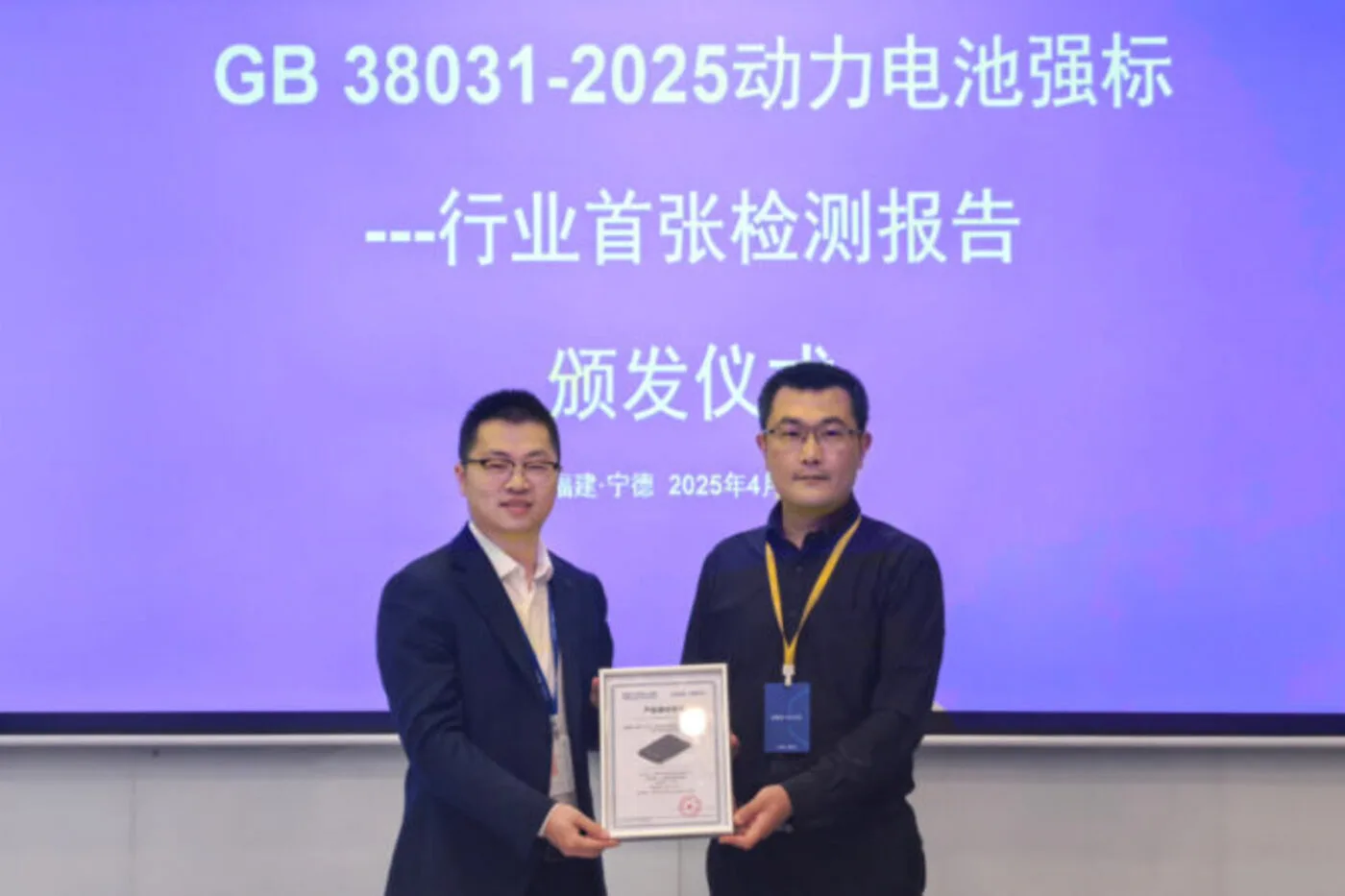
In a swift and strategically important response to these new regulatory benchmarks, Contemporary Amperex Technology Co. Limited (CATL), the world’s largest producer of EV batteries, declared its products already meet the impending safety requirements. The company promptly revealed its proprietary “No Thermal Propagation (NP) technology” as the cornerstone of its compliance. By the close of April, CATL confirmed that its advanced Qilin battery cells and packs had successfully undergone and passed the two newly introduced tests under GB 38031-2025.
The Qilin battery pack, first introduced to the market in 2022, has already achieved widespread adoption across China’s EV ecosystem. Prominent manufacturers such as Zeekr, Xiaomi, Lotus, Neta, Avatr, Li Auto, and Aito have integrated these cell-to-pack batteries, available with either Nickel Manganese Cobalt (NMC) or Lithium Iron Phosphate (LFP) cells, into their vehicle lines. An independent certification body, the China Automotive Technology & Research Center (CATARC), subsequently published a test report verifying the compliance of both CATL cell types. Notably, the report specifically identified NMC chemistry as a “ternary lithium-ion battery,” a classification typically applied in China to cathodes utilizing nickel-manganese-cobalt or nickel-manganese-aluminum oxide. This validation is particularly significant because, while NMC cells are generally perceived as more susceptible to thermal runaway events than their LFP counterparts, CATL’s specific NMC variant successfully navigated the stringent tests, alongside the inherently more robust LFP cell. This achievement underscores CATL’s engineering prowess and its leading position in battery technology.
Market Consolidation: Investment Implications for Battery Giants
For the broader battery industry, these new, more stringent specifications are poised to act as a powerful catalyst for market consolidation. Dominant manufacturers, notably CATL and BYD, possess the financial muscle and extensive R&D capabilities necessary to absorb the substantial development and testing costs associated with meeting such elevated standards. This creates a significant barrier to entry for smaller, less capitalized companies, many of whom will struggle to afford the requisite investment in advanced technology and rigorous testing infrastructure.
From an investor perspective, this dynamic suggests an accelerated concentration of market share among the established giants. Capital flows will increasingly favor these proven leaders, reinforcing their competitive moats and potentially driving higher valuations within the battery manufacturing sector. For oil and gas investors, this trend offers a crucial insight: as the alternative energy sector matures and consolidates, the efficiency and safety of its core technologies improve dramatically. A safer, more reliable EV battery directly translates to increased consumer confidence and potentially faster adoption rates for electric vehicles, which in turn influences long-term oil demand forecasts and necessitates a proactive re-evaluation of energy portfolio allocations. The capital intensity required to meet these new standards highlights the scale of investment now flowing into competing energy technologies.
The Broader Energy Transition Context
The implications of China’s new “no fire, no explosion” battery standard extend far beyond individual manufacturers. This regulatory push is a pivotal moment for the global energy transition, reinforcing the criticality of safety in driving widespread EV adoption. Enhanced battery safety not only protects lives but also bolsters public trust, a non-negotiable factor for mainstream consumer acceptance of electric mobility. Government mandates, particularly from a market as influential as China, serve as powerful accelerators for technological innovation, compelling the industry to push boundaries and fostering a more resilient and secure EV ecosystem.
As an oil and gas investor, understanding these developments is paramount. The increasing safety, reliability, and performance of EV batteries directly impact the timeline and scale of the global shift away from fossil fuels in transportation. Investments in advanced battery technology are effectively competing for capital with traditional energy projects, signaling a fundamental realignment of global energy infrastructure. The continued dominance of major players like CATL, driven by stringent regulatory environments, showcases the evolving competitive landscape. Monitoring these technological breakthroughs and market consolidations is essential for accurate long-term forecasting and strategic positioning within the ever-changing global energy investment portfolio.