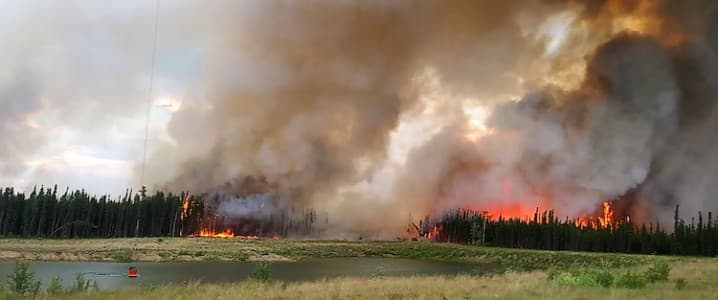
Alberta’s critical oil and gas heartland is once again confronting a severe wildfire season, with an uncontained blaze near Swan Hills forcing immediate evacuations and temporary shutdowns of energy operations. This early-season inferno serves as a stark reminder to investors of the escalating operational risks facing Canadian energy producers from an increasingly volatile climate.
The active wildfire, currently burning out of control and spanning an estimated 1,600 hectares, is situated a mere 7 kilometers from the town of Swan Hills. This proximity triggered the mandatory evacuation of the town’s 1,200 residents on Monday evening, highlighting the immediate threat to both communities and industrial infrastructure.
Immediate Production Impacts and Corporate Responses
The energy sector has already felt the direct impact. Aspenleaf Energy, a significant operator in the affected region, has confirmed a curtailment of approximately 4,000 barrels of oil equivalent per day (boepd). The company swiftly moved to evacuate its field crews as a precautionary measure. According to CEO Bryan Gould, the fire was approximately 10 kilometers from Aspenleaf’s critical assets as of Monday evening, underscoring the dynamic and unpredictable nature of these events.
Further afield, Canadian Natural Resources (CNQ.TO), Canada’s largest oil producer, also maintains operations within the vicinity. While the company has not yet issued a statement regarding its specific operational status or potential impacts from the current fires, its presence in the region means investors will be closely monitoring any developments. The broader energy market remains sensitive to news of production disruptions from this vital North American supply basin.
The Swan Hills incident is not an isolated event. Another significant wildfire, covering roughly 390 hectares, is currently burning unchecked in Yellowhead County. Across Alberta, a total of 47 wildfires are active, with two designated as uncontrolled, indicating a challenging spring for provincial authorities grappling with public safety and the imperative of maintaining energy security.
A Recurring Threat: Historical Context for Investors
For seasoned investors in the Canadian energy space, this scenario is far from unprecedented. Wildfires have become a challenging annual reality in Alberta’s oil-producing regions, often disrupting operations during the spring and summer months. The financial implications and operational vulnerabilities associated with these events are well-documented.
Last year, extensive wildfires across Alberta led to widespread evacuations in key oil and gas areas. The cumulative impact in 2023 saw more than 319,000 boepd temporarily taken offline across the province amidst over 100 active blazes. This significant production loss underscored the substantial short-term supply shocks that can emanate from these natural disasters.
The most devastating precedent remains the catastrophic 2016 Fort McMurray wildfire. That event compelled the evacuation of 90,000 residents and resulted in a staggering 1 million barrels per day reduction in oil production, demonstrating the potential for widespread and prolonged disruption. These historical events serve as critical benchmarks for assessing the potential magnitude of future wildfire-related risks to energy assets and supply chains.
Alberta’s Oil Sands: Growth Amidst Growing Vulnerability
Alberta’s oil sands sector represents a cornerstone of Canada’s economy and a crucial component of global energy supply. Over the past decade, oil sands output has surged by 1.3 million barrels per day (bpd), reaching an impressive 3.3 million bpd today. Projections anticipate further growth, with production expected to climb to 3.8 million bpd by 2030.
However, this expansion in production capacity and associated infrastructure, while economically beneficial, concurrently increases the region’s exposure to environmental hazards. More pipelines, processing facilities, and operational sites translate into a larger footprint susceptible to the direct and indirect impacts of wildfires. Investors must weigh the attractive growth trajectory against the inherent and seemingly escalating risks of operational continuity in a climate-challenged environment.
Investor Outlook: Navigating Climate Risk and Energy Security
The ongoing wildfire threat in Alberta introduces a critical dimension to investment considerations in the Canadian energy sector. Beyond traditional market volatility, investors must increasingly factor in the tangible impacts of climate change on operational stability, supply chain resilience, and even long-term asset valuations.
Energy companies operating in fire-prone regions face mounting pressure to implement robust risk mitigation strategies. These include enhanced fire prevention protocols, advanced monitoring systems, emergency response planning, and ensuring adequate insurance coverage. For investors, evaluating a company’s environmental, social, and governance (ESG) performance now critically involves scrutinizing its preparedness for and resilience against climate-related operational disruptions.
The immediate consequence of production curtailments is a tightening of supply, which can exert upward pressure on crude oil prices. However, the broader narrative for investors centers on the long-term sustainability and predictability of supply from regions frequently impacted by such events. The ability of Canadian producers to consistently deliver on output targets will be increasingly influenced by their capacity to adapt to and mitigate these recurring environmental challenges.
Conclusion: An Unrelenting Challenge for Canadian Energy
This year’s initial significant wildfire flare-up in Alberta provides a potent reminder that Canada’s vital oil patch remains deeply vulnerable. The increasing frequency and intensity of these natural events pose not only an immediate threat to operations and communities but also represent a significant, enduring challenge for energy security and investor confidence in the region.
As the world grapples with energy demand and supply dynamics, the operational resilience of major producing regions like Alberta takes center stage. Investors tracking the Canadian energy sector will need to maintain a keen eye on evolving wildfire conditions, corporate responses, and the broader strategies employed to safeguard production amidst the undeniable realities of an increasingly combustible climate.