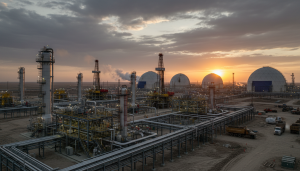
For years, the Permian Basin has stood as the undisputed powerhouse of the U.S. shale oil and gas sector. Its prolific output and attractive economics drew immense investment and defined a generation of energy expansion. However, this reign faces growing headwinds. Rising production costs and the natural exhaustion of its most prized drilling locations are challenging the basin’s long-term growth trajectory. As the industry seeks the next frontier, all eyes are increasingly turning north, specifically to Canada’s Montney Formation, poised to inherit the mantle of North American shale leadership.
The Montney Formation, spanning the rich hydrocarbon provinces of Alberta and British Columbia in Western Canada, represents a colossal repository of natural gas, ranking among the largest on the continent. Beyond its immense gas potential, it also harbors significant crude oil resources. Crucially for investors, the Montney distinguishes itself with some of the most competitive production costs found anywhere in the global energy landscape.
Unrivaled Cost Efficiency and Resource Depth
A recent analysis by Enverus underscored the strategic advantages of Canadian assets, particularly emphasizing the Montney shale. According to the energy intelligence firm, “The primary benefit of Canadian oil sands and Montney assets lies in their extensive inventory of low-cost resource.” This deep inventory translates into remarkable resilience. Enverus noted that Montney assets possess the financial fortitude to remain profitable even with West Texas Intermediate (WTI) crude prices sustained below $50 per barrel, outperforming many U.S. shale competitors. This inherent cost efficiency positions these Canadian plays as economically viable over an extended period, presenting a stable and highly attractive investment proposition for long-term capital.
Currently, the Montney shale contributes approximately 2 million barrels of oil equivalent daily (BOE/d) to North American energy supplies. While a substantial portion of this output consists of natural gas, destined for an increasingly hungry market, the balance between liquids and gas is set to evolve. With the imminent commencement of operations at LNG Canada later this year, the region’s gas production is expected to surge, solidifying its role as a critical supplier to global liquefied natural gas markets. Yet, the Montney’s oil potential remains a significant draw, sparking speculation that U.S. exploration and production (E&P) companies, facing diminishing returns in the Permian, may increasingly pivot their investment strategies northward.
Montney: The Future Supply Anchor
The narrative of the Permian’s slowing production growth opens the door for other shale plays to ascend to prominence. A recent report from energy investment firm Kimmeridge unequivocally identifies the Montney as a prime contender for industry leadership. Kimmeridge’s assessment positions the Montney as the leading shale basin in North America for future supply, attributing this distinction to its enormous volumes of undeveloped, high-quality resources.
Kimmeridge highlights several compelling advantages that elevate the Montney’s investment profile. These include a more measured pace of exploitation compared to the fast-depleting Permian, contributing to its longevity and resource preservation. Furthermore, its exceptionally low breakeven costs ensure robust profitability even during periods of market volatility. Perhaps most timely, the Montney is particularly rich in natural gas, aligning perfectly with surging global demand for this cleaner-burning hydrocarbon, a trend expected to strengthen in the coming years. This strategic alignment with market needs enhances the basin’s revenue potential and long-term relevance.
Exceptional Longevity and Policy Support
A standout characteristic of the Montney, as detailed by Kimmeridge, is its remarkable operational lifespan. The investment firm projects an impressive 22-year lifespan for the Montney shale, a calculation derived from its front-end inventory duration and the 2023 North American recycle ratio. This projection signifies the Montney as the most enduring asset among all shale plays analyzed in the report. In practical terms, this means drillers in the Montney can sustain their 2023 activity pace for over two decades, systematically developing wells from the highest to the lowest recycle ratio locations before encountering reserves that fall below their 2023 average well quality.
Such an extended horizon for high-quality drilling is exceptionally appealing for E&P companies focused on achieving long-term, sustainable oil and, more significantly, natural gas production. Adding another layer of attractiveness, the provincial government of Alberta has recently implemented policies designed to stimulate its energy sector. Notably, Alberta has frozen the price of carbon emissions at C$95 per tonne, departing from earlier plans for gradual increases. This policy decision provides greater certainty and predictability for energy producers, fostering an environment conducive to continued investment and development within the Montney and other regional energy assets.
As the North American energy landscape evolves, the Montney Formation emerges as a compelling investment story. Its vast, low-cost resources, strategic alignment with rising natural gas demand, and an impressive multi-decade drilling inventory, further bolstered by supportive government policies, collectively present a robust case for its ascent. For investors seeking durable growth and resilient returns in the dynamic oil and gas sector, Canada’s Montney Formation represents not just a promising play, but potentially the next dominant force in global hydrocarbon supply.