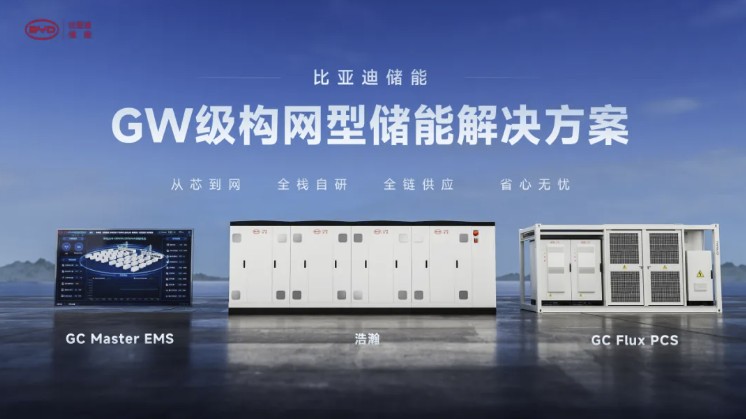
The Seismic Shift: How BYD’s HaoHan Redraws the Energy Storage Map and Threatens Peak Oil Demand
The global energy landscape is undergoing an accelerated transformation, driven by relentless innovation in renewable technologies and, increasingly, in energy storage. While headlines often focus on the immediate gyrations of crude markets, a deeper, more fundamental shift is taking hold. The recent unveiling of BYD’s “HaoHan” DC battery block, a single-unit system boasting a colossal 14.5 MWh capacity, represents far more than just another product launch. For oil and gas investors, this development signals a potent acceleration towards grid decarbonization and a direct challenge to the long-term viability of fossil fuels for baseload and peak power generation, raising critical questions about the trajectory of global oil demand.
Disrupting Utility-Scale Storage: Economics and Efficiency Drive the Transition
BYD’s HaoHan system sets a new benchmark in utility-scale energy storage, fundamentally altering the economic calculus for integrating renewable power. With a minimum single-unit capacity of 14.5 MWh, it more than doubles the industry norm, significantly streamlining large-scale projects. Housed within a standard 20-foot container, the system delivers 10 MWh, achieving an impressive volumetric energy density of 233 kWh per cubic meter – a 51% improvement over existing averages. This translates directly into tangible benefits for developers: a 1 GWh storage plant utilizing HaoHan would require less than half the number of units, reduce land footprint by a third, and slash cell count by 76%. At the heart of this innovation lies BYD’s 2,710 Ah Blade Battery cell, designed for over 10,000 cycles and poised to drive down the total lifecycle cost per kilowatt-hour to an unprecedented sub-$0.014 (CNY 0.1). Such advancements promise to cut project-level levelized costs (LCOS) by over 20% and procurement, transportation, and installation costs by approximately 30%. This isn’t merely incremental improvement; it’s a structural cost reduction that makes large-scale battery storage an increasingly irresistible alternative for grid balancing and renewable energy integration, directly eroding the market share historically dominated by fossil fuel peaker plants and backup generators.
Market Volatility and the Accelerating Demand Shift
The immediate concerns of the oil and gas market often overshadow these long-term structural shifts. As of today, Brent crude trades at $90.38, reflecting a notable decline of over 9% within the day, while WTI crude has similarly fallen to $82.59, down 9.41%. This sharp correction follows a challenging period for crude, with Brent having trended downwards from $112.78 on March 30th to $91.87 just yesterday, a significant drop of over $20. The price of gasoline has also followed suit, currently at $2.93. While these fluctuations are driven by a complex interplay of macroeconomic factors, geopolitical tensions, and supply-demand dynamics, they occur against a backdrop where the long-term viability of fossil fuels is increasingly questioned by advancements like HaoHan. Investors frequently ask about the trajectory of oil prices by the end of 2026. While short-term forecasts remain volatile, the increasing cost-effectiveness and deployment speed of utility-scale storage solutions fundamentally alter the demand ceiling for crude and natural gas, particularly in the power generation sector. This makes sustained high prices increasingly difficult to achieve in the long run, even as immediate supply concerns might provide temporary spikes. The accelerating energy transition means that every new, highly efficient storage solution like HaoHan chips away at the foundational demand that has historically supported oil and gas valuations.
Grid-Forming Capabilities and the Erosion of Peak Oil Demand
The HaoHan system’s capabilities extend beyond mere storage; its in-house power conversion system and advanced energy management software enable millisecond-level response and critical grid-forming functions at gigawatt scale. This is a game-changer for grid stability, allowing large quantities of intermittent renewable energy from solar and wind hubs to be seamlessly integrated without relying on traditional fossil fuel power plants for grid synchronization or frequency regulation. For oil and gas investors, this directly impacts the “peak oil demand” narrative. As battery storage becomes cheaper and more capable, its applications expand from merely storing excess renewable energy to actively stabilizing the grid and providing reliable backup power. This directly displaces demand for natural gas in peaker plants and reduces the need for oil-derived fuels in various industrial and commercial backup scenarios. The system’s ability to lower failure rates and maintenance costs by 70% further enhances its appeal, making it a robust and reliable alternative even in harsh environments. The blockchain-based carbon tracking system also positions HaoHan favorably against evolving environmental regulations and carbon border tariffs, adding another layer of competitive advantage over carbon-intensive energy sources.
Navigating Short-Term Signals Amidst Long-Term Transformation
For investors focused on the oil and gas sector, the immediate horizon remains critical, even as long-term structural shifts accelerate. This week offers several key events that will undoubtedly influence market sentiment and prices. Investors are closely watching the upcoming OPEC+ Joint Ministerial Monitoring Committee (JMMC) meeting today, April 18th, followed by the full Ministerial meeting on April 19th. The outcome of these discussions regarding production quotas and market stability will likely trigger significant price movements. Our readers are keenly interested in OPEC+’s current production strategies, and any deviation from expectations could send ripples through the market. Furthermore, the API Weekly Crude Inventory report on April 21st and the EIA Weekly Petroleum Status Report on April 22nd will provide crucial insights into domestic supply and demand dynamics, followed by similar updates on April 28th and 29th. The Baker Hughes Rig Count reports on April 24th and May 1st will offer a snapshot of drilling activity, indicating future supply potential. While these events dictate short-term volatility, the overarching trend driven by technologies like HaoHan continues to challenge the fundamental demand outlook for fossil fuels. Companies like Repsol, which many of our investors are tracking, must increasingly balance their upstream investments with strategic pivots into renewables and energy storage to secure long-term value in this evolving landscape.