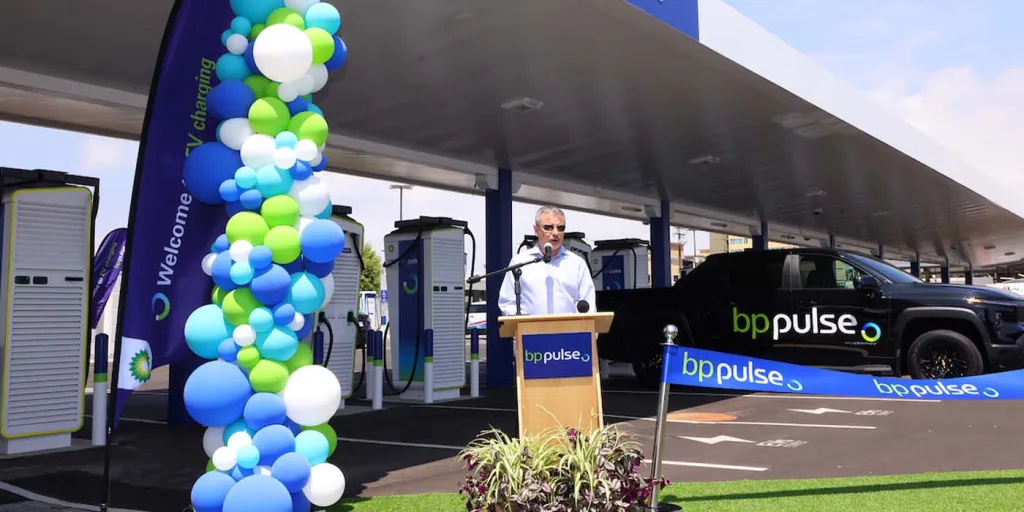
BP’s latest strategic move into the burgeoning electric vehicle (EV) charging market solidifies its commitment to energy transition, with the unveiling of its largest U.S. charging hub near Los Angeles International Airport (LAX). This significant investment underscores a broader industry pivot, as traditional energy giants seek to diversify revenue streams amidst volatile commodity markets. For investors, understanding the implications of such large-scale infrastructure projects is crucial for assessing BP’s long-term growth trajectory and its resilience against the inherent cyclicality of oil and gas markets. This analysis delves into the strategic positioning of the new LAX hub, its role in BP’s wider diversification efforts, and the investor sentiment surrounding these shifts, all while considering the backdrop of live market data and upcoming energy events.
The LAX Hub: A Strategic Beachhead for BP Pulse
The new bp pulse hub, strategically located just two miles from LAX, represents a critical expansion of BP’s EV charging footprint in the United States. Featuring 48 ultrafast DC fast charging bays, a mix of 400kW and 150kW chargers, and both CCS and NACS connectors, this facility is designed for high-demand usage. Its proximity to one of the world’s busiest airports positions it perfectly to serve a diverse clientele, including ride-hail drivers, rental car customers through its partnership with Hertz, and local EV owners. The hub’s comprehensive amenities, such as upcoming public restrooms, a lounge, vending machines, and Wi-Fi, aim to enhance the user experience, fostering loyalty and repeat business. Partially funded by a $2 million grant from the California Energy Commission (CEC), this project highlights the critical role of public-private partnerships in accelerating EV infrastructure development. Sujay Sharma, CEO of bp pulse Americas, emphasized the strategic importance of such metro and airport locations, signaling a clear intent to build out a robust, high-volume network. For BP, these hubs are not just charging stations; they are integral components of a future-proof energy ecosystem.
Navigating Volatility: BP’s Diversification Amidst Crude Swings
BP’s aggressive expansion into EV charging infrastructure provides a tangible hedge against the inherent volatility of traditional oil markets. As of today, Brent Crude trades at $94.88 per barrel, marking a 0.63% decline, while WTI Crude stands at $86.53, down 1.02%. This snapshot reflects a broader trend of significant price fluctuations; over the last 14 days, Brent has seen a notable drop from $118.35 on March 31st to $94.86 on April 20th, a decline of nearly 20%. Such dramatic swings underscore the market’s sensitivity to geopolitical events, supply-demand imbalances, and macroeconomic indicators. In this environment, investors are increasingly scrutinizing energy companies’ resilience and their strategies for long-term value creation beyond the fossil fuel cycle. BP’s investment in bp pulse, particularly with large-scale hubs like the one near LAX, signals a deliberate shift towards more stable, predictable revenue streams. The EV charging business, while capital-intensive upfront, offers recurring revenue opportunities through subscriptions and usage fees, insulating a portion of BP’s earnings from the unpredictable gyrations of crude oil prices. This strategic diversification aims to build a more robust and sustainable business model, appealing to a broader base of investors focused on future energy landscapes.
Investor Focus: Long-Term Growth Beyond the Barrel
The prevailing sentiment among investors, as evidenced by proprietary intent data from our platform, continues to grapple with the immediate trajectory of crude benchmarks. Inquiries such as “is WTI going up or down” and predictions for “the price of oil per barrel by end of 2026” highlight a keen focus on short-term commodity price movements. However, a deeper analysis reveals that sophisticated investors are also looking beyond these immediate fluctuations, seeking companies with a credible long-term growth strategy. BP’s significant commitment to EV infrastructure, epitomized by the LAX hub and its partnership with Hertz, directly addresses this need for diversified and sustainable growth. By investing in areas like ultrafast charging, BP is not merely reacting to market pressures but proactively shaping its future. This strategy positions BP to capture value from the accelerating global energy transition, providing a compelling narrative for investors concerned about the long-term viability of pure-play fossil fuel companies. The expansion into high-traffic, high-demand locations like airports, supported by government grants, mitigates some of the initial investment risk and demonstrates a clear path to market penetration and scale, crucial factors for investor confidence in a nascent industry segment.
Future Outlook: Catalysts and Challenges Ahead
Looking ahead, the energy market will continue to be shaped by a confluence of traditional and emerging factors. Upcoming events such as the OPEC+ Joint Ministerial Monitoring Committee (JMMC) Meeting on April 21st, and the EIA Weekly Petroleum Status Reports on April 22nd and April 29th, will undoubtedly influence short-term crude oil prices and investor sentiment towards conventional energy stocks. Similarly, the Baker Hughes Rig Count on April 24th and May 1st will provide insights into upstream activity levels. However, for BP, these events serve as a backdrop to its evolving strategic narrative. The EIA Short-Term Energy Outlook on May 2nd will offer broader perspectives on energy demand and supply trends, including the trajectory of EV adoption, which directly impacts BP’s new ventures. While the capital intensity and competitive landscape of the EV charging market present challenges, BP’s strategy of targeting high-volume locations, securing government funding, and forming strategic partnerships like that with Hertz, positions it favorably. The long-term growth potential in EV charging, driven by increasing EV sales and supportive policy environments, offers a robust earnings stream that is less susceptible to the geopolitical and economic forces that sway crude oil prices. BP’s journey is a compelling case study for investors seeking exposure to the energy transition while managing traditional commodity risk.


