BAM’s Sodium Battery Breakthrough Signals Long-Term Oil Demand Headwinds
The global energy landscape is undergoing a profound transformation, driven by relentless innovation in energy storage. A recent development from researchers at the Federal Institute for Materials Research and Testing (BAM) in Germany, focusing on advanced sodium battery technology, presents a compelling long-term risk factor for traditional oil and gas demand. This cutting-edge work on high-performance solid-state batteries, particularly those leveraging a novel liquid alkali metal anode, underscores the accelerating pace of decarbonization efforts and the potential for disruptive technological shifts to reshape energy markets.
For investors keenly observing the horizon for future energy trends, these advancements are not merely academic curiosities. They represent tangible progress towards a future where electric vehicles (EVs) boast extended ranges and faster charging, and renewable energy grids achieve unprecedented stability and efficiency. Such a future inevitably implies reduced reliance on fossil fuels, particularly crude oil, for transportation and power generation.
Overcoming Lithium-Ion Limitations: A New Frontier in Energy Storage
Current generation lithium-ion batteries, while transformative, are approaching their theoretical limits. Their prevalent graphite anodes can only accommodate a finite number of ions, restricting further gains in energy density and charging speed. This inherent constraint has spurred extensive research into alternative anode materials, with pure lithium and the more abundant, cost-effective sodium emerging as frontrunners.
However, the adoption of these pure metal anodes presents its own set of engineering challenges. To operate safely and efficiently, they necessitate a solid electrolyte rather than the liquid counterparts found in conventional lithium-ion cells. The critical hurdle lies at the interface between the solid anode and solid electrolyte: contact losses and microscopic cavities can form, severely compromising battery performance and lifespan. It’s precisely this problem that the BAM researchers, in collaboration with Humboldt University Berlin, are addressing with an innovative solution: a partially liquid anode.
The Power of Partially Liquid Anodes: A Hundredfold Efficiency Leap
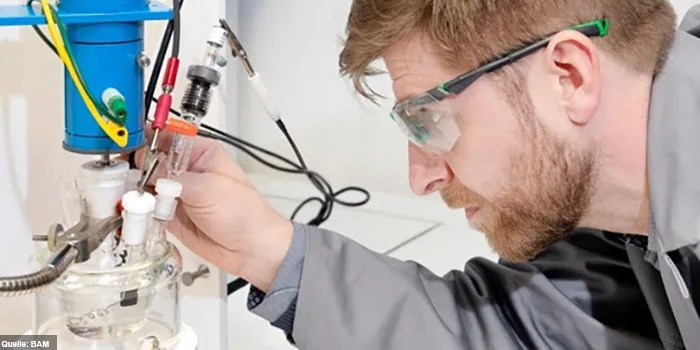
The BAM team’s breakthrough involves a sophisticated approach utilizing a partially liquid alkali metal anode. Gustav Graeber, a battery material expert from Humboldt University Berlin and a guest scientist at BAM, highlighted the staggering potential of this technology. According to their study, a liquid alkali metal anode demonstrated efficiency an astonishing hundred times greater than that of conventional graphite anodes. This dramatic improvement in ion storage and transfer capability could fundamentally redefine battery performance metrics.
While the initial proof-of-concept for this highly efficient technology currently operates at elevated temperatures, specifically 250 degrees Celsius, the central objective of the research is to translate these performance advantages to room temperature. Achieving this would unlock its potential for widespread commercial application in everything from consumer electronics to electric vehicles and grid-scale storage systems. To lower the anode’s melting point to ambient temperatures, the research team is experimenting with potassium additives. This, however, introduces a new set of material compatibility challenges, as many common solid electrolytes lack sufficient stability when exposed to potassium.
NASICON Electrolytes: A Path to Stability and Performance
The solution to these compatibility issues, according to the BAM team, may reside in a specialized solid electrolyte based on Sodium Super-Ion Conductors (NASICON). These materials are celebrated for their exceptional ionic conductivity at room temperature and their robust chemical stability, even in the presence of reactive elements like potassium. The stability is further enhanced when NASICON electrolytes are mixed with hafnium, a relatively rare and expensive metal.
Recognizing the economic and sustainability implications of hafnium, the interdisciplinary team of BAM experts, led by Graeber in the NASICON project, is actively seeking alternative additives. The goal is to identify materials that deliver comparable efficiency and stability to hafnium but are more sustainable and readily available for large-scale production. Promising candidates are being rigorously tested directly within sodium battery prototypes, accelerating the pathway from laboratory discovery to practical application.
Decarbonization and the Investor Outlook: A Ticking Clock for Oil Demand
Graeber emphasizes the profound implications of this research, stating that it represents “a decisive step towards high-performance batteries that are more sustainable, cheaper and more efficient.” The successful commercialization of sodium solid-state batteries could drastically cut charging times and significantly boost the performance of both mobile and stationary energy storage systems. Such advancements are not just incremental improvements; they are foundational to global decarbonization efforts, directly challenging the existing energy paradigm dominated by fossil fuels.
For oil and gas investors, these developments signal an intensifying long-term threat to demand. Enhanced battery performance translates directly into more competitive electric vehicles, accelerating the displacement of gasoline and diesel in the transportation sector. Similarly, more efficient and cost-effective stationary storage solutions will bolster the penetration of intermittent renewable energy sources like solar and wind, reducing the need for natural gas peaker plants and potentially even baseload fossil fuel generation.
The establishment of the ‘Berlin Battery Lab’ by BAM, Humboldt University, and the Helmholtz Centre Berlin further underscores the strategic importance of this research. By pooling expertise and opening its doors to industry collaboration, this initiative aims to accelerate the commercialization of next-generation battery technologies. This collaborative ecosystem is designed to bridge the gap between scientific discovery and industrial deployment, potentially bringing these disruptive innovations to market faster than many traditional energy analysts might anticipate.
While direct commercial deployment of BAM’s specific sodium battery technology may still be years away, the direction of travel is unmistakable. The relentless pursuit of cheaper, more efficient, and more sustainable energy storage solutions is a direct assault on the traditional revenue streams of the oil and gas sector. Investors in fossil fuels must integrate such technological advancements into their long-term risk assessments and strategic planning. Companies that fail to adapt, diversify, or innovate within the evolving energy landscape risk being left behind as the world transitions towards a battery-powered, decarbonized future.