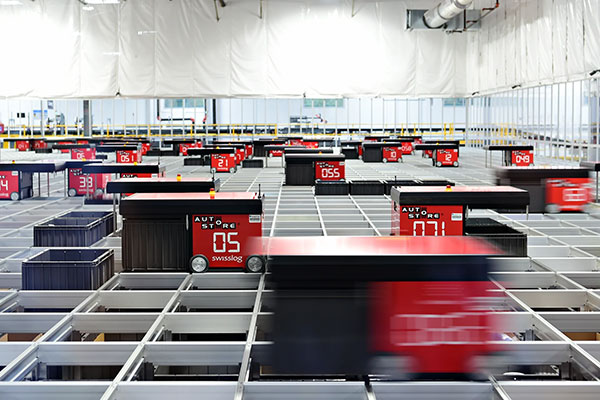
The relentless pursuit of efficiency is reshaping industrial landscapes, and with it, the long-term energy demand profile that oil & gas investors must scrutinize. While headlines often focus on geopolitical tensions or OPEC+ maneuvers, a silent revolution in industrial automation, exemplified by AutoStore reaching its 300th warehouse installation in North America, is steadily re-calibrating the fundamentals. This milestone, underscored by Medline’s expansive network of over 20 systems and 1,900 robots, highlights a profound shift towards high-throughput, precision logistics. For energy investors, understanding these operational transformations is no longer a niche concern but a critical component of assessing future demand for crude, natural gas, and refined products. As businesses move faster and supply chains become more resilient, the energy intensity of global commerce is evolving, presenting both challenges and opportunities for the sector.
The Automation Tsunami: Efficiency vs. Demand Growth
AutoStore’s achievement of 300 North American installations, with its latest system live at Medline’s Aurora, Colorado site, is more than just a logistical triumph; it’s a testament to the accelerating pace of industrial digitization. Medline, AutoStore’s first U.S. customer over a decade ago, now leverages 1,900 robots across more than 20 systems to ensure next-day delivery to 95% of its U.S. customers. This level of automation, described by AutoStore’s Chief Commercial Officer as a “high-throughput advantage,” directly impacts the energy equation. Faster picking, improved accuracy, and enhanced supply chain resilience inherently reduce waste and optimize movement, theoretically lowering the energy expenditure per unit of goods processed or shipped.
However, the narrative isn’t purely one of reduced energy demand. While individual warehouses become more energy-efficient per operation, the widespread adoption of such technologies, including AutoStore’s new CarouselAI robotic picking system and VersaPort workstation, could simultaneously fuel an overall increase in economic activity and the volume of goods traded. This creates a complex dynamic: efficiency gains per unit might be offset by a larger total volume of goods moving through the global supply chain, which still requires energy for manufacturing, transportation, and the electricity to power these sophisticated robotic systems and their supporting data infrastructure. The primary shift, therefore, is not necessarily a definitive decrease in energy demand, but rather a re-allocation of demand towards electricity for automation and data centers, potentially impacting the mix of fossil fuels required for power generation.
Navigating Market Volatility: Automation’s Long-Term Pull Amidst Price Swings
In the immediate term, energy markets remain highly sensitive to geopolitical factors and supply-side dynamics. As of today, Brent crude trades at $90.38 per barrel, reflecting a significant 9.07% daily decline, while WTI sits at $82.59, down 9.41% over the same period. This recent volatility is not an isolated event; our proprietary data shows Brent has shed over 18% in just the past two weeks, dropping from $112.78 on March 30th to $91.87 yesterday. Gasoline prices have also seen a notable dip, currently at $2.93, down 5.18%.
Against this backdrop of short-term price fluctuations, the structural shifts driven by industrial automation often get overlooked by investors. While daily price movements dictate immediate trading strategies, the long-term adoption of technologies like AutoStore’s warehouse robots represents a foundational change in how global commerce consumes energy. The efficiency gains in logistics, combined with the growing electricity demand from data centers and robotics, introduce a new layer of complexity to energy demand modeling. Savvy investors must look beyond the daily ebb and flow of crude prices and begin to factor in these deep-seated technological trends that will ultimately influence the trajectory of global energy consumption for years to come, impacting everything from refining margins to the demand for natural gas in electricity generation.
Investor Focus: Deciphering Automation’s Impact on Future Oil Demand
Our proprietary reader intent data consistently highlights investor preoccupation with the long-term trajectory of crude oil prices. Questions such as “what do you predict the price of oil per barrel will be by end of 2026?” frequently surface, underscoring the market’s hunger for insight into future demand and supply fundamentals. Industrial automation, while seemingly distant from the oil rig, directly influences these long-term forecasts by altering the energy intensity of economic activity.
The proliferation of systems like AutoStore’s, which enable companies like Medline to process orders with unparalleled speed and accuracy, could lead to a moderation in the growth of demand for traditional transportation fuels (e.g., diesel for trucking, jet fuel for cargo flights) per unit of economic output. By streamlining logistics and reducing redundant movements, automation optimizes fuel usage. However, this is balanced by the potential for automation to unlock new levels of economic growth and consumerism, which could, in turn, drive up the total volume of goods produced and shipped, thereby creating new avenues of energy demand, particularly for electricity. For investors seeking to understand the 2026 oil price outlook and beyond, integrating the impact of these macro-efficiency trends and the shifting energy mix towards electricity is paramount for accurate long-term modeling.
Upcoming Events and the Shifting Energy Paradigm
In the immediate term, the energy industry’s focus remains sharply tuned to critical supply-side signals and inventory data. This weekend, the market will closely monitor the OPEC+ Joint Ministerial Monitoring Committee (JMMC) meeting on April 18th, followed by the full Ministerial meeting on April 19th. These gatherings are poised to influence crude supply decisions and, consequently, short-to-medium-term price stability. Following these, the API Weekly Crude Inventory reports on April 21st and 28th, alongside the EIA Weekly Petroleum Status Reports on April 22nd and 29th, will offer crucial insights into current market balances and demand trends. Further upstream indicators will come from the Baker Hughes Rig Count on April 24th and May 1st.
While these events dominate the near-term outlook for crude oil and natural gas, investors must simultaneously extend their analytical horizon to account for the structural shifts driven by industrial automation. The increasing reliance on electricity to power thousands of robots, advanced sorting systems, and vast data centers fundamentally alters the demand profile for energy commodities. Natural gas, as a primary fuel for electricity generation, stands to be a significant beneficiary of this transition, even as crude demand for transportation per unit of GDP may become more efficient. The forward-looking investor, therefore, must consider how the outcomes of these upcoming OPEC+ meetings and inventory reports will intersect with the enduring forces of automation, shaping not just the price of a barrel, but the very composition of global energy demand in the decades to come.