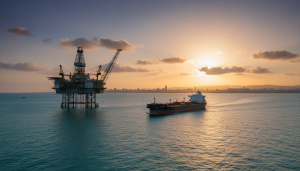
Arctic LNG 2 Shatters Production Records Amidst Sanctions
In a powerful demonstration of operational resilience, Russia’s Arctic LNG 2 project surged to unprecedented production levels in the final days of June, signaling a potential breakthrough in its efforts to circumvent international sanctions. This significant development sends ripples through global energy markets, forcing investors to re-evaluate the efficacy of Western restrictions on key Russian energy infrastructure.
Sources close to the matter reveal that the Novatek PJSC-led facility, a cornerstone of Russia’s ambitious liquefied natural gas expansion strategy, averaged a robust 14 million cubic meters of natural gas daily on both June 28th and June 29th. This peak performance establishes a new historical benchmark for the plant, marking its highest daily output since its inception. While elevated natural gas production does not automatically guarantee a proportional increase in LNG exports, historical patterns at Arctic LNG 2 strongly correlate higher gas output with successful cargo loadings.
Operational Peaks and Strategic Context
The recent surge surpasses the plant’s initial performance metrics from its December 2023 launch, when it registered an average daily output of 13.7 million cubic meters of gas. This robust operational data underscores the project’s technical capabilities, even as it navigates a complex geopolitical landscape. For the majority of June, the facility’s gas output averaged 8.9 million cubic meters per day, a slight decrease from May’s average of 9.4 million cubic meters daily. The dramatic late-June spike therefore represents a significant pivot, indicating a renewed drive towards maximizing production and export potential.
Situated strategically above the Arctic Circle, Arctic LNG 2 remains pivotal to Russia’s long-term energy goals, specifically its ambition to triple national LNG production by 2030. This audacious target has faced considerable pressure from a comprehensive suite of international restrictions imposed following geopolitical events in Ukraine. The latest production figures, however, suggest that Russia and its lead operator, Novatek, are actively developing strategies to mitigate the impact of these penalties and maintain momentum in their critical energy projects.
Circumventing Sanctions: The Iris Tanker Saga
A key indicator accompanying this production surge is the recent activity involving the Iris tanker. This vessel, previously known as North Sky and specifically blacklisted by the United States, European Union, and United Kingdom, departed the Arctic LNG 2 site on Sunday. Ship-tracking data compiled from various sources reveals an increase in its draft level—a metric manually input by the crew—strongly suggesting the vessel successfully loaded a cargo. This event highlights a potentially evolving approach to managing and exporting LNG from sanctioned Russian projects.
The Iris tanker is currently en route to the Arctic port of Murmansk, with an estimated arrival date of July 2nd. Murmansk serves as a crucial logistical hub for Novatek, facilitating ship-to-ship (STS) transfers of LNG cargoes. Here, ice-class vessels, capable of navigating the challenging Arctic waters, typically offload their contents to conventional tankers for onward global distribution. This transfer point is also where Novatek’s sanctioned Saam floating LNG storage facility operates, providing a critical buffer in the logistics chain. The use of a blacklisted tanker and its movement through this established, albeit sanctioned, logistics corridor represents a direct challenge to the international sanctions regime.
Novatek’s Strategic Silence and Market Implications
As the largest shareholder and operator of Arctic LNG 2, Novatek has remained silent regarding these developments, not immediately responding to requests for comment. This lack of official confirmation is typical in situations involving sanctions and sensitive operational maneuvers, yet the observed data points provide concrete evidence of activity. For investors, Novatek’s ability to maintain and even increase output at such a high-stakes project offers a complex risk-reward profile, underscoring the company’s strategic importance within the global LNG landscape.
The implications for the global energy market are substantial. If Russia can consistently circumvent sanctions to bring Arctic LNG 2’s capacity online, it introduces a significant new supply into an already dynamic market. This could influence global LNG prices, reshape supply routes, and impact the energy security strategies of importing nations. Investors must closely monitor not only the production figures but also the geopolitical responses to these apparent workarounds, as enforcement actions or new sanctions could swiftly alter the project’s viability.
Investor Outlook: Navigating Geopolitical Energy Flux
For investors focused on the oil and gas sector, the Arctic LNG 2 situation presents a multifaceted challenge. On one hand, the operational success demonstrates a resilience that might appeal to certain risk-tolerant portfolios. On the other, the project remains deeply entangled in geopolitical tensions and subject to potential escalations in sanctions or enforcement. The reliance on blacklisted vessels and complex logistical maneuvers through hubs like Murmansk introduces heightened operational and reputational risks.
The world’s energy landscape is continuously reshaped by geopolitical forces, and the Arctic LNG 2 project stands as a prime example of this ongoing flux. Its record-setting output, despite the concerted efforts of international sanctions, serves as a stark reminder of the complexities inherent in global energy supply chains and the persistent drive by major energy producers to meet demand and uphold their strategic interests. Investors are advised to consider the long-term implications of these developments on global energy prices, supply stability, and the evolving efficacy of international economic pressure campaigns.