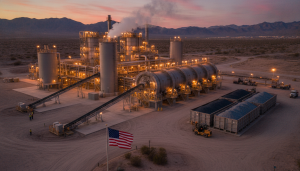
The recent landmark agreement between Australian miner Anson Resources and South Korean battery giant LG Energy Solution has sent a powerful signal across the critical minerals investment landscape. Anson’s shares surged by nearly 25% on the news, marking its strongest intraday gain in months, as the market reacted positively to the securement of a definitive offtake deal for battery-grade lithium carbonate. This partnership, which will see up to 4,000 dry metric tons of lithium carbonate supplied annually from Anson’s Paradox Basin project in Utah, USA, starting in 2028, is more than just a company-specific win; it underscores the escalating strategic importance of domestic critical mineral supply chains, the de-risking of nascent projects, and the shifting dynamics within the broader energy transition investment thesis.
De-Risking Supply Chains and Securing Long-Term Value
For Anson Resources, this five-year initial agreement, with an option for a further five-year extension, is indeed a transformative event. Representing nearly 40% of the Paradox Basin project’s estimated 10,000 tons per annum start-up production capacity, the deal provides crucial revenue visibility and, as noted by Anson’s CEO, establishes a foundation for a long-term partnership. Crucially, this commitment is anticipated to bolster Anson’s debt funding efforts as the project approaches its final investment decision stage. From an investor perspective, such significant offtake agreements are paramount for early-stage mining ventures, mitigating market risk and demonstrating a clear path to commercialization. The emphasis on “low-cost U.S.-made lithium” also resonates with a broader geopolitical push for secure, localized supply chains, a sentiment echoed by industry observers who see this as a firming of U.S. battery manufacturing capabilities and a strategic win for LG Energy Solution in a competitive market.
Navigating Volatility: Lithium’s Path Amidst Broader Energy Markets
While Anson’s stock soared, the broader lithium market has faced a challenging period, mired in a year-long downturn driven by slower-than-anticipated electric vehicle (EV) uptake in some regions. This divergence highlights a key investment principle: securing future supply, especially from geographically strategic and potentially low-cost sources, can command a premium even when spot commodity prices are soft. This dynamic is not entirely unfamiliar to investors in the wider energy sector. As of today, April 18th, 2026, we observe significant volatility in traditional energy benchmarks: Brent crude futures are trading at $90.38, reflecting a notable daily decline of 9.07% and moving within a wide day range of $86.08 to $98.97. Similarly, WTI crude stands at $82.59, down 9.41% over a day range of $78.97-$90.34, while gasoline prices are at $2.93, down 5.18%. This illustrates the constant flux in energy markets, where investor sentiment can swing rapidly. For lithium, despite recent price headwinds, the long-term demand forecast remains robust, driven by the inevitable expansion of EV production and energy storage solutions, underscoring why strategic partnerships like the Anson-LG deal are so highly valued.
Forward Outlook: Critical Minerals and Upcoming Energy Catalysts
The 2028 commencement of lithium supply from Anson’s Paradox Basin project signals the long lead times inherent in developing critical mineral resources. This forward-looking perspective is crucial for investors. While the immediate focus for many energy investors will be on the critical OPEC+ Joint Ministerial Monitoring Committee (JMMC) meeting today, April 18th, followed by the full Ministerial Meeting on April 19th, where discussions on production quotas could dramatically shift oil market sentiment, the long-term narrative for securing future energy supply is increasingly centered on critical minerals. Furthermore, weekly data points like the API and EIA petroleum status reports on April 21st and 22nd, respectively, provide short-term market signals for traditional energy, but the Anson deal points to a deeper, structural shift. Many of our readers are keenly focused on future price trajectories, asking questions like ‘what do you predict the price of oil per barrel will be by end of 2026?’. This forward-looking perspective extends directly to the lithium market, where securing reliable, ethically sourced supply years in advance is becoming a competitive differentiator for battery manufacturers and, by extension, a critical value driver for mining companies like Anson.
Investor Takeaways: Diversification and Strategic Positioning
The Anson-LG Energy Solution deal serves as a clear blueprint for investors navigating the energy transition. Firstly, it highlights the increasing importance of strategic partnerships and secured offtake agreements in de-risking capital-intensive critical mineral projects. Such deals provide the financial stability and market validation necessary to move projects from development to production. Secondly, it underscores the value placed on domestic supply, particularly in the U.S., where policy support and geopolitical considerations are amplifying the appeal of local resources. Investors should look for companies with clear pathways to commercialization backed by strong customer commitments. Finally, this event reinforces the need for diversification within energy portfolios. While traditional oil and gas will remain central, integrating exposure to critical minerals, which are foundational to the clean energy future, positions portfolios to capture growth from both established and emerging energy sectors. The market’s enthusiastic response to Anson’s news suggests a growing recognition that the future of energy investment is multifaceted, spanning from conventional barrels to battery-grade tons.