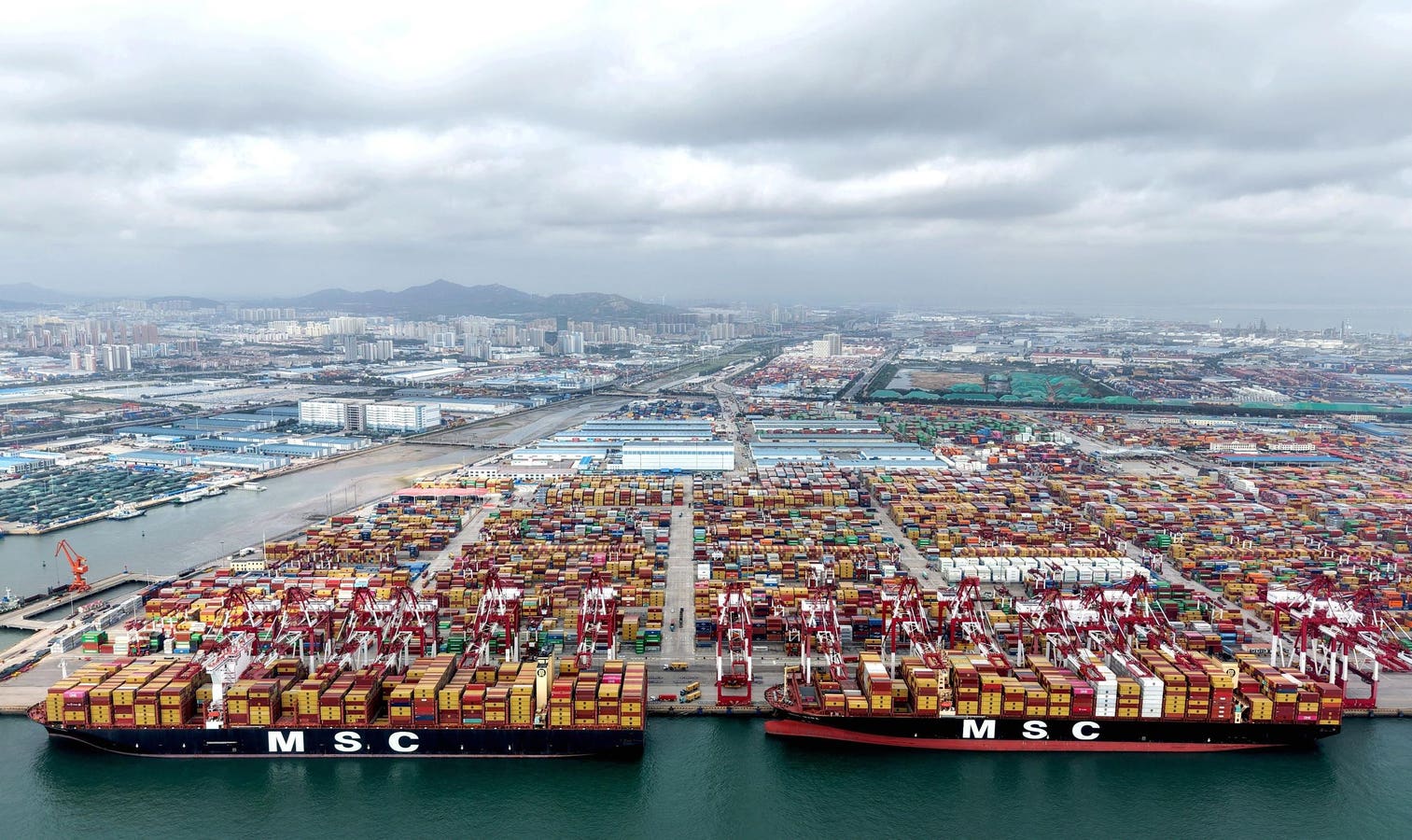
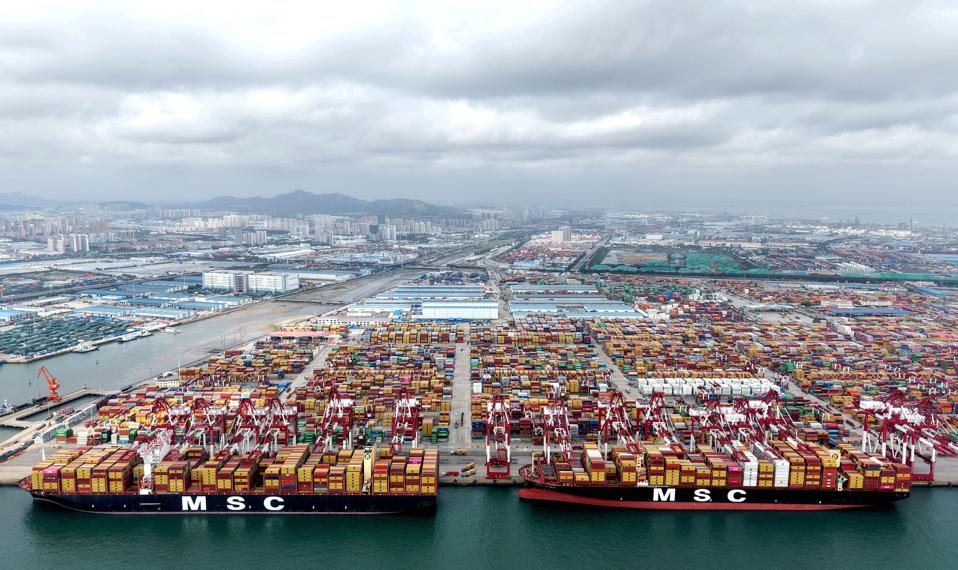
Ships are berthed at the container terminal of the port in Qingdao, in China’s eastern Shandong province on October 9, 2025. US President Donald Trump announced an additional 100 percent tariff on China on October 10 and threatened to cancel a summit with Xi Jinping, reigniting his trade war with Beijing in a row over export curbs on rare earth minerals. (Photo by AFP) / China OUT (Photo by -/AFP via Getty Images)
AFP via Getty Images
The United States could well be facing its most critical energy crisis in decades thanks to its longstanding reliance on imports for its rare earth minerals needs. The dramatic move announced by China last week to restrict the flow of such minerals around the world presents the U.S. and global community with its first potential global energy crisis since the Arab oil embargo sent crude prices skyrocketing in October 1973.
China’s Ministry of Commerce published a notice on October 9 announcing heavy restrictions, effective December 1, on any country which wishes to export rare earth minerals mined or processed in its country, including high-grade magnets, chips, and other materials made with Chinese-processed rare earths. Citing concerns that such materials have been exported by third-party countries to other nations to be used in military applications, Chinese officials cited national security concerns as the justification for the move.
“China has taken note of the important uses of medium and heavy rare earths and related items in the military field,” a Ministry spokesman said. “China, as a responsible major country, employs export controls on related items according to the law, in order to better defend world peace and regional stability, and to fulfill non-proliferation and other international obligations.”
Later in his comments, the spokesman struck a more conciliatory tone, adding, “China stands ready to work with the rest of the world to step up export control dialogue and exchange, so as to better safeguard the security and stability of global industrial and supply chains.”
America Reacts To The Rare Earth Minerals Threat
Reactions in the United States was swift and severe. Every U.S. stock market index — which had opened the day on Friday in firmly positive territory — immediately turned deeply negative with the NASDAQ dropping by more than 800 points by the end of the day’s trading.
President Donald Trump responded to China’s latest restrictive move with a post on his Truth Social, noting “some very strange things happening in China.” Shortly thereafter, Trump announced another round of heavy tariffs on Chinese imports. “Based on the fact that China has taken this unprecedented position, and speaking only for the U.S.A., and not other Nations who were similarly threatened, starting November 1st, 2025 (or sooner, depending on any further actions or changes taken by China), the United States of America will impose a Tariff of 100% on China, over and above any Tariff that they are currently paying,” he wrote.
Trump initially speculated that the latest move by President Xi Jinping’s government would obviate the need to follow through with his planned face-to-face meeting with the Chinese leader, scheduled for the end of October during the Asia-Pacific Economic Cooperation summit in South Korea. But Trump said later on Friday that the meeting would still move forward.
The president took to Truth Social again on Sunday, October 12, in an effort to calm the waters. “Don’t worry about China,” Trump wrote, “it will all be fine! Highly respected President Xi just had a bad moment. He doesn’t want Depression for his country, and neither do I. The U.S.A. wants to help China, not hurt it!!! President DJT”
The calmer language from Trump, combined with positive vibes could be related to several days of moderately successful efforts to reduce violence between Israelis and Hamas, plus the Dow Jones Industrial Average opening up by more than 400 points on Monday. But whether things really will “all be fine” related to the global supply and demand for rare earth minerals remains an open question.
China’s Series Of Rare Earth Minerals Clampdowns
Concerns about minerals are especially heightened given the key role these elements play in the making of cell phones, computers, all types of renewable energy and electric vehicles, and a wide array of military weapons systems. In reality, the maintenance of a ready, reliable supply of these minerals is a critical component of every nation’s energy security, which today is indistinguishable from national security.
Between 2020 and 2023, China accounted for 70% of U.S. rare earth imports. This chart shows where the U.S. gets its rare earths from. Data Source: USGS. (Graphic by Visual Capitalist via Getty Images)
Getty Images
It is key to note that this looming crisis is one which has been building for some time. China’s October announcement was just the latest in a series of moves over the last year to restrict its exports and global trade in these elements.
This isn’t the first time Chinese leaders have made a move to protect Chinese dominance regarding both mineral processing and supply chains. On October 1, 2024, China invoked restrictions on non-Chinese companies trying to purchase rare earth minerals mined and/or processed in China. The restrictions were mainly focused on semiconductor manufacturers, but they impacted other industries as well.
Xi’s government followed that move in December 2024 with a ban on exports of germanium, gallium, and antimony to the United States, specifically. The ban, framed as a countermeasure to U.S. export controls on advanced chips and technology, forced major U.S. defense contractors to scramble for alternative supplies. This revealed vulnerabilities in American military procurement processes. The restrictions disrupted global markets, causing prices for these materials to surge.
Beijing’s next escalation came in April 2025, when the government imposed broader export controls on seven specific rare earth elements: samarium, gadolinium, terbium, dysprosium, lutetium, scandium, and yttrium, along with magnets derived from them. These elements are vital for high-performance magnets used in fighter jets, wind turbines, and electric motors.
All of those moves by China brought retaliatory responses from the U.S. government, under both the Biden and Trump White Houses. Thus, last Thursday’s announcement by the Xi government and the Trump response constitute the latest moves in a year-long game of geostrategic chess related to these crucial minerals, arguably bringing the world to the edge of a major energy crisis.
Rare Earth Minerals Are Not In Fact Rare
One of the prevailing myths about what we refer to as rare earth minerals is that they are actually rare. They aren’t. Many countries, including the U.S., are home to massive reserves of these minerals just waiting to be mined. While it is true that the permitting of new mines in America often consumes more than a decade, that process could be dramatically sped along with a presidential declaration of a national energy emergency specific to this need, a move Trump has often discussed.
But even with faster permitting, the opening of new mines would still take years before first production could be achieved, and that’s assuming the most ideal conditions. As such, scaling domestic production to meet U.S. national needs cannot be accomplished in weeks or months. In a world in which China produces two thirds of the global supply, and controls over 80% of the processing capacity, this is a true national security issue that could linger for years to come.
EIA chart depicting Chinese dominance of global trade in critical energy minerals for 2023. Based on UN Comtrade data.
U.S. Energy Information Administration
This is an issue which, much like the oil-related energy crisis of the 1970s, has been building for decades. As the CEO of tungsten mining company Almonty, Lewis Black, told me in an interview published in October 2021, Western countries made a conscious decision to get out of the hard rock mining business in response to the environmentalist movement of the 1970s, intentionally ceding the playing field to China and other developing nations. At the time, the Carter and Reagan administrations saw this as a marriage of convenience that would allow these developed nations to continue cleaning up their own air and water by simply shifting environmental impacts related to mining, processing, and refining to China, where it would be out of sight and, presumably, out of mind to the U.S. population. But here we sit today, with the looming crisis now on America’s doorstep.
Where This Game of Rare Earth Minerals Geopolitical Chess Goes From Here
The Biden White House seemed to recognize the problem when, in June, 2021, President Joe Biden said in a speech that he would commit his administration to a “whole of government” approach to free the U.S. from dependency on China-dominated supply chains. Unfortunately, that promise never led to much discernible action, leaving the issue behind for future presidential administrations to address.
Since taking office in January, the Trump administration, realizing the unlikelihood of effective congressional action, has placed a heavy focus on taking executive branch actions designed to streamline federal permitting processes for energy-related projects. That effort is being managed by Trump’s newly created Energy Dominance Council, chaired by Interior Secretary Doug Burgum, and also involving Energy Secretary Chris Wright, Transportation Secretary Sean Duffy, and Environmental Protection Agency Administrator Lee Zeldin, among others.
WASHINGTON, DC – FEBRUARY 14: U.S. President Donald Trump signs an executive in the Oval Office at the White House on February 14, 2025 in Washington, DC. Trump was joined by, from left to right, Environmental Protection Agency (EPA) Administrator Lee Zeldin, Energy Secretary Chris Wright, Interior Secretary Doug Burgum and Transportation Secretary Sean Duffy. (Photo by Andrew Harnik/Getty Images)
Getty Images
The Pentagon has entered into a series of deals in recent months to purchase equity interests in mining and rare earth processing companies, starting with a deal with California-based MP Materials in July. MP Materials is currently the largest processor of rare earths in the U.S. and will work to double its capacity as a part of the government’s investment in a 15% share of its operations.
The Trump administration has also reportedly been engaged in negotiations to invest in an equity interest in the Tanbreez mining operation located on the coast of Greenland. Plus, Reuters reported in August that the Trump administration is considering a reallocation of $2 billion in CHIPS Act funds to additional investments in America’s critical energy resource needs.
Regardless of how the Trump/Xi meeting goes in a few weeks, it should be obvious that America’s current dependance on China for its energy needs is not sustainable. Many more strategic moves by government and industry players will be required to fully free the U.S. from China’s dominance over all aspects of rare earth minerals. The Xi government is fully aware of that reality and also has a long history of taking aggressive action to protect its dominance in this realm. Thus, this long game of geopolitical chess is certain to continue — and likely escalate— across the months and years to come.