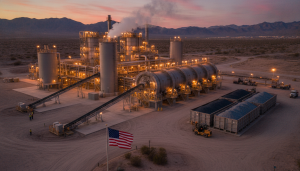
Albemarle’s recent announcement to keep its ambitious $1.3 billion lithium refinery project in South Carolina on hold sends a stark message across the energy investment landscape: the economics of building out a domestic battery metals supply chain are simply not viable under current market conditions. This decision, driven by a persistent global glut of lithium and a punishing 74% decline in prices over the past two years, underscores the significant hurdles facing the energy transition and America’s strategic push for mineral independence. For investors, this isn’t merely a company-specific delay; it’s a bellwether for the broader challenges of funding capital-intensive projects in a volatile commodity market, demanding a closer look at both the lithium sector’s unique dynamics and the wider energy complex.
The Economic Reality of Lithium: A Supply Chain in Stasis
The core issue is profitability. As Albemarle’s CEO, Kent Masters, articulated, “The math doesn’t work today.” The planned South Carolina facility, intended to be the largest U.S. lithium refinery, remains conceptual due to uneconomic conditions. This delay leaves the United States with minimal capacity to process lithium, a critical metal for electric vehicle batteries and the broader energy transition. Despite concerted efforts from Washington officials to bolster the country’s mineral supply chain and reduce reliance on dominant players like China, the private sector is struggling to justify the significant upfront investment. The 74% plunge in lithium prices, as tracked by Benchmark Mineral Intelligence, has eroded the confidence needed for such a substantial capital outlay. Albemarle, which operates the U.S.’s sole lithium mine in Nevada, finds itself in a challenging position, having to prioritize competition at the “bottom of the cycle” rather than aggressive expansion.
Broader Energy Market Volatility and Investor Focus
While lithium faces specific headwinds, the entire energy complex is experiencing significant shifts, a fact keenly observed by investors. As of today, April 18, 2026, Brent crude trades at $90.38 per barrel, marking a sharp 9.07% decline within the day, with its range spanning from $86.08 to $98.97. WTI crude mirrors this downturn, trading at $82.59, down 9.41%, having moved between $78.97 and $90.34. This intraday volatility follows a more extended trend, with Brent crude having fallen from $112.78 on March 30, 2026, to $91.87 on April 17, representing an 18.5% drop of $20.91 in just over two weeks. Gasoline prices have also seen a notable decline, currently at $2.93, down 5.18% on the day. Our proprietary reader intent data reveals a strong focus on macro oil dynamics, with investors frequently asking about the future price of oil per barrel by the end of 2026 and seeking insights into OPEC+ current production quotas. This broader market uncertainty, driven by crude price swings and geopolitical factors, influences capital allocation decisions even for battery metals projects. The lack of clear price signals and the prevailing volatility in the wider energy sector make long-term, capital-intensive investments like Albemarle’s refinery pause more understandable, as investors and companies alike seek stability and predictable returns.
Government Support: The Missing Link for Western Lithium Ambitions
Albemarle’s CEO explicitly stated that private companies might not be able to build out the necessary Western supply chain infrastructure “on their own,” suggesting that some form of government support will be crucial. This perspective highlights a fundamental tension: the strategic imperative for the U.S. to secure its energy transition supply chain versus the economic realities faced by corporations. The current reliance on China for lithium processing capacity presents a significant vulnerability, both economically and geopolitically. Building domestic processing capabilities requires substantial, patient capital and a long-term outlook that current market conditions do not support for private entities. For investors, this implies that future opportunities in U.S. lithium processing may be heavily influenced by policy decisions, subsidies, tax incentives, or even direct government involvement. Without such intervention, the vision of a robust, independent Western lithium supply chain could remain largely aspirational, leaving strategic mineral security at the mercy of global commodity cycles.
Navigating the Bottom: Albemarle’s Strategic Playbook Amidst Market Uncertainty
In this challenging environment, Albemarle is actively positioning itself to compete at the “bottom of the cycle.” This strategy involves a cautious approach to M&A, with the CEO noting a lack of a “war chest” for aggressive acquisitions unless “super quality resources” emerge. The company remains focused on its existing operations, particularly in Chile’s Salar de Atacama, and is investing in direct lithium extraction (DLE) projects in both Chile and the United States, though timelines for these advancements remain unspecified. Interestingly, Albemarle previously paused lithium auctions, which were designed to generate higher returns and enhance price transparency, for its quarterly earnings report. The potential resumption of these auctions signals a continued effort to better understand and influence market pricing, a critical factor for future investment decisions. Looking ahead, the next two weeks are packed with critical energy market events that could further shape investor sentiment and capital flows across the entire sector, from traditional hydrocarbons to essential energy transition metals. Investors will be closely watching the OPEC+ Joint Ministerial Monitoring Committee (JMMC) meeting tomorrow, April 18th, followed by the full Ministerial meeting on April 19th. Decisions from these gatherings on production quotas have historically triggered significant price movements in crude oil, which in turn influences broader market confidence. Furthermore, weekly API and EIA crude inventory reports on April 21st, 22nd, 28th, and 29th, alongside the Baker Hughes Rig Count on April 24th and May 1st, will provide granular insights into supply-demand balances. While these directly impact oil and gas, the resulting market stability or volatility can indirectly affect investment appetite for capital-intensive projects like lithium refineries, which require long-term price confidence to break ground.