The dawn of the artificial intelligence era, much like the construction of a colossal skyscraper, is marked by extensive and often unseen foundational work. For investors in the energy sector, understanding this intricate, long-term development phase is paramount, as it directly translates into a sustained and escalating demand for power that will fuel energy markets for decades to come. While the end-user applications of AI capture headlines, the underlying technical infrastructure and intellectual property, meticulously built over years or even decades, are the true drivers of its transformative potential and, consequently, its energy footprint.
These crucial “building blocks” of AI, largely invisible to the average consumer, are the bedrock upon which sophisticated generative AI products operate. Without this deep technical foundation, the most advanced AI solutions simply cannot function. A select group of technology giants has either painstakingly developed or is aggressively acquiring these core capabilities, creating a significant competitive moat that has direct implications for strategic positioning and long-term energy consumption.
The AI Arms Race: Industry Leaders and Strategic Gaps
Among the tech titans, Google stands out, having strategically amassed an unparalleled portfolio of these fundamental AI components over many years. Microsoft, Amazon, and Meta have also made substantial progress, securing many of these essential elements. OpenAI, a formidable player in the generative AI space, is currently engaged in a frenetic effort to implement and integrate these foundational technologies, acknowledging the extensive journey still ahead. In stark contrast, Apple, the iPhone manufacturing giant, possesses remarkably few of these deep-seated AI capabilities, a deficiency that poses a considerable challenge to its long-term AI ambitions.
While the absence of these foundational elements often remains obscured from public view, the consequences became starkly apparent this year when Apple was forced to delay a significant update to its AI-powered digital assistant, Siri. The company’s ambitious goal was to fundamentally re-engineer Siri’s technical underpinnings for the generative AI age, but the system simply wasn’t ready for widespread deployment. Rectifying Siri’s deficiencies may necessitate a comprehensive overhaul, potentially involving the development of critical AI building blocks almost from scratch. Should this internal development prove insufficient, Apple might find itself compelled to seek assistance from rival tech behemoths or embark on a costly acquisition spree to bridge its strategic AI gap.
Google’s Deep AI Moat: A Blueprint for Enduring Demand
To grasp the sheer scale of the foundational AI infrastructure required, consider Google’s extensive investments and innovations spanning decades, positioning it uniquely for the current AI surge. Just last week, Google unveiled Flow, a generative AI tool designed to empower creators in producing professional-grade videos. This seemingly singular product is underpinned by a vast and complex array of AI building blocks, illustrating the depth of Google’s technological advantage.
At the heart of Google’s video generation capabilities is Veo, now in its third iteration. The development and continuous improvement of Veo would be impossible without the immense training data provided by YouTube, a video repository that Google owns and has nurtured for years. Similarly, Google’s image generation model, Imagen, is now in its fourth incarnation, demonstrating continuous refinement based on extensive data and computational power. Gemini, Google’s potent response to the generative capabilities of ChatGPT, further showcases its advancements in large language models.
Crucially, the very architecture that made generative AI possible, the Transformer architecture, was a groundbreaking research breakthrough pioneered by Google around 2017. This innovation alone fundamentally reshaped the landscape of AI development. Furthermore, Google has developed its own specialized AI chips, known as Tensor Processing Units (TPUs), specifically engineered to accelerate machine learning workloads, from model training to inference. Beyond these visible products and innovations, Google’s foundational strength lies in its decades-long effort to index virtually everything on the internet, meticulously “slurping up” vast quantities of data that now serve as an invaluable training ground for its AI models.
The Energy Nexus: Powering AI’s Ascent for Decades
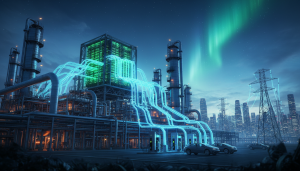
The intricate tapestry of AI building blocks – the massive datasets, sophisticated models, specialized hardware, and continuous research – demands colossal amounts of computational power. Training these advanced AI models, like Veo, Imagen, or Gemini, involves processing petabytes of data across thousands of GPUs or TPUs, an endeavor that consumes staggering quantities of electricity. Moreover, running these models for everyday inference, as users interact with AI applications globally, further contributes to an ever-growing energy demand profile. Data centers, the physical manifestation of this computational infrastructure, are becoming increasingly energy-intensive, requiring robust and reliable power supplies.
This isn’t a transient trend. The continuous evolution of AI, the development of even more complex models, the expansion of AI applications across every industry, and the perpetual need for retraining and fine-tuning will ensure that AI remains a persistent and escalating consumer of energy for decades. As AI permeates manufacturing, healthcare, finance, logistics, and countless other sectors, the demand for electricity will only intensify, creating a fundamental and long-term tailwind for the energy industry.
Investment Implications for Oil and Gas Markets
For investors focused on the oil and gas sector, this sustained surge in electricity demand driven by AI development and deployment represents a significant macro trend. While much of the direct energy consumption will be in the form of electricity for data centers, the generation of that electricity still largely relies on a diverse energy mix, including natural gas, which plays a crucial role as a reliable baseload power source. The ongoing build-out of energy infrastructure, from power plants to transmission lines, will be directly influenced by AI’s insatiable appetite for power. This structural shift underpins long-term investment opportunities in energy production, distribution, and related commodities, positioning the sector for durable growth in an increasingly digitized world.