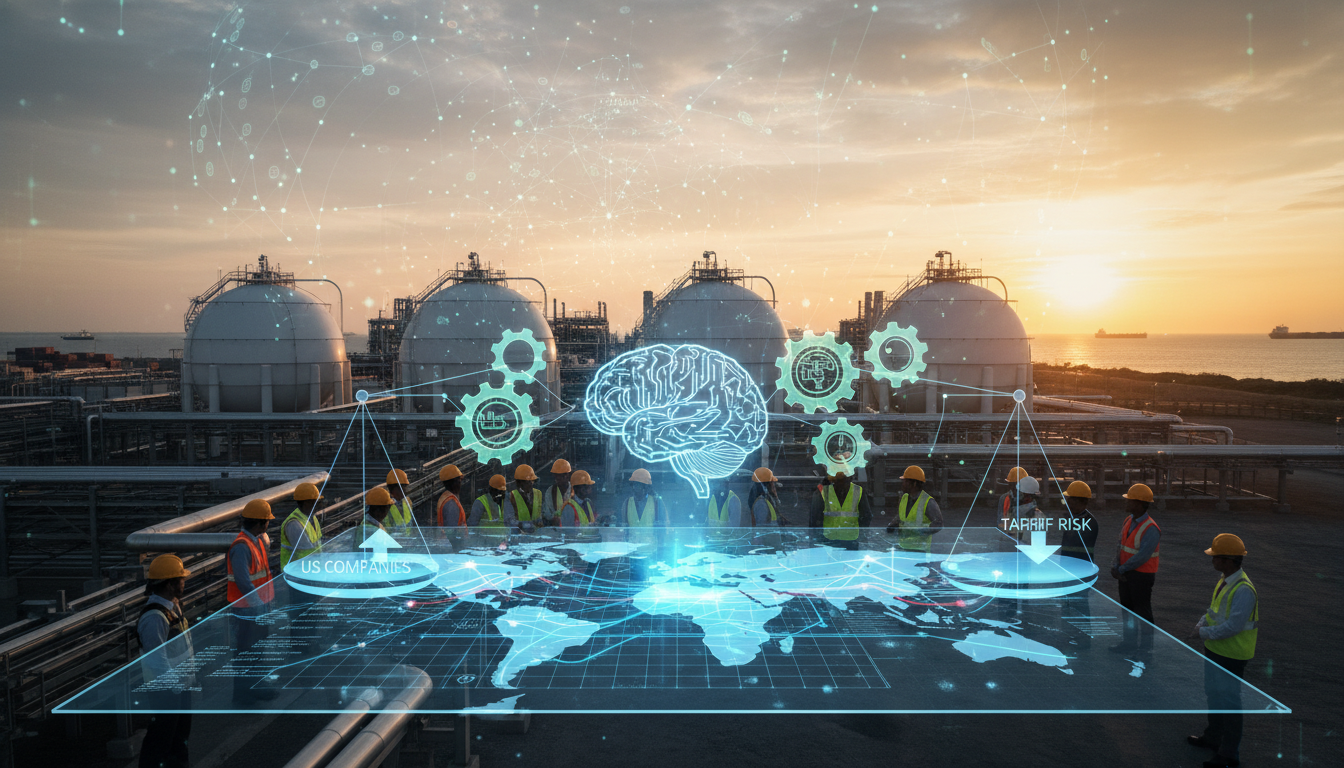
AI-Powered Precision: Navigating Global Tariffs to Safeguard Oil & Gas Investments
The global energy landscape, already a crucible of geopolitical shifts and market volatility, now presents an additional layer of complexity for oil and gas investors: a tumultuous tariff environment. Over the past year, US businesses have contended with sweeping import duties, implemented with varying degrees of intensity across international borders. While some of these tariffs have since been challenged and overturned by the highest court, companies face an administrative labyrinth in seeking potential refunds. Savvy players in the oil and gas sector are now turning to artificial intelligence (AI) to cut through this regulatory fog, protecting margins and enhancing supply chain resilience.
For an industry characterized by vast capital expenditures and intricately globalized supply chains – from specialized drilling equipment and pipeline steel to refinery catalysts and LNG plant components – tariff fluctuations can have profound financial implications. The sheer volume and specificity of goods imported and exported by energy giants make trade compliance a monumental task. This is precisely where generative AI is proving to be an invaluable asset.
According to Brendan Connallon, Vice President of Finance at EQI, a firm specializing in metal components and supply chain advisory for manufacturers, companies are leveraging AI to “process all that chaos.” This advanced technology rapidly scrapes, synthesizes, and analyzes colossal datasets. It actively tracks evolving tariff schedules, models a myriad of potential supply chain scenarios, and, crucially, accurately classifies goods using government-assigned tariff codes – a system encompassing over 17,000 nuanced designations that can make or break project economics.
Emil Stefanutti, CEO of Gaia Dynamics, a software innovator providing AI tools for trade compliance automation, highlights AI’s particular utility in this dynamic environment. The technology significantly reduces compliance errors and liberates valuable time for businesses. In the wake of recent Supreme Court rulings overturning specific tariffs, importers are deploying AI to meticulously analyze historical payment data, pinpointing instances of overpayment and flagging areas ripe for correction. Stefanutti emphasizes that AI “can continuously track and adapt to new rules in a way humans simply can’t at scale,” offering a significant competitive edge to oil and gas firms navigating international trade complexities.
AI Drastically Accelerates Tariff Refund Identification for Energy Companies
For decades, consulting powerhouses like KPMG have advised clients on trade compliance. However, the last year witnessed tariffs “changing fast and furious,” as noted by Andrew Siciliano, leader of KPMG’s Global and US Trade and Customs practices. This rapid flux demanded immediate, actionable data for critical business decisions, spurring KPMG to launch its AI-powered tariff modeler, a tool increasingly relevant to the energy sector.
Many of KPMG’s clientele include large industrial players, akin to oil and gas majors and service companies, importing everything from specialized auto parts to high-value pharmaceuticals. Critically, these businesses often utilize multiple ports of entry and engage various customs brokers. KPMG’s AI solution ingests decentralized customs entries and product information from a multitude of suppliers and freight forwarders – the intermediaries connecting importers with transportation providers – feeding this extensive data into its sophisticated tariff modeler.
This AI-driven approach has been instrumental in guiding clients through the intricate process of applying for refunds on tariff overpayments, particularly those stemming from policy changes post-Supreme Court decisions. Trade rules are often riddled with subtle exceptions, leading some businesses to inadvertently incur multiple duties when only one was applicable. Siciliano explains that AI interacts with client data to gain a granular understanding of product origins, precisely identifying which items qualify for refunds. For energy companies dealing with hundreds of thousands of specialized parts for a single facility or drilling campaign, this capability is a game-changer.
While the refund system is still evolving and promises potential “administrative nightmares,” as anticipated by EQI’s Connallon, AI provides a crucial pathway to clarity. Prior to AI, manually sifting through thousands of custom entry data points to uncover overpayments could consume weeks or even months, or simply be abandoned due to overwhelming complexity. Now, an importer can prompt AI, receiving critical refund-related information almost instantaneously, directly impacting an oil and gas firm’s bottom line.
AI Supercharges Strategic Supply Chain Modeling for Oil & Gas
Beyond retrospective analysis and refund identification, AI delivers transformative time savings in strategic scenario planning. Consider an oil and gas investor or supply chain executive contemplating how procurement costs might shift if sourcing critical drilling pipe or LNG compressor components moved from one geographic region to another. Historically, updating multiple complex spreadsheets to model such scenarios could take weeks. AI now performs these intricate calculations and presents various scenarios with just a few clicks, enabling agile decision-making vital for multi-billion dollar projects.
EQI, for instance, actively leverages AI in a similar fashion to model prospective sourcing scenarios, utilizing platforms like Altana, which specializes in comprehensive supply chain management and trade compliance solutions. When evaluating a potential sourcing shift for metal components – perhaps from country A to country B for an upstream project – EQI employs AI to model total costs. This includes a holistic assessment of tariffs, manufacturing expenses, and fluctuating ocean freight rates. For the manufacturing sector, which often sources thousands of distinct products from myriad global locations, “the complexity becomes extremely dense very fast,” Connallon emphasizes. “So, AI helps us simplify it.” The streamlined data is then swiftly transmitted to trade attorneys, allowing for expert interpretation within hours. “We’ve turned something that would take weeks into a same-day thing,” Connallon proudly states.
However, it is crucial to recognize AI’s role as an amplification tool, not a replacement for human intellect. Connallon rightly points out that “AI is not good at critical thinking,” underscoring the indispensable role of human judgment in strategic sourcing decisions. While an AI model might indicate maximum cost savings from consolidating all materials from a single country, experienced business leaders and investors must consider the broader strategic picture. Recent global supply chain disruptions have powerfully reminded executives across the energy sector that sole reliance on a single sourcing nation carries inherent risks, potentially leading to debilitating product shortages or project delays if geopolitical or economic instability disrupts trade flows. AI provides the data; human expertise applies the wisdom, ensuring resilience and safeguarding long-term investment value in the oil and gas industry.


